About Telopea truncata (Labill.) R.Br.
Common Name and Growth Habit
Telopea truncata, commonly called the Tasmanian waratah, is usually a large, erect shrub reaching up to 3 metres (10 ft) in height with multiple stems, though it occasionally grows as a single-stemmed tree up to 10 m (35 ft) tall. Unlike the New South Wales waratah (T. speciosissima), which has only a few stems topped with flowers, Tasmanian waratah stems branch freely, with many smaller branches ending in flower heads.
Young Stem and Flower Head Indumentum
Young branches and flower heads are often covered in a layer of brownish hairs.
Mature Leaf Dimensions and Texture
Mature leaves are narrow, 3–14 cm (1+1⁄8–5+1⁄2 in) long and 0.5–2.2 cm (1⁄4–7⁄8 in) wide, with a rough texture. They range from spathulate (spoon-shaped) to obovate in shape, with smooth, slightly downward-curving margins.
Leaf Lower Surface and Lobed Variation
The underside of the leaves is hairy, and occasional lobed leaves may occur.
Flowering Period and Altitude Correlation
Flowering takes place from October to January, and timing correlates with altitude: plants growing at lower elevations flower earlier than plants at higher elevations.
Inflorescence Position and Bract Characteristics
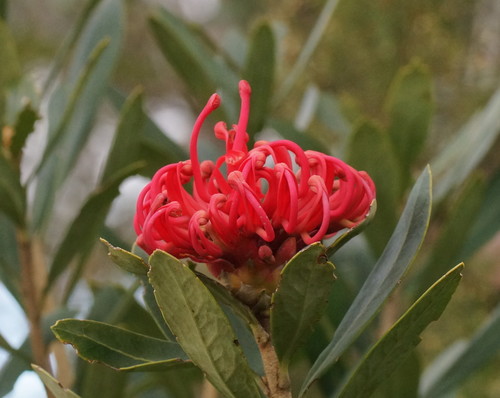
The flower heads, called inflorescences, grow at the ends of small branches (terminal position) and are surrounded by small, inconspicuous hairy bracts. This hairy bract trait distinguishes T. truncata from all other waratah species, which have hairless bracts.
Inflorescence Structure and Size
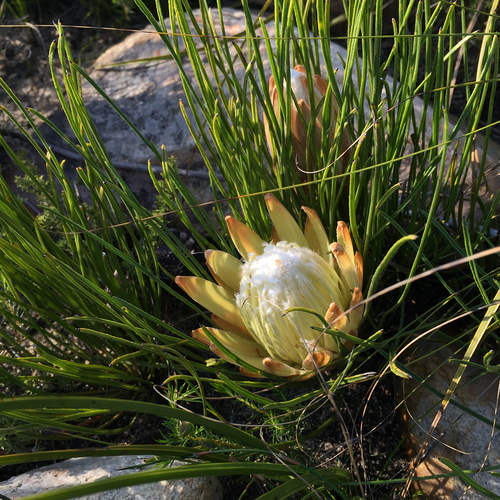
The flower heads are flattened racemes, 3.5–6 cm (1+3⁄8–2+3⁄8 in) in diameter, and made up of 10 to 35 individual flowers. They are most often bright red, though rare yellow-flowered plants occur scattered across populations.
Yellow Flower Form Taxonomy and Genetics
These yellow variants were originally classified as forma lutea, but they are only superficial colour variations and are not genetically distinct; yellow-flowered plants produce both red- and yellow-flowered offspring.
Flower Opening Sequence
Flower opening (anthesis) is basipetal, meaning the flowers at the base (edges) of the flower head open first.
Individual Flower Morphology and Style Trait
Each individual flower has a 2 cm-long perianth borne on a 1 cm-long stalk, and has a distinct sharp kink in the style just above the ovary; all other waratah species have only gently curving styles.
Anther Position
Anatomically, the flower has a sessile anther (it lacks a filament), which sits next to the stigma at the tip of the style.
Ovary and Gynophore Structure
The ovary sits at the base of the style, on top of a stalk called the gynophore, and the seed pod develops from this structure. A crescent-shaped nectary is located at the base of the gynophore.
Seed Pod Development and Structure
After flowering, curved leathery to woody seed pods called follicles develop. They hang downward from woody stalks, are roughly oblong, and grow to around 5 cm (2 in) long.
Seed Pod Dehiscence and Ripening Time
They split open lengthwise to release their winged seeds, which ripen around March.
Seed Count and Follicle Internal Structure
Each follicle holds around 16 seeds arranged in two rows, and woody structures called lamellae separate individual seeds from each other and the follicle walls.
Native Distribution Range
This species is native to central, southern, and western Tasmania, and does not grow in the island's warmer, drier areas.
Habitat Soil and Altitude
It grows on moist acidic soils in wet sclerophyll forest or subalpine scrub, at altitudes between 600 and 1200 m (2000–4000 ft).
Associated Forest and Scrub Communities
It is an understory plant in subalpine forests dominated by alpine ash (Eucalyptus delegatensis) and alpine yellow gum (E. subcrenulata), as well as in multiple rainforest and scrub communities: Athrotaxis selaginoides–Nothofagus gunnii short rainforest, Athrotaxis selaginoides rainforest, Leptospermum-with-rainforest scrub, tall Nothofagus–Atherosperma rainforest, and Nothofagus–Phyllocladus short rainforest.
Occasional Forest Community Habitat
It is occasionally found in the Leptospermum scoparium–Acacia mucronata forest community of western Tasmania.
Pollination Adaptation
The prominent placement and bright colour of T. truncata flowers, shared with many of its relatives in the subtribe Embothriinae across Australia and South America, indicates this species is adapted to bird pollination, a trait that has evolved over the last 60 million years. The flower heads produce large amounts of nectar, which is eaten by many bird species.
Lignotuber Structure and Function
The Tasmanian waratah grows a large swollen woody base called a lignotuber, most of which sits under the soil; this structure stores energy and nutrients to support rapid regrowth after bushfires.
Proteoid Root Characteristics
Like most species in the family Proteaceae, T. truncata produces fine proteoid roots that grow out of larger roots. These roots form dense clusters of short lateral rootlets that create a mat in the soil just below leaf litter, and are very efficient at absorbing nutrients from Australia's naturally nutrient-poor, phosphorus-deficient soils.
Seed Predation and Dispersal
Seeds of the Tasmanian waratah are often eaten and destroyed by animals, and do not disperse more than a few metres from the parent plant.
Cultivation Garden Wildlife Value
In cultivation, the nectar-rich flowers of the Tasmanian waratah provide food for birds visiting gardens.
Propagation Method and Seedling Disease Risk
The species can be propagated from seed, though seedlings are often killed by damping off disease.
Flowering Timing Environmental Influences
Growing in a naturally shady location delays flowering by 2 to 4 weeks, while growing in cooler conditions (from higher latitude or higher altitude) can delay flowering by up to 6 weeks.
Pruning Effect
Pruning spent flower heads encourages new leaf and branch growth.
Cultivation Climate Requirements and Overseas Performance
It grows best in cool climates with plentiful water and good drainage, and has grown successfully in cultivation in England.
Horticultural Awards
The Royal Horticultural Society awarded it an Award of Merit in 1934 and a First Class Certificate in 1938.
Flower Production Research Gaps
The connections between light duration and intensity, temperature, vegetative growth, and flower production are still not well understood.
Cultivated Yellow Form Origin
Yellow forms grown in cultivation were originally propagated from a plant found on Mount Wellington.
Historical Flower Harvesting
Historically, the flowers of T. truncata were widely harvested for use as decoration. In 1909, Geoffrey Smith noted that large-scale flower collection had caused declines in some populations on Mount Wellington.
Timber Use
The timber of larger specimens has been used for decorative inlays, as it has an attractive grain and pale red colour.