About Gorsachius leuconotus (Wagler, 1827)
Physical Measurements
The white-backed night heron (Gorsachius leuconotus) measures 50–55 cm (20–22 in) in length.
Adult Plumage and Head Features
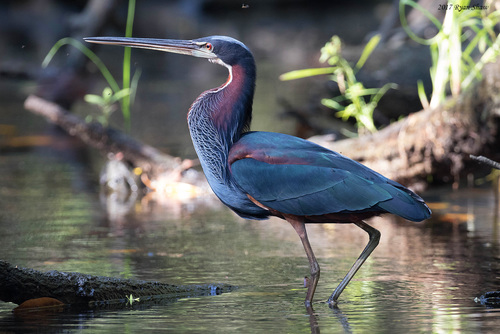
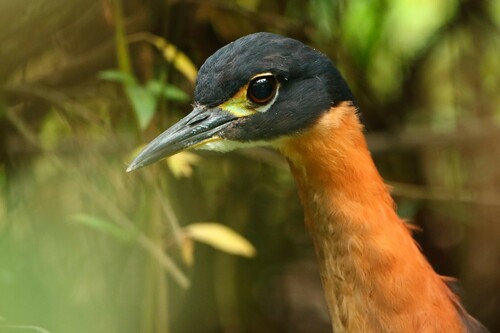
Adults have a black head with a short, prominent crest, large red eyes surrounded by white-ringed markings, and pale yellow lores (the region behind the eye). The throat is white, while the neck and breast are rufous (reddish-brown).
Body and Limb Features
A distinct white triangular patch forms along the back from the white scapulars (small shoulder feathers). The belly is whitish-brown, and the legs are yellow.
Immature and Chick Appearance
Immature individuals can be recognized by their streaked breast and white spots on the upper-wing coverts. Newly hatched chicks are covered in olive-brown down.
Distribution Range
This heron is distributed across central and southern Africa, with an estimated total range of 20,900,000 km2 (8,100,000 sq mi).
Habitat Preferences
Its primary habitat is dense forest adjacent to waterways, including streams, lakes, mangroves, and marshes.
Social and Roosting Behavior
White-backed night herons live either alone or in pairs. They are strictly nocturnal, roosting in dense vegetation of marshes and forests during the day, and often nest high in trees.
Nest Characteristics
Their nests are well-hidden, usually built in vegetation near water, and sometimes placed in reedbeds, mangroves, rocks, or caves. Each nest is a platform constructed from sticks or reeds, measuring 25–30 cm (9.8–11.8 in) wide.
Breeding Cycle
Breeding usually takes place during the rainy season or early dry season. A clutch contains 2 to 3 greenish-white eggs, and incubation lasts approximately 24 to 26 days. Chicks leave the nest six to seven weeks after hatching.
Movement Patterns
While generally considered sedentary, the species has been observed moving to areas that have received heavy rain.
Foraging and Diet
It forages for food primarily along waterways, and its diet includes fish, amphibians, mollusks, and insects.
Vocalizations
Although usually quiet, it gives a loud kroak call when alarmed and a taash call when disturbed.