About Nycticorax caledonicus (Gmelin, 1789)
Scientific Name and Size Classification
The nankeen night heron, scientifically named Nycticorax caledonicus (Gmelin, 1789), is a medium-sized heron. Adult males measure 55 to 65 cm in length, while females are slightly smaller at 55 to 60 cm.
Weight and Wingspan
The species has a weight range of 810 g to 1014 g, and a wingspan of 95 to 105 cm. Apart from most body measurements being smaller in females, male and female nankeen night herons look identical.
Bill and Facial Features
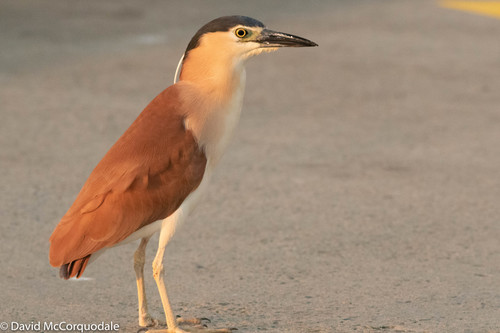
This heron has a thick black bill that is roughly the same length as its head. Its face is white with a subtle cinnamon tint; breeding adults have a grey-black nape and crown.
Breeding Crown Plumes
During the breeding season, breeding adults typically grow two or three thin white plumes that curve down from the crown toward the neck; these plumes have black tips when they are new.
Upperpart Coloration
The nankeen night heron's upperparts are a rich chestnut color, and this color becomes more intense during the breeding season.
Underpart and Neck Coloration
Its underparts are white, and the chestnut upperbody color and white underbody color blend gradually across its neck and upper breast. Its back, tail, and upper wings are a rich rufous color.
Iris and Leg Coloration
The iris is straw yellow, and may develop an orange tinge during the breeding season, while the legs and feet are creamy yellow.
Leg Length and Breeding Leg Color
Compared to other herons, the nankeen night heron has relatively shorter legs; these legs turn bright pink during courtship and the early stages of breeding.
Juvenile Head and Neck Markings
Juvenile nankeen night herons look very different from adults: the top of the head and nape are black-brown with beige streaks. The upper throat and chin are white, while the rest of the neck has heavy brown streaking.
Juvenile Body and Appendage Features
Juveniles have a rufous-brown tail, lime-green to olive-grey legs and feet, and a dull olive-yellow bill with a black tip.
Chick Plumage
Nankeen night heron chicks are covered in dark brown down feathers on their back, and white down on their undersides.
Chick Beak and Leg Features
Chicks have cream-colored beaks with a dark grey edge, and olive legs.
Global Distribution
Nankeen night herons have a broad distribution, and can be found in Australia, New Zealand, the Philippines, Papua New Guinea, the Solomon Islands, Java, New Caledonia, Palau, and the Caroline Islands, Federated States of Micronesia.
Australian Distribution
They are native to Australia, and widespread across most Australian states, except in western Australia where they are rare or entirely absent.
Subspecies Overview
There are six subspecies of nankeen night heron, including the Bonin nankeen night heron (Nycticorax caledonicus crassirostris). This subspecies was endemic to Japan's Bonin Islands, but has been extinct since the late 1800s.
General Habitat Types
The nankeen night heron lives in a wide variety of habitats, including grasslands, meadows, forests, lagoons, beaches, reefs, marshes, shores, wetlands, and swamps. It is most commonly found close to rivers and streams.
Wetland Habitat Preferences
The species prefers habitats with emergent vegetation when located near permanent water.
Diurnal Roosting Habits
The nankeen night heron is mainly nocturnal, so it roosts during the day in dense cover provided by trees, bushes, and reeds. It is also known to roost in dead trees when denser cover is not available.
Urban Habitat Preferences
In urban areas, the nankeen night heron prefers to nest and roost in trees such as cypresses and pines. It also lives in urban wetlands, dry fields, gardens, ponds, airports, and parks.