About Agamia agami (Gmelin, 1789)
Species and Size
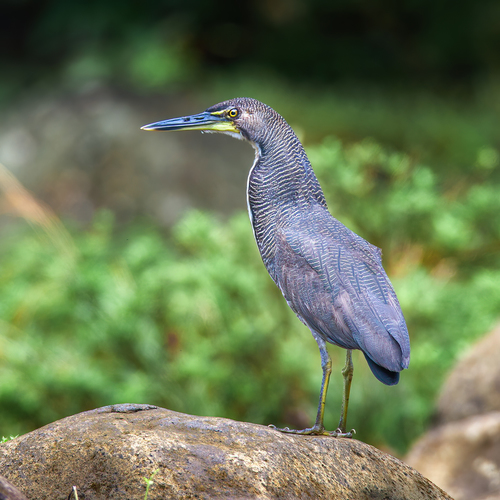
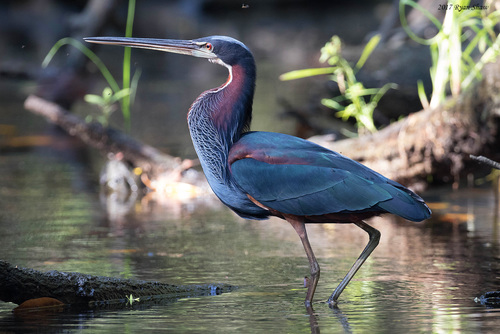
Agamia agami, commonly called the agami heron, is an uncommon species measuring 66–76 centimetres (26–30 inches) in length. Compared to other herons, it has short legs and a thin bill that is considerably longer than its head, with an average total bill length of 15 cm.
Bill Function
This extremely long bill lets the agami heron strike prey from greater distances from its body than similarly sized heron species with shorter bills.
Adult Plumage
The neck and underparts are chestnut, with a white stripe running down the center of the foreneck, and the wings are shiny green. Wispy pale blue feathers adorn the crown, sides of the foreneck, and lower back.
Soft Part Coloration
The legs, bill, and bare facial patch are dull yellow; during the breeding season, the facial patch can change color to reddish.
Sexual Dimorphism
Male and female agami herons are similar in appearance.
Juvenile Appearance
Juveniles are largely brown on the upperparts, have a white foreneck, and have underparts streaked brown and white.
Clutch Characteristics
The species' typical clutch size is two blue eggs.
Distribution Range
The agami heron is a Neotropical species found in Central and South America. Its range extends from southeastern Mexico through central and Caribbean Central America to the Amazon basin in South America, occurring across the countries of Mexico, Guatemala, Belize, El Salvador, Honduras, Nicaragua, Costa Rica, Panama, Colombia, Ecuador, French Guiana, Suriname, Guyana, Venezuela, Peru, Bolivia and Brazil.
Habitat Preferences
The species is rare in open areas. Its native habitat includes swamp forests, mangroves, forest streams and freshwater wetlands.
Elevation Range
It mostly occurs at elevations between sea level and 300 metres (1,000 feet), though there are records of the species being found at elevations as high as 2,600 metres (8,500 feet) in the Andes.
Nesting Behavior
Agami herons nest in both single-species and mixed-species colonies, building stick platforms in bushes and trees standing over water. Very few colonies have been documented to date, but some are quite large, holding hundreds or even over a thousand nests.
Known Colony Locations
Known colony locations within the species' range include a tiny island at the center of a lagoon in Pacuare Nature Reserve, Costa Rica; Tapiche Reserve, Peru; Marais de Kaw-Roura National Reserve and Amazonian National Park, French Guiana; and additional colonies outside protected areas in Colombia, Mexico and Belize.