About Rana dalmatina Fitzinger, 1838
Common Name and General Morphology
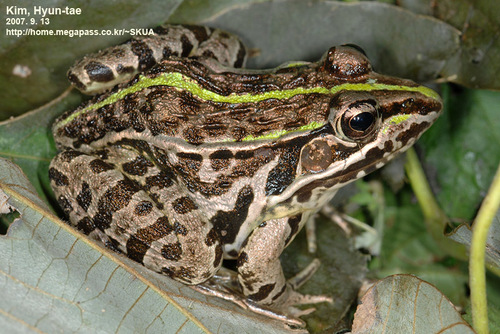
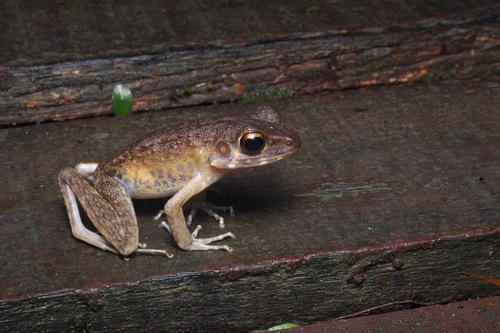
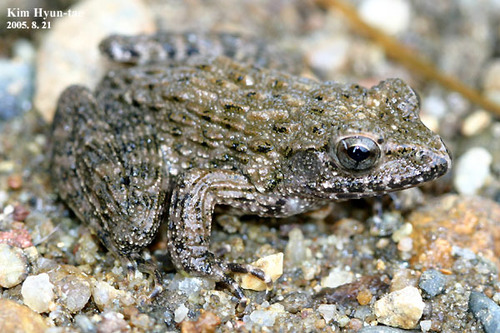
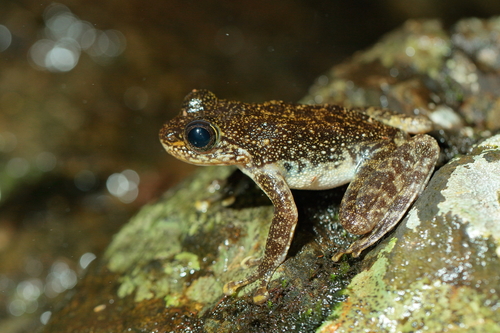
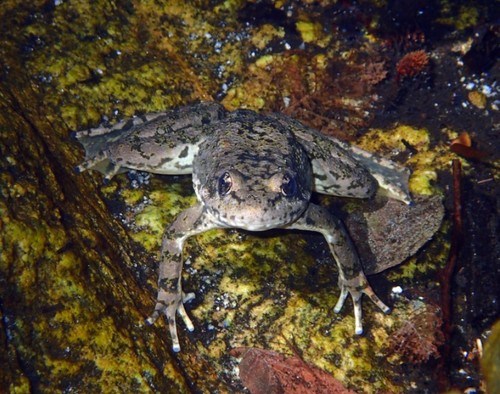
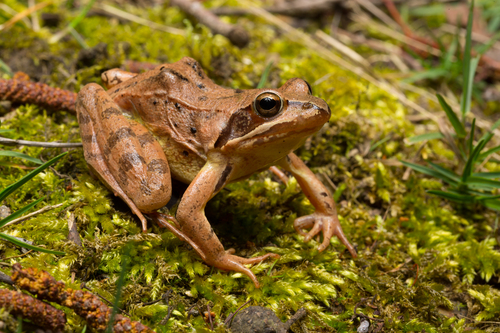
Rana dalmatina, commonly the agile frog, is a stocky frog with long limbs and a pointed snout.
Adult Size
Adult males rarely grow larger than 6.5 cm, while females can reach up to 8 cm in length.
Dorsal Coloration
Its dorsal surface is light brown, reddish-brown, or light greyish-brown with very low contrast. Dark brown, triangular spots extend from the temple to the eardrum.
Underside Coloration
The agile frog’s underside is white and completely unspotted.
Mating Season Male Coloration
During the mating season, males often turn dark brown.
Jumping Ability
Its unusually long hind legs let this species jump further than other similar frogs, with recorded jumps reaching up to two metres.
Eye Features
This frog has horizontal pupils; the upper third of the iris, above the pupil, is lighter and gold in colour.
Tympanum Size
The tympanum (eardrum) is roughly equal in diameter to the eye.
Dorsal Glandular Stripes
The glandular stripes running along the frog’s back are not well developed and are partially interrupted.
Primary Habitat Preference
The agile frog prefers open deciduous mixed forests with abundant water.
Secondary Habitat Range
It also often inhabits open land adjacent to forests, as long as this open land is connected to the forest by shrubs.
Dry Habitat Tolerance
In dry, warm forests, this species can live far from water.
Climatic Preference
Of the three Rana species native to Central Europe, this frog has the greatest preference for warm, dry conditions.
Current Distribution
The agile frog is distributed across France, the Channel Islands, parts of Germany, Denmark, Sweden, Italy, the Czech Republic, Slovakia, Austria, Hungary, the Balkans, Greece, and areas around the Black Sea.
Historical British Presence
The species once lived in Great Britain during the Middle Saxon period, and archaeological remains have been found in East Anglia.
Proposed Great Britain Reintroduction
The organization Celtic Reptile & Amphibian has discussed reintroducing the species to Great Britain.
Jersey Reintroduction
A reintroduction has already been carried out on Jersey by the Durrell Wildlife Conservation Trust, as the species was very close to being extirpated from the island.
Call Characteristics
The agile frog’s call is a fairly quiet repeated “rog ... rog ... rog” that can last up to 12 seconds, and is similar to the clucking of a chicken.
Calling Behavior
They often call underwater, so observers can only hear the calls from a very short distance.
Spawning Period Duration
Spawning activity lasts only a few days.
Male Spawning Behavior
During this period, males sometimes gather in large calling groups on the water surface to attract females.
Central Europe Spawning Timing
In Central Europe, spawning usually takes place within the first 20 days of March, but may be delayed depending on weather conditions.
Spawn Cluster Features
Each spawn cluster contains between 450 and 1800 eggs, and is usually attached to tree branches, roots, or plant stems at depths between 5 cm and 40 cm (2 to 16 inches), so the clusters rarely sink to the bottom.
Spawning Egg Laying Pattern
Unlike the moor frog (Rana arvalis) and common frog (Rana temporaria), the agile frog does not lay all its eggs in a single clump.
Individual Egg Size
A single agile frog egg, not including the outer gelatinous capsule, has a diameter of 1.5–2.1 mm (0.06–0.08 inches).