About Gazella gazella (Pallas, 1766)
Common Name and Horn Presence
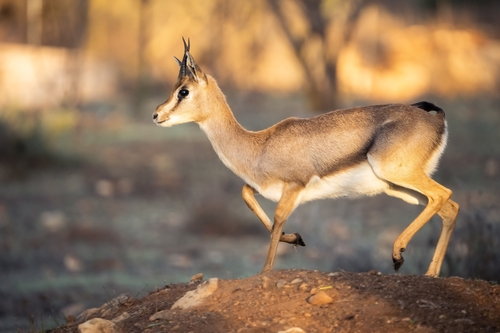
Gazella gazella, commonly called the mountain gazelle, has horns in both sexes.
Sexual Dimorphism in Horns
Males have noticeably larger horns marked with rings, while females have thinner, smoother, and shorter horns.
Sexual Dimorphism in Size
Mountain gazelles are also sexually dimorphic in overall size, with males growing larger than females.
Mature Weight Range
Mature males weigh between 15 and 25 kg, and mature females weigh between 13 and 20 kg.
Maximum Running Speed
Mountain gazelles can reach running speeds up to 80 km/h, or 50 mph.
Historical Distribution
Historically, mountain gazelles ranged across the entire Levant.
Current Main Distribution
Today, they are most abundant in Israel, and also occur in the West Bank (Palestine), the Golan Heights, and Turkey.
Isolated and Possible Remaining Populations
Small, isolated populations exist in parts of Jordan and the Gaza Strip, and the species may still be present (though this is considered unlikely) in Lebanon, Egypt, and Syria outside of the Golan Heights.
Legal Protection and Stronghold Status
The species is protected as endangered under Israeli law, and Israel is described as "the last stronghold" of the mountain gazelle in the Levant.
Arid Condition Adaptations
Mountain gazelles are adapted to live in dry, arid conditions.
Moisture Requirements
They get most of the moisture they need from the vegetation they eat, but still cannot go very long without water.
Preferred Terrain for Activity
They spend most of their time on the flat tops and crests of mountains, hills, and valleys.
Temperature Adaptations and Resting Behavior
They are adapted to an annual average temperature of 21–23 °C, and prefer to rest on breezy, elevated areas to escape the heat of the day.
Feeding Period and Habitat
Around dawn and dusk, these antelope move cautiously through hills to feed in open forests, fields, or rocky plateaus.
Comparative Arid Adaptation and Competition
Because of their preference for elevated terrain, mountain gazelles appear to be less well adapted to hot, dry conditions than other ungulates such as the Dorcas gazelle; the smaller Dorcas gazelle outcompeted the mountain gazelle across parts of the mountain gazelle's range during the late Holocene, a period of climatic warming.
Wild and Captive Lifespan
In the wild, mountain gazelles rarely live past the age of eight, but can live up to 15 years in captivity when given proper care.
Breeding Maturity Age
Female mountain gazelles reach breeding maturity at 12 months old, while males begin breeding at 18 months old.
Mating System
The species is polygamous, meaning individuals do not mate for life.
Breeding Season Timing
Their typical breeding season falls in early winter.
Offspring Production Timing
Females give birth to one offspring per year, most often between April and May.
Pre-Birth Behavior of Females
A few days before giving birth, the pregnant female leaves her herd to live alone for a time.
Newborn Predation Vulnerability
Newborn mountain gazelles are especially vulnerable to predation.
Post-Birth Maternal Behavior
The mother and her newborn stay alone together for up to two months; the mother keeps her baby well-hidden in vegetation while she goes to forage.
Newborn Anti-Predator Behavior
The baby does not usually join its mother to graze for several weeks, relying entirely on camouflage and remaining perfectly still to avoid being detected by predators.
Maternal Threat Monitoring
When the mother returns to the baby, she watches closely for potential threats.
Juvenile Dispersal Patterns
Young males leave their mother after six months to join herds of other young males, while young females sometimes join their mother in the herd of adult females.
Primary Food Sources and Foraging Method
Grasses and shrubs are the mountain gazelle's most common food, and grazing is their preferred foraging method.
Additional Browsing Food Sources
They also browse on low-hanging branches and young shoots, especially when their range includes acacia trees.
Alternative Water Sources
They can survive for long periods without an open water source, instead getting water from succulent plants and dew droplets.