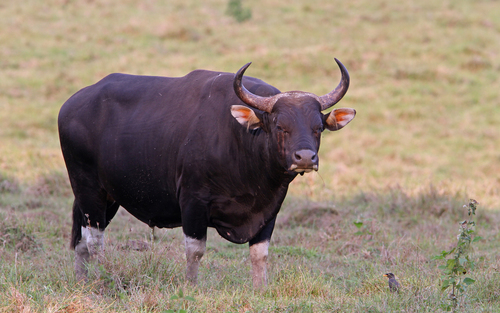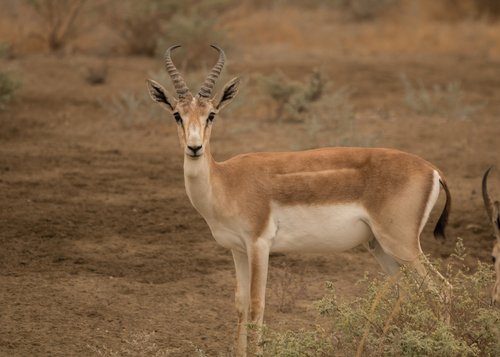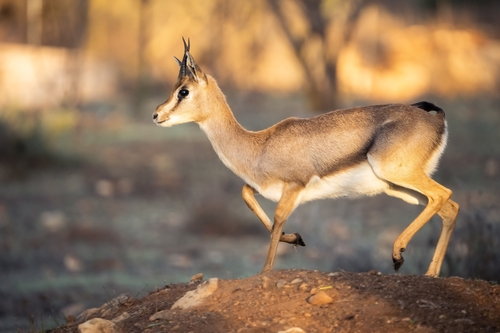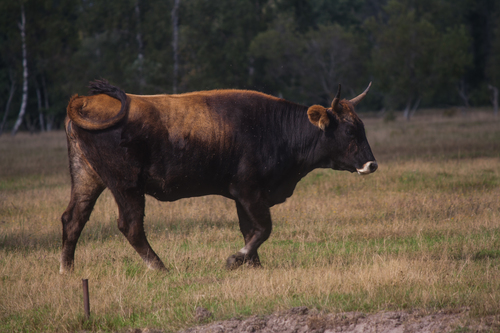
About Connochaetes gnou (Zimmermann, 1780)
Sexual Dimorphism Note
Black wildebeest (Connochaetes gnou) are sexually dimorphic: females are shorter and more slender than males.
Head-and-Body Length
Their typical head-and-body length ranges from 1.7 to 2.2 m (5 ft 7 in to 7 ft 3 in).
Shoulder Height
Bulls stand 1.11 to 1.21 m (3 ft 8 in to 4 ft 0 in) at the shoulder, while cows stand 1.06 to 1.16 m (3 ft 6 in to 3 ft 10 in).
Weight
Bulls usually weigh 140 to 157 kg (309 to 346 lb) and cows weigh 110 to 122 kg (243 to 269 lb).
Tail Traits
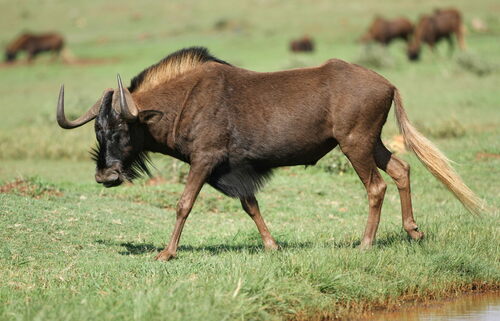
A distinct feature shared by both sexes is a long, horse-like tail. Its bright white color gives the species its alternate common name "white-tailed gnu", and separates it from the blue wildebeest, which has a black tail. The tail measures 80 to 100 cm (2.6 to 3.3 ft) long.
Coat Coloration
Black wildebeest have dark brown or black coats that are slightly paler in summer, and coarser, shaggier in winter. Newborn calves have shaggy, fawn-colored fur, and males are darker than females.
Mane and Body Hair
Both sexes have bushy, dark-tipped manes that stand upright from the back of the neck (similar to blue wildebeest); the mane hairs are white or cream-colored with dark tips. Black bristly hair grows on the muzzle and under the jaw, with long dark hair between the forelegs and under the belly.
Other Physical Traits
Other physical traits include a thick neck, a plain back, and relatively small, beady eyes.
Horn Characteristics
Both sexes have strong, forward-curving hook-shaped horns that can reach up to 78 cm (31 in) long. Mature males have horns with a broad, flattened base that forms a protective shield, while females have shorter, narrower horns. Horns finish developing at 3 years old in females, and at 4 to 5 years old in males.
Vertebrae Structure
The species normally has 13 thoracic vertebrae, though 14-vertebra specimens have been recorded, and the thoracic region tends to be elongated.
Scent Glands and Female Anatomy
Scent glands located in front of the eyes (under hair tufts) and on the forefeet secrete a glutinous substance. Females have two teats.
Comparison to Blue Wildebeest
Beyond the tail difference, black wildebeest are smaller and darker than blue wildebeest.
Thermoregulation
Black wildebeest can keep their body temperature within a narrow range despite large external temperature fluctuations. They have well-developed orientation behavior toward solar radiation, which helps them thrive in hot, often shadeless habitats.
Haematological Parameters
Erythrocyte counts are high at birth and increase until 2–3 months of age, while leucocyte counts are low at birth and decrease throughout the animal's life. Neutrophil counts are high at all ages. Haematocrit and haemoglobin content decrease until 20–30 days after birth. All these haematological parameters peak at 2–3 months of age, after which readings gradually decline to their lowest values in the oldest individuals.
Muscle and Locomotion Adaptations
Fast-twitch muscle fibers and the ability of muscles to use large amounts of oxygen support the black wildebeest's rapid running speed and high fatigue resistance.
Lifespan
Individuals typically live around 20 years.
Native Range
The black wildebeest is native to southern Africa. Its historical range included South Africa, Eswatini, and Lesotho, but it was hunted to extinction in Eswatini and Lesotho in the 19th century. It has since been reintroduced to both countries, and also introduced to Namibia where it is now well established.
Habitat and Altitude
It inhabits open plains, grasslands, and karoo shrublands in both steep mountainous areas and lower undulating hills, at altitudes between 1,350 and 2,150 m (4,430 to 7,050 ft).
Home Range Size
Herds are often migratory or nomadic; non-migratory groups maintain regular 1 km² (0.39 sq mi) home ranges. Female herds roam over home ranges of around 250 acres (100 ha; 0.39 sq mi).
Historical Habitat Use
Historically, black wildebeest occupied temperate highveld grasslands during the dry winter season and arid karoo regions during the rainy season.
Current Distribution
After massive hunting for their hides eliminated them from most of their original range, they are now largely restricted to game farms and protected reserves in southern Africa. In most reserves, black wildebeest share their habitat with blesbok and springbok.
Activity Patterns
Black wildebeest are most active during early morning and late afternoon, and rest during the hottest part of the day. They can run at speeds up to 80 km/h (50 mph).
Anti-Predator Behavior
When a person approaches a herd within a few hundred meters, the wildebeest snort, run a short distance, stop and look back, repeating this pattern if approached further.
Communication Methods
They communicate via pheromones detected through flehmen response, and multiple forms of vocalization. One vocalization is a metallic snort or echoing "hick" that can be heard up to 1.5 km (1 mi) away.
Predators
Their predators include lion, spotted hyena, Cape hunting dog, leopard, cheetah, and Nile crocodile; hyenas mainly target calves, while lions hunt adults.
Social Structure Overview
Black wildebeest are gregarious, with a complex social structure split into three distinct groups: female herds of adult females and their young, bachelor herds of yearlings and older males, and territorial bulls.
Female Herd Dynamics
Female herd size is variable, generally ranging from 14 to 32 individuals; herd size is highest in dense populations and increases with forage density. There is strong social bonding between female herd members, many of whom are related. Large herds often split into smaller groups. Young calves stay with their mothers, while older calves form their own subgroups within the herd.
Female Herd Hierarchy
Female herds have a social hierarchy, and resident females are aggressive toward new individuals trying to join the group. Young males are usually driven away by their mothers before the start of the calving season; separation from the mother is a major cause of calf mortality.
Bachelor Herd Traits
Some male yearlings remain in the female herd, while others join bachelor herds. Bachelor herds are loose associations, with little social attachment between individuals, and males show lower levels of aggression than those in other groups. Bachelor herds travel widely across available habitat, serving as a refuge for males that have lost territorial status and a reserve for future breeding males.
Territorial Bull Ranges
Mature bulls (generally over 4 years old) establish individual territories that female herds regularly pass through. Territories are maintained year-round, and bulls are usually spaced 100–400 m (330–1,310 ft) apart, though spacing varies with habitat quality. In favourable habitat, spacing can be as little as 9 m (30 ft), while it can reach 1.6 km (0.99 mi) in poor habitat.
Territory Display Behavior
Each bull maintains a central dung patch in his territory, where he regularly displays through urinating, scraping, pawing, rolling on the ground, and thumping the ground with his horns, to demonstrate his strength to other bulls.
Bull Challenge Rituals
Encounters between two bulls involve elaborate challenge rituals, a term first coined for blue wildebeest that also applies to black wildebeest due to their similar behavior. Bulls approach each other with lowered heads in a posture resembling grazing, sometimes grazing actualy. This is usually followed by movements like standing in a reverse-parallel position, where one male urinates and the opponent smells it and performs flehmen, after which they may reverse the roles. During or after this step, the bulls may toss their horns at one another, circle each other, or even look away.
Bull Fighting Behavior
Fighting then begins; low intensity fights involve interlocking horns and pushing while standing, while high intensity fights involve dropping to the knees and straining powerfully against each other, keeping contact with foreheads nearly touching the ground. Threat displays such as head shaking may also occur.
Sexual Maturity
Male black wildebeest reach sexual maturity at 3 years old, though they may mature younger in captivity. Females experience their first estrus and breed at 1 or 2 years old, and breed only once per year.
Breeding System
A dominant male maintains a harem of females and does not allow other males to mate with them. The breeding season occurs at the end of the rainy season, lasting a few weeks between February and April.
Mating Behavior
When a female in his harem enters estrus, the male focuses on her and mates with her multiple times. Male courtship behavior includes low stretching, holding ears down, sniffing the female's vulva, ritual urination, and touching the female's rump with his chin. During this time, the female holds her tail up (sometimes vertically) or swishes it across the male's face. The pair usually separates after copulation, though the female may occasionally follow the male and touch his rump with her snout.
Breeding Season Male Condition
During the breeding season, males lose body condition because they spend very little time grazing. Males have been observed mounting other males.
Gestation and Birth
Gestation lasts approximately 8.5 months, after which a single calf is born. Laboring females do not leave the female herd, and repeatedly lie down and stand back up. Births typically occur in short grass areas while the cow is lying down. She stands immediately after birth, breaking the umbilical cord, then licks the calf vigorously and chews the afterbirth.
Calving Season Timing
Despite regional variation, around 80% of females give birth within a 2–3 week period after the start of the rainy season, from mid-November to late December. Seasonal breeding has also been recorded for captive black wildebeest in European zoos. No twin births have ever been reported.
Newborn Calf Traits
Newborn calves have a tawny, shaggy coat and weigh around 11 kg (24 lb). By the end of the fourth week, all four incisors have fully erupted, and two knob-like horn buds appear on the head. These buds later develop into full horns, which reach 20–25 cm (8–10 in) by five months old, and are well developed by eight months old.
Calf Development and Care
Calves can stand and run shortly after birth, a particularly high-risk period for wild calves. Calves nurse from their mother for 6–8 months, begin nibbling grass at one month old, and stay with their mother until she gives birth to her next calf a year later.
Cultural Significance
The black wildebeest appears on the coat of arms of South Africa's Province of Natal. South African authorities have issued postage stamps featuring the animal, and the South African Mint has produced a 5-rand coin depicting a prancing black wildebeest.
Ecological Role
Though no longer present in large numbers in their natural habitat today, black wildebeest were once the dominant herbivores in their ecosystem and the main prey for large predators such as lions.
Economic Uses
Currently, the species is economically important to humans as a major tourist attraction, and produces animal products including leather and meat. The hide makes high-quality leather, while the flesh is coarse, dry, and rather tough. Dried wildebeest meat is used to make biltong, an important part of South African cuisine. Female meat is more tender than male meat, and is at its best during autumn.
Meat and Tail Products
A single black wildebeest provides 10 times as much meat as a Thomson's gazelle. The silky, flowing tail is used to make fly-whisks called chowries.
Negative Human Impacts
Black wildebeest can also have negative impacts on humans. Wild individuals compete with commercial livestock for forage, can transmit fatal diseases such as rinderpest that cause epidemics among domestic cattle, and can spread ticks, lungworms, tapeworms, flies, and paramphistome flukes.