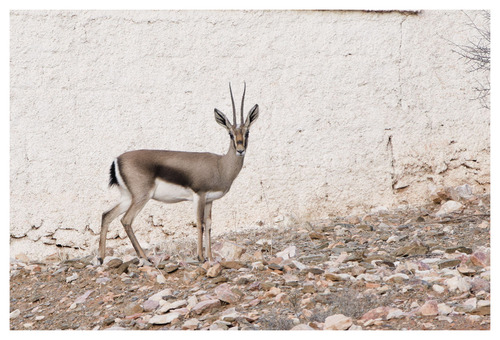
About Gazella cuvieri (Ogilby, 1841)
Species Overview
Cuvier's gazelle (scientific name Gazella cuvieri) is one of the darkest and smallest species of gazelle.
Body Size
It stands 60–69 cm (1.97–2.26 ft) tall, with an average weight of 35 kg (77 lb).
Distinctive Side Marking
A key identifying feature of this species is a distinctive wide, dark band that runs along the sides of its body, separating the brown upper (dorsal) body from the white lower (ventral) body.
Ear and Horn Structure
Cuvier's gazelles have long, slender ears. Both sexes have horns that measure 10 to 15 cm (3.9 to 5.9 in) long, but males have more ribbed, heavier horns.
Countershading Function
The dark side bands work as part of countershading: lighter ventral fur paired with darker dorsal fur counteracts the shadow created by the animal's own body.
Geographic Range
This gazelle lives in the Atlas Mountains of Northwestern Africa, across many different landscape types.
Habitat Preferences
It prefers sandy or stony hills and plateaus, and also occupies regenerating forests and lush pine forests.
Grazing Behavior
Cuvier's gazelles leave the mountains to graze in low grasslands during early morning and late evening.
Resting Behavior
In the afternoon, they travel back up the mountain into forests to find a cool spot to rest for the rest of the day.
Breeding and Gestation Period
Cuvier's gazelles breed in winter, and have a gestation period of around 160 days, so they give birth in early spring.
Post-Birth Mother and Newborn Routine
Before giving birth, a mother separates from her herd to give birth, then hides the newborn in thick underbrush outside the herd, returning only occasionally to nurse it. This routine continues for the first month, until the newborn begins eating vegetation, though it still gets nourishment from its mother.
Twin Birth Rate
Cuvier's gazelle is one of the few gazelle species that frequently gives birth to twins, with 40.5% of births producing twins.
Newborn Weight
On average, singlets weigh 2.99 kg (6.59 lb), while twins weigh an average of 2.85 kg (6.28 lb).
Female Reproductive Frequency
Females can breed again just ten days after giving birth, allowing them to produce two sets of offspring per year.
Female Sexual Maturity
Female newborns can become fertile as early as 27 weeks old, and can give birth for the first time as early as 70 weeks of age.