About Redunca redunca (Pallas, 1767)
Taxonomy and Naming
The bohor reedbuck, with the scientific name Redunca redunca (Pallas, 1767), is a medium-sized antelope.
Head-and-Body Length
Its typical head-and-body length ranges from 100–135 cm (39–53 in).
Shoulder Height
Males stand approximately 75–89 cm (30–35 in) tall at the shoulder, while females reach 69–76 cm (27–30 in) at the shoulder.
Weight
Males typically weigh 43–65 kg (95–143 lb), and females weigh 35–45 kg (77–99 lb).
Tail Length
Its bushy tail measures 18–20 cm (7.1–7.9 in) long.
Sexual Dimorphism Overview
This species is sexually dimorphic: males are 10% to 20% larger than females and have more prominent markings.
Subspecies Size Variation
Among its recognized subspecies, R. r. cottoni is the largest, and R. r. redunca is the smallest.
Base Coat Coloration
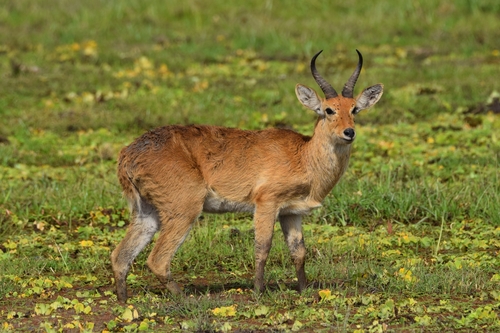
This sturdily built antelope has a yellow to grayish-brown coat, and is generally yellower than other reedbuck species.
Coat Gland Characteristics
Large, diffuse sebaceous glands in the coat make the fur greasy and give the animal a strong odor.
Juvenile Coat Traits
Juveniles are darker and have longer hair than adults.
Subspecies Coat Color Variation
Subspecies vary in coat color: R. r. bohor is yellowish gray, while R. r. wardi has a richer tint.
Underside Coloration
The bohor reedbuck's undersides are white.
Distinct Body Markings
It has several distinct markings: a dark stripe on the front of each foreleg, white markings under the tail, and a pale ring of hair around the eyes that extends along the lips, lower jaw, and upper throat.
Subspecies Marking Variation
The subspecies R. r. redunca lacks the dark foreleg stripes.
Male Neck Morphology
Males have thicker necks.
Ear Characteristics
The species can be distinguished from other antelopes by its large, oval-shaped ears, and there is a round bare spot below each ear.
Gland and Mammary Features
In addition to sebaceous glands, bohor reedbuck have a pair of inguinal glands, vestigial foot glands, and four nipples.
Lifespan
A bohor reedbuck can live for at least ten years.
Track Characteristics
Its tracks are slightly smaller than those of the southern reedbuck.
Male Horn Presence
As a key part of its sexual dimorphism, only males have a pair of short, stout horns that extend backward from the forehead and hook slightly forward.
Typical Horn Length
Horns typically measure 25–35 cm (9.8–13.8 in), though some individuals from Senegal have longer, wide-spreading horns.
Horn Comparison to Other Reedbucks
Compared to other reedbucks, the bohor reedbuck has the shortest and most hooked horns.
R. r. cottoni Horn Traits
R. r. cottoni has the longest horns, which are less hooked than typical and may curve inwards.
R. r. bohor Horn Traits
In contrast to R. r. cottoni, R. r. bohor has short, stout horns with hooks that point forward.
Regional Horn Length Variation
Horn length in a given region is somewhat related to population density in that area: bohor reedbuck in eastern Africa, where populations are dispersed, have short horns, while those in the Nile valley, where populations are concentrated, have longer, wide-spreading horns.
General Habitat Types
The bohor reedbuck inhabits moist grasslands, swamplands, and woodlands.
Cameroon Habitat Specifics
In northern Cameroon, it occupies two main habitat types: seasonally flooded grasslands with abundant grasses such as Vetiveria nigritana and Echinochloa pyramidalis in the Sahelo-Sudan region, and Isoberlina woodlands in the Sudano-Guinean region.
Habitat Adaptability
It is often found on grasslands prone to both floods and droughts, and adapts well to extreme seasonal changes and calamities.
Habitat Range Limitation
Due to its specific habitat requirements, it is not as widespread as the bushbuck.
Sympatry with Mountain Reedbuck
In some edge areas of its range, it shares habitat with the mountain reedbuck.
Sympatry with Southern Reedbuck
The ranges of the bohor reedbuck and southern reedbuck overlap extensively in Tanzania.
Native Geographic Range
Endemic to Africa, the bohor reedbuck is native to Benin, Burkina Faso, Burundi, Cameroon, Central African Republic, Chad, Democratic Republic of the Congo, Ethiopia, the Gambia, Ghana, Guinea, Guinea-Bissau, Kenya, Mali, Mauritania, Niger, Nigeria, Rwanda, Senegal, Sudan, Tanzania and Togo.
Extirpation Status
It is possibly extinct in Ivory Coast and Uganda.
Current Range Extent
Formerly widespread across western, central, and eastern Africa, its current range extends from Senegal in the west to Ethiopia in the east.
Tanzania Range Abundance
Among the three reedbuck species, the bohor reedbuck is the most widespread in Tanzania.
Regional Conservation Status
Its conservation status is uncertain in Burundi, Eritrea, Ghana and Togo, and it is rare in Niger and Nigeria.
Activity Pattern
Bohor reedbuck are active throughout the day, seeking cover during daytime and grazing at night.
Daily Time Allocation
A large portion of each day is spent feeding and staying vigilant.
Anti-predator Camouflage Behavior
They can easily camouflage in grasses and reeds, and typically hide instead of running when they sense danger.
Threat Response Behavior
When threatened, they usually stay motionless or retreat slowly into cover for defense, but will flee and whistle shrilly to alert others if the threat is close.
Predator Avoidance Strategy
They hide from predators rather than forming herds for defense.
Known Predators
Many predators, including lions, cheetahs, leopards, hyenas, wild dogs, and crocodiles, prey on the bohor reedbuck.
Female Herding Behavior
When shade is available, females stay solitary; if no shade is available, females and their offspring gather into herds of up to ten individuals.
Home Range Size
Female home ranges cover 15–40 hectares, while the larger territories of males cover 25–60 hectares.
Home Range Overlap
These home ranges often overlap.
Female Offspring Dispersal
As female offspring mature, they move away from their mothers' home ranges.
Territorial Male Tolerance
Territorial males are very tolerant, and may even associate with up to 19 bachelor males when no females are present.
Female Presence in Male Territories
Up to five females may be found in a single male's territory.
Juvenile Male Expulsion
Territorial males drive out their sons once the young males start growing horns, which happens when they are about a year and a half old.
Bachelor Male Group Behavior
These young males form small groups of two to three on the borders of territories, until they mature around their fourth year.
Dry Season Aggregation Behavior
Large aggregations of hundreds of bohor reedbuck gather near rivers during the dry season.
Common Displays
Two common displays in this species are whistling and bounding.
Territorial Marking Behavior
Instead of scent-marking territory, the bohor reedbuck produces a shrill whistle to mark its territory boundaries.
Whistling Mechanism
When whistling, it expels air through its nose with enough force that its entire body vibrates.
Whistling and Bounding Sequence
These whistles, usually one to three in number, are followed by a few stotting bounds.
Alarm Display Function
This behavior is also used to raise alarm in herds.
Bound Display Physical Characteristics
During this display, the reedbuck raises its neck to expose the white patch on its throat, keeps its tail down, and leaps similarly to an impala, landing on its forelegs.
Bound Display Gland Feature
The display is also accompanied by popping of the inguinal glands in the legs.
Male Fight Behavior
Fights between males begin with both opponents holding their horns low in a combat stance, followed by locking of horns and pushing.
Fight Severity
These fights can even result in death.
Sexual Maturity Age
For reproduction, males become sexually mature at three to four years old, while females can conceive as early as one year old and reproduce every nine to fourteen months.
Breeding Seasonality
There is no fixed breeding season, but mating peaks in the rainy season.
Male Dominance Fight Locations
Dominance fights take place in specific "assembly fields", where up to 40 males may gather in an area of 1 hectare.
Assembly Field Attractants
Some parts of these grounds are marked with dung and urine and are particularly attractive to males, because of the oestrogen present in females' urine.
Courtship Initiation
Courtship starts when the dominant male approaches the female, who then assumes a low-head posture and urinates.
Unresponsive Female Behavior
Unresponsive females will run away when pursued by a male.
Male Courtship Behavior
A male that is interested in the female will repeatedly sniff her vulva and flick his tongue.
Mating March Behavior
As the pair continues their "mating march", the male licks the female's rump and persistently attempts to mount her.
Mounting Behavior
When mounting, the male tries to clasp her flanks tightly.
Female Receptivity Signal
If the female stands firmly, she is signaling that she is ready to mate.
Copulation Process
Copulation involves a single ejaculation, after which both animals stand motionless for a time before returning to grazing.
Gestation Period and Litter Size
The gestation period is seven and a half months long, after which a single calf is born.
Calf Confinement Period
Mothers keep their calves concealed for up to eight weeks.
Mother-Calf Proximity
The mother stays within 20–30 m of her calf.
Nursing Session Characteristics
Nursing, which usually lasts two to four minutes, includes licking the calf's entire body and suckling.
Nursing Frequency
The infant is typically suckled once during the day and one to two times at night.
Previous Calf Behavior
A female's previous calf usually resists separation from her.
Calf Grazing Onset
By two months old, the calf starts grazing alongside its mother, and will seek protection from her if threatened.
Post-Four-Month Grooming Behavior
After four months, the mother no longer licks the calf, though she may still groom it.
Weaning Age
Calves are weaned at eight to nine months old.