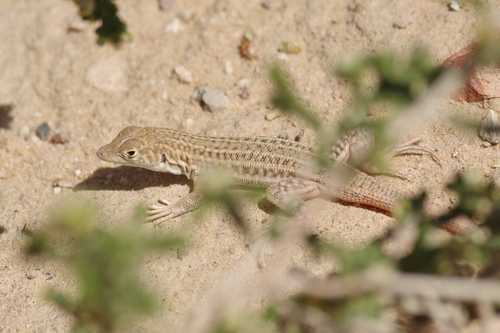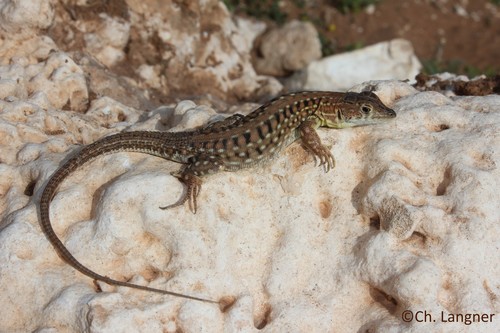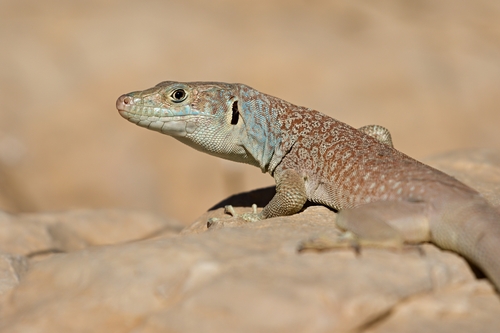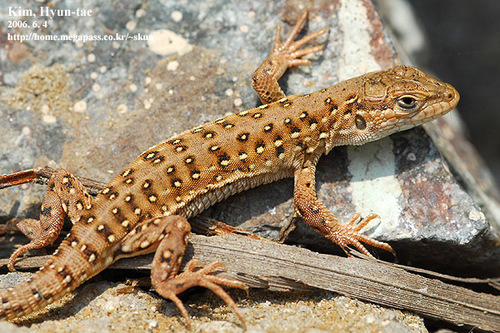
About Zootoca vivipara (Lichtenstein, 1823)
Size
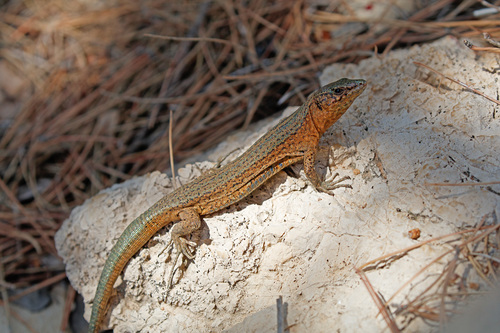
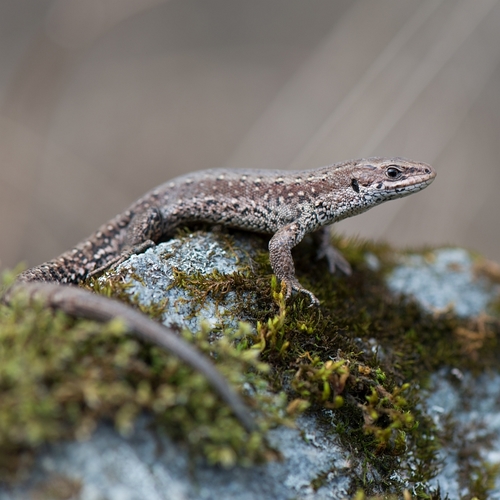
Zootoca vivipara is a small lizard with an average total length between 150 and 200 mm.
General Color Variability
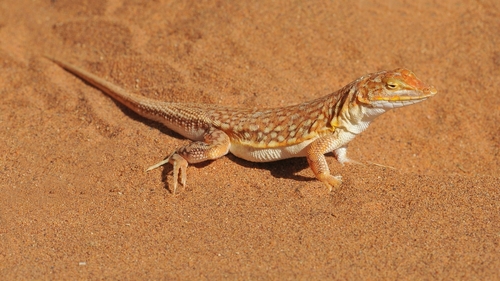
It does not have a single fixed color, and individuals can be brown, red, grey, green, or black.
Sexual Dimorphism Overview
This species shows several distinct sexual dimorphisms.
Female Ventral Color Polymorphism
Female Z. vivipara are more likely to have color polymorphism than males, with variation in ventral coloration ranging from pale yellow to bright orange, plus mixed color morphs.
Hypotheses for Color Polymorphism
Many hypotheses have been proposed for the genetic origin of this polymorphic coloration, suggesting it could be linked to thermoregulation, predator avoidance, or social cues related to sexual reproduction.
Color Polymorphism Driver Experiment
An experiment conducted by Vercken et al. found that color polymorphism in this species is caused by social cues, rather than the other tested factors.
Link Between Color and Reproduction
More specifically, the ventral color variation seen in females is associated with patterns of sexual reproduction and sex allocation.
Male Coloration
Males typically have more colorful, brighter undersides that can be yellow, orange, green, or blue, and usually have spots along their backs.
Female Dorsal Coloration
In contrast, females usually have darker stripes running down their backs and sides.
Head Size Dimorphism
In addition to color differences, males generally have larger heads than females, and this trait is thought to be sexually selected.
Reproductive Advantage of Larger Male Heads
Males with larger heads are more successful in mating and male-male interactions than smaller-headed Z. vivipara.
Male Size and Reproductive Frequency
Larger males also reproduce more frequently within a single mating season than smaller males.
Species Behaviors
Characteristic behaviors of this species include tongue flicking when a predator is present, and female-female aggression that appears to be influenced by the color of a lizard's side stripe.
Habitat Stratum
Zootoca vivipara is a terrestrial species, so it spends most of its time on the ground, though it occasionally occurs at higher elevations.
Thermoregulation Behavior
This lizard thermoregulates by basking in the sun for much of its active period.
Hibernation
In cold weather, it hibernates to maintain safe body temperatures, with hibernation occurring between October and March.
Habitat Types
Its typical habitats include heathland, moorland, woodland, and grassland.
Native Range Overview
The viviparous lizard is native to most of northern Eurasia.
European Distribution
In Europe, it is mainly found north of the Alps and the Carpathians, including the British Isles but not Iceland, and also occurs in parts of northern Iberia and the Balkans.
Asian Distribution
In Asia, it is mostly found in Russia (excluding northern Siberia), as well as in northern Kazakhstan, Mongolia, China, and Japan.
Distribution Size Distinction
Z. vivipara has the largest geographic distribution of any lizard species in the world.
Home Range Size
The home range size of Zootoca vivipara ranges from 539 square meters to 1692 square meters, with males generally having larger home ranges than females.
Home Range Influencing Factors
An individual lizard's home range size also depends on local population density and the presence of prey.