About Fundulus grandis Baird & Girard, 1853
Taxonomic Classification
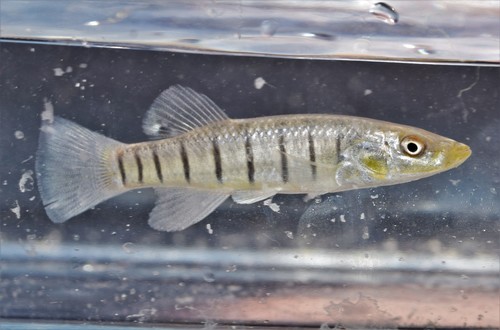
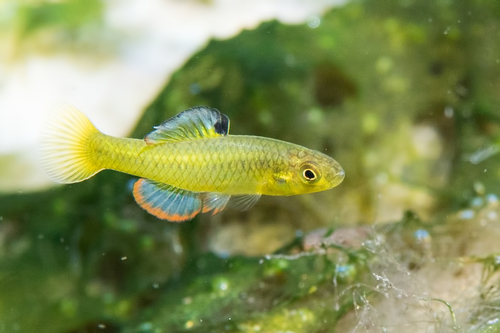
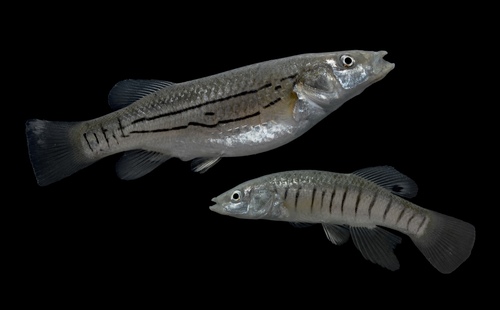
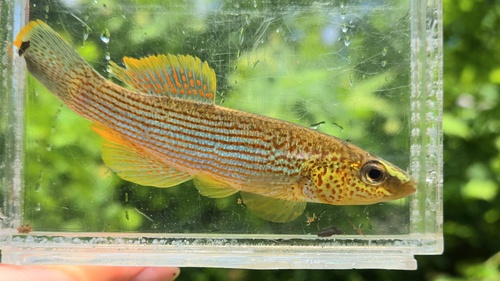
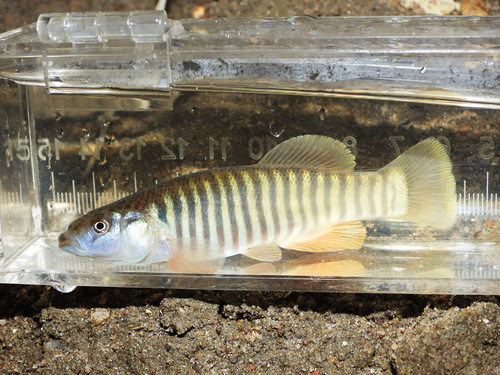
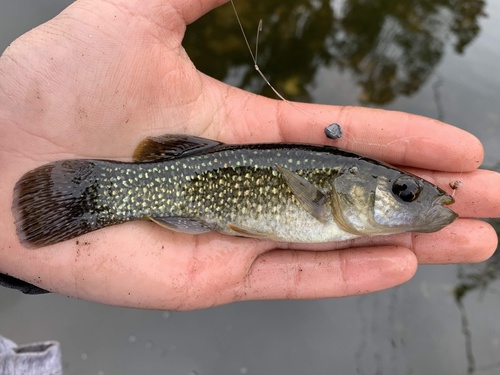
The Gulf killifish, with the scientific name Fundulus grandis, is one of the largest species in the Fundulus genus.
Maximum Size
It can grow up to 7 inches (18 cm) in length, while most other Fundulus species reach a maximum length of only 4 inches (10 cm).
Predator Prey Role
Because of its larger size, F. grandis is among the biggest minnows hunted as prey by many sport fish, including flounder, speckled trout (Cynoscion nebulosus), and red drum (Sciaenops ocellatus).
Etymology
The genus name Fundulus comes from Latin meaning "bottom," and the species name grandis means "large".
Native Distribution
This fish is native to the Gulf of Mexico from Texas to Florida, the eastern coast of Florida, and the Caribbean Sea in the Atlantic Ocean.
Survival Threats
Threats to the Gulf killifish's survival include extreme salinity changes, temperature changes, and toxic events such as Louisiana's hypoxic dead zone and the Deepwater Horizon oil spill.
Research Application
Currently, the Gulf killifish is used in research to test how oil and oil dispersants affect the physiology of marine species exposed to these substances.
Research Relevance
This research is important for conservation biology, as ongoing extraction of oil and other natural resources from North American waters makes it increasingly critical to understand the risks and consequences of worst-case scenarios like the Deepwater Horizon oil spill, and their long-lasting impacts on marine ecosystems.
Habitat Range
The Gulf killifish inhabits the Atlantic Ocean, Gulf of Mexico, Caribbean Sea, and the Southeast United States Continental Shelf.
Geographical Range Extent
Its natural range extends from Texas to Florida's western coast, along Florida's east coast, and throughout the Caribbean.
Habitat Water Characteristics
The waters in its range experience frequent changes to water characteristics including temperature, dissolved oxygen, and salinity.
Environmental Impact on Populations
These changes can have major impacts on the survival and population size of the Gulf killifish.
Pollution Adaptation Observation
Populations of F. grandis living in the heavily polluted waters of the Houston Ship Channel have recently been found to have adapted to resist the effects of local pollution.
Embryo Resistance Trait
This resistance protects the embryos of these populations from cardiac teratogenesis, which refers to developmental heart deformities, when compared to embryos from reference, uncontaminated populations.
Additional Adapted Traits
In addition, these adapted Gulf killifish populations are also more resistant to pesticides and oxidative stress, and have a higher metabolism.
Adaptation Driver
These traits likely developed due to strong natural selection acting on these populations to build resistance to severe contamination.
Adaptive Significance
This strong resistance and cross-resistance to multiple stressors shows how adaptation to human-caused contaminants can occur in this species' environment, and similar adaptive events are common across many fish species and populations.