About Fundulus catenatus (Storer, 1846)
Size
The northern studfish, Fundulus catenatus, has an average adult length of 3 to 6 inches (7.6 to 15.2 cm), and reaches a maximum size of 7 inches (18 cm).
Sexual Dimorphism
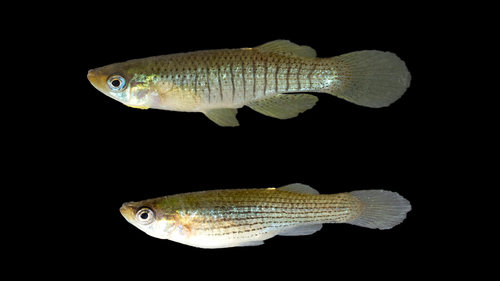
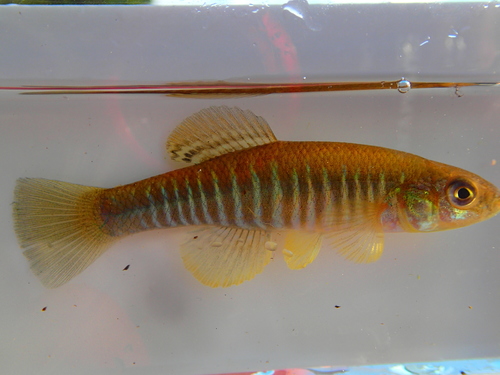
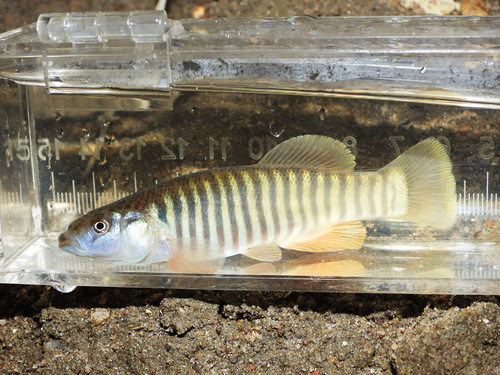
This species is sexually dimorphic.
Breeding Male Coloration
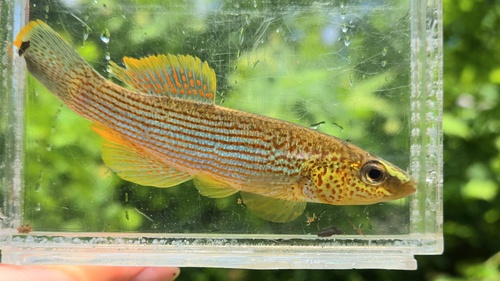
During the breeding season, males have horizontal rows of bright orange spots on a light blue body, plus a bright orange margin on the tail that is followed by a nearly black band.
Female Coloration
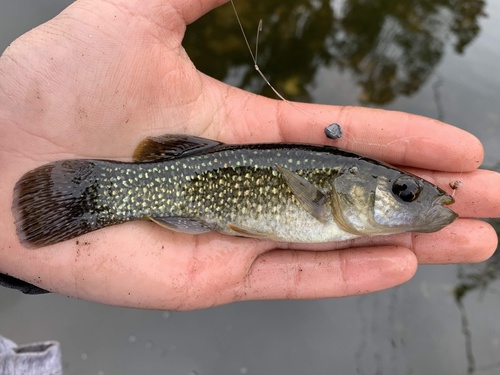
Females have more cryptic coloration in shades of beige and olive.
Body Structure
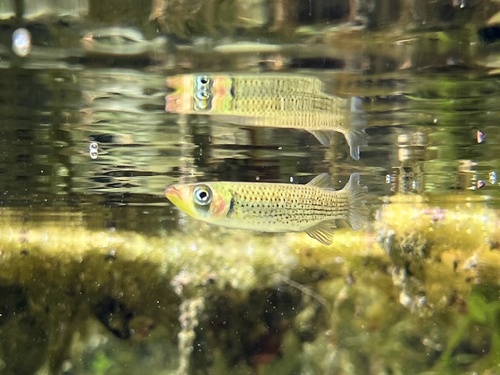
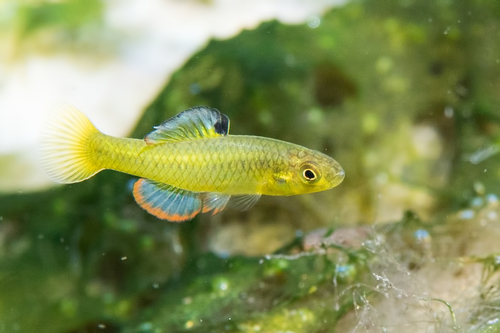
Northern studfish have an elongated, narrow body, and lack a lateral line.
Fin Structure
Their fins are spineless, and both the anal and dorsal fins are large.
Native Distribution
This species is native to a wide range of river drainages across the central and southeastern United States: the upper East Fork White River system in Indiana; upper Salt and Kentucky River drainages in Kentucky; upper Green, middle, and lower Cumberland, and Tennessee River drainages across Virginia, Kentucky, Tennessee, Alabama, and Mississippi; west of the Mississippi River, it occurs in central and southern Missouri, southeastern Kansas, eastern Oklahoma, and southern Arkansas, primarily in the Ozark and Ouachita uplands; and in southwestern Mississippi, it is found in the Mississippi drainage (Coles Creek, Homochitto River, and Buffalo Bayou) and the Gulf Slope drainage (Amite River and Pearl River).
Range Expansion
Introduction via live bait bucket release and release of unwanted aquarium pets has caused the species' native range to expand beyond its original boundaries.
Habitat
Northern studfish are egg-laying fish that prefer clear, shallow pools and rocky creeks with mixed sand and gravel substrate, and constant, sluggish flow.
Male Territoriality
Males do not build nests, but they establish and defend individual territories.
Reproduction
Females lay clutches of 28 to 245 eggs, and provide no parental care to their offspring.
Diet
The diet of northern studfish consists mainly of insects skimmed from the water surface, but they also consume snails.