About Lucania parva (Baird & Girard, 1855)
Species Introduction
Lucania parva (Baird & Girard, 1855), commonly called the rainwater killifish, has the following documented characteristics:
General Body Coloration
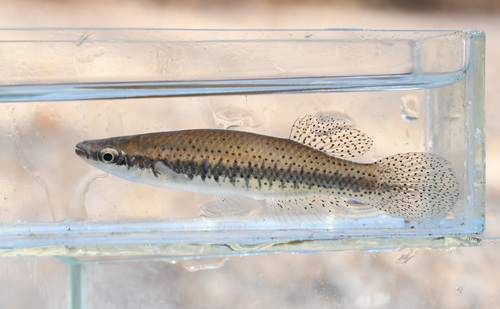
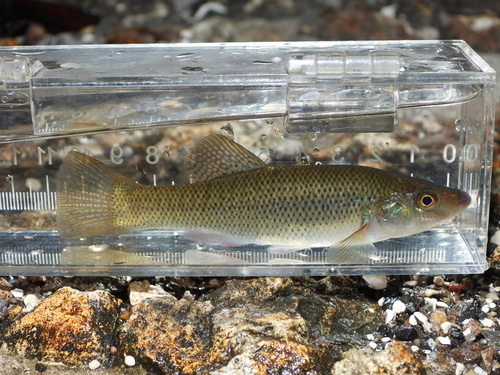
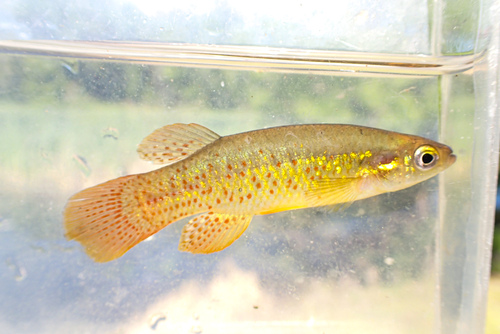
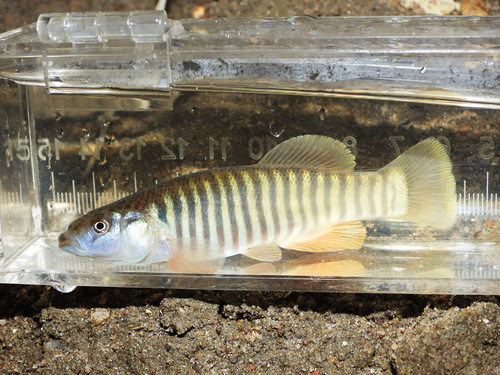
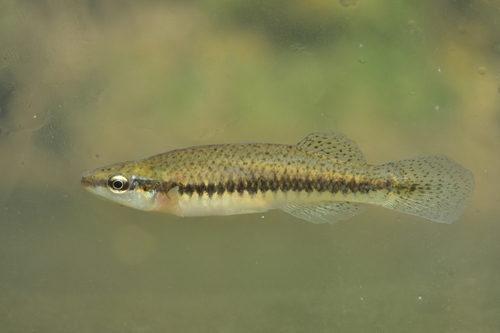
Coloration: The body has no bars. The back ranges from silvery to light green, with a narrow dark middorsal stripe.
Side scales are outlined with melanophores, creating a cross-hatched pattern that is particularly prominent in breeding males.
Head Coloration
The forward and upper surfaces of the head are speckled with melanophores, which also extend onto the underside of the lower jaw. The belly and lower body surfaces are silver.
Non-breeding Fin Coloration
Fins are generally unpigmented, except for some melanophores along the fin rays.
Breeding Male Coloration
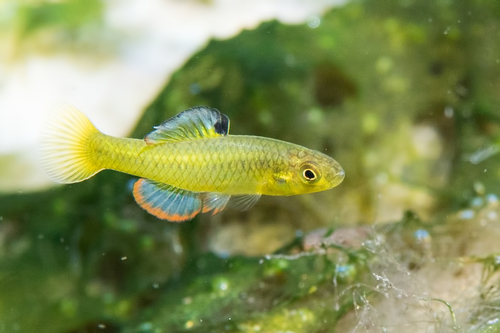
In breeding males, the dorsal fin has a black anterior blotch plus dark marginal and basal bands that may contain orange pigment. The caudal, anal, and pelvic fins are red to orange with black marginal bands.
Morphometric Counts
Documented counts: There are 10 or more dorsal fin rays; 8 to 13 scale rows between the pelvic origin and isthmus; 30 or fewer longitudinal scale rows; 27 (range 26 to 28) lateral scales; 11 (range 9 to 13) dorsal fin rays; 13 (range 12 to 14) pectoral fin rays; 6 (range 4 to 7) pelvic fin rays; 9 (range 8 to 13) anal fin rays; 16 (range 15 to 18) caudal fin rays; and 8 (range 5 to 9) gill rakers on the first gill arch.
General Body Shape
Body shape: The body is deep and fairly compressed; the head is flattened on top, tapering to a vertically rounded, blunt snout. Body depth is equal to one quarter of standard length. The body axis is straight.
Mouth Morphology
Mouth: The mouth is supraterminal, oblique, and small, with an obliquely sloped, protruding lower jaw.
Fin Placement and Shape
External morphology: The distance from the dorsal fin origin to the end of the hypural plate is greater than the distance from the dorsal fin origin to the preopercle. The dorsal and caudal fins are rounded, and the apexes of the pectoral, pelvic, and anal fins are also rounded.
Sexual Dimorphism External Traits
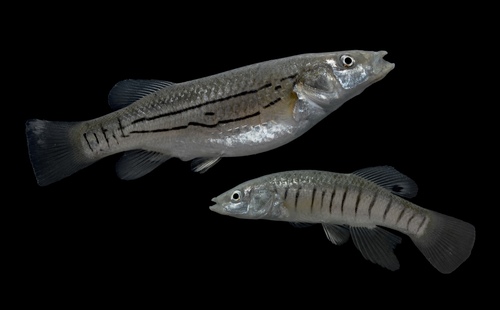
Males develop prickly contact organs on the top and sides of the head, and on the side of the body between the dorsal and anal fin bases. Females have a membranous sheath surrounding the genital opening.
Tooth Morphology
Internal morphology: Teeth are conical and simple. Premaxillary and mandibular teeth are arranged in a single row or irregularly, and occasionally have a few strong inner teeth.
Original Taxonomic Description
The rainwater killifish was formally described by Spencer Fullerton Baird and Charles Frédéric Girard as Cyprinodon parvus, with type localities at Beesley's Point, New Jersey and Greenport, Long Island, New York.
Genus Name Etymology
The genus name Lucania is a Native American word from an unknown language with an unknown meaning, which Girard reportedly chose for its sound.
Type Species Designation
In 1859, Girard designated this species as the type species of the genus Lucania, but used the junior synonym Limia venusta.
Specific Name Etymology
Its specific name parva is Latin for "small".
Habitat Types
Habitat: This species is found in salt marshes, bays, and lagoons from Cape Cod, Massachusetts to Tampico, Mexico. It is common in freshwaters of Florida's St. John's River system, and in the Rio Grande and Pecos River of Texas and New Mexico.
Schooling Behavior
Lucania parva is a schooling species.
Native and Introduced Range
Distribution: It is native to coastal waters from Massachusetts to Tampico, Mexico, and has been introduced to California, Nevada, Oregon, and Utah.
New Mexico Distribution Details
It is locally abundant in the lower Pecos River drainage of New Mexico, and does not ascend tributary streams far above their mouths.
Texas Spawning Season
Reproduction and life cycle: Spawning season: In Texas, females start ripening in February, and a small number remain gravid in July. Peak spawning occurs in May and June; males show breeding coloration from February into June or July, with the greatest color intensity in May, and spawning may start earlier in spring.
New Mexico Spawning Season
In southern New Mexico, spawning has been recorded from spring through fall.
Spawning Site Characteristics
Spawning location: During spawning, males and females swim into vegetation with fine leaves, where eggs are released and fertilized. Eggs have mucous threads that anchor them to plant material. Male courtship behavior has been observed near clumps of Naias and Vallisneria.
Courtship Behavior
Reproductive strategy: A courting male swims in loops slightly below the female, waiting for the female to stop. After the female stops, the male moves under her and flicks his head against her throat.
Spawning Act
The pair moves slowly toward the water surface, while the male continues rubbing his head against the female's underside. When near the surface, the female swims into fine-leaved vegetation or algal masses, and the male follows. The male then clasps the female with his dorsal and anal fins, and eggs are released and fertilized.
Fecundity Counts
Fecundity: Females carry 7 to 46 ripe ova, with a mean of 24.5 per fish, plus numerous smaller ova. The maximum reported count of ova is 104.
Egg Characteristics
Freshly laid eggs are spherical, nearly colorless, and have chorionic threads. Live eggs average 1.23 mm in diameter, and hatch in six days at a water temperature of 23.9 °C.
Brood Frequency
A single female may produce more than one brood per year.