About Falco deiroleucus Temminck, 1825
Scientific Name
Falco deiroleucus Temminck, 1825, commonly called the orange-breasted falcon.
Description
Size and Sexual Dimorphism
Male orange-breasted falcons measure 35 to 36 cm (14 to 14 in) long and weigh 325 to 425 g (11 to 15 oz). Females measure 38 to 40 cm (15 to 16 in) long and weigh 550 to 700 g (19 to 25 oz). Among all falcon species, this one shows the largest size difference between males and females.
General Physical Traits
It is a relatively husky bird with a large head. Both sexes share similar plumage, and the species resembles the smaller bat falcon.
Adult Plumage
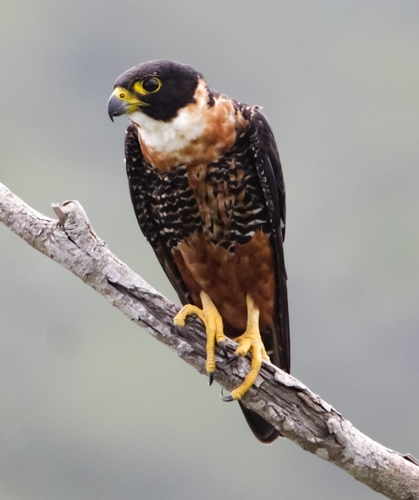
Adults have a black head and bluish black upperparts, with paler blue-gray edges along the feathers. Their throat and the sides of their neck are white, and their upper breast is a buffy rufous orange that also extends onto the sides of the neck. The ratio of white to orange coloring varies between individual birds.
Adult Body Markings
Their lower breast is black with coarse reddish brown bars, and the barring is somewhat lighter on the flanks. Their belly, thighs, and undertail coverts are the same buffy rufous orange as the upper breast.
Adult Bare Parts
Their cere (the bare skin around the eye), legs, and feet are usually bright yellow, but may range from pale yellow to dull bluish green. Their iris is dark brown.
Immature Plumage
Immature orange-breasted falcons are paler and have less sharply defined markings than adults. Their back and tail are dark brownish, and their underparts are mostly pale buffy with dark brown barring on the breast.
Immature Bare Parts
Their bare body parts are dull bluish green, and become more yellow as the bird ages.
Identification Difficulty
Distinguishing the orange-breasted falcon from the bat falcon is difficult, because small male orange-breasted falcons are only marginally larger than large female bat falcons.
Adult Identification Cues
However, as its common name suggests, the orange-breasted falcon has an orange band on the upper breast above the black chest. By contrast, the adult bat falcon has white breast plumage with no or only very limited orange coloration.
Juvenile Identification Cues
Juveniles of the two species are even harder to tell apart, because both have a buffy-colored upper breast. Juvenile orange-breasted falcons can be most reliably distinguished by black spotting on their leg feathers, while juvenile bat falcons have the same orange-red leg feathers as adult bat falcons.
Distribution and habitat
Historical Range
The orange-breasted falcon was historically found from southern Mexico all the way to northern Argentina. Its current range is greatly reduced.
Middle America Distribution
The only confirmed fairly recent records of the species in Middle America come from Belize, Guatemala, and Panama, though it may still persist in southern Mexico. It is extremely rare or extirpated in Costa Rica, Nicaragua, and Honduras, and there are no recorded observations in El Salvador.
South America Distribution
The species is present but rare in Brazil, Ecuador, Peru, and Venezuela. Its conservation status is uncertain in Bolivia, Colombia, Guyana, Paraguay, Suriname, and Trinidad and Tobago. Study specimens have been collected from all of these countries, and most are believed to host a small number of resident pairs.
Distribution Notes
Except in a very small number of locations, the species is very sparsely distributed. Understanding of its distribution is complicated by its close resemblance to the much more widespread and numerous bat falcon.
Habitat Requirements
The orange-breasted falcon depends on tropical rainforest and semi-deciduous forest that includes cliffs suitable for nesting. It prefers undisturbed mature forest, but also occurs in mosaic landscapes made up of forest and more open areas.