About Microhierax latifrons Sharpe, 1879
Taxonomy and Basic Classification
The white-fronted falconet (Microhierax latifrons Sharpe, 1879) is an extremely small, shrike-like falcon species.
Size Measurements
It measures 14–17 cm (5.5–6.7 in) in length, weighs 35–65 g (1.2–2.3 oz), and has a wingspan of 28–31 cm (11–12 in). It resembles other falconets, but is slightly smaller than all of them.
Common Plumage Features
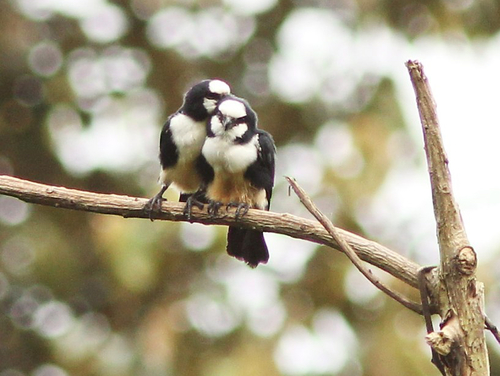
Individuals of both sexes have glossy bluish-black upperparts, black flanks and outer thighs, and a black mask. Their throat, cheeks, and breast are white, fading to pale yellowish-brown on the belly and vent. The tail is short and black, and the wings reach halfway to the tail tip.
Sexual Dimorphism
Males have a white forecrown and forehead, while females have a reddish-brown forecrown and forehead. Females are also 9% larger overall and have 4% longer tails than males. Both sexes have brown eyes, and their cere and legs range from dark grey to black.
Juvenile Plumage
Juveniles look similar to adult females, but have tawny-buff forecrowns and cheeks; young females may also have reddish-brown coloring on the forecrown.
Similar Species Confusion
This species can overlap in range with the black-thighed falconet, and the two are easily confused. However, the white-fronted falconet can be distinguished from the black-thighed falconet and all other falconets by the color of its forehead.
Distinguishing Plumage Traits
The black-thighed falconet also has more intense reddish-brown coloring on the belly and vent, plus white bars on the underside of its tail, while the white-fronted falconet’s tail is entirely black.
Vocalizations
The vocalizations of the white-fronted falconet are not well studied, but they are assumed to be similar to those of other falconets; this species produces a quavering kree-kree-kree call.
Endemic Range
The white-fronted falconet is endemic to the island of Borneo. It occurs in the Malaysian states of Sarawak and Sabah, as well as the extreme northeastern part of Kalimantan, the Indonesian portion of Borneo.
Habitat Preferences
It lives in open forests, forest edges, clearings with dead trees, and cultivated areas with scattered trees, and is thought to be particularly common on mountainous slopes. It is also found infrequently in mangrove forests.
Elevation Range
This species occurs at elevations ranging from 0 to 1,200 m (0–3,937 ft).
Social Structure
White-fronted falconets are found either alone or in small groups of multiple individuals.
Generation Length
The species has a generation length of 3.2 years.
Diet Composition
It feeds mainly on insects including dragonflies, bees, and cicadas, but has also been recorded chasing birds. Hunting groups have been observed in November.
Hunting Behavior
The species hunts from perches, flying out to catch flying insects, then returning to the perch to eat the prey roughly two minutes after capture. Other hunting behaviors are thought to match those of other falconets, though there may be differences between the hunting techniques of the white-fronted falconet and the black-thighed falconet.
Breeding Season
The white-fronted falconet’s breeding season is thought to be either March to June or March to April, but breeding activity has also been observed in November. In Sabah, a male was observed feeding a fully-fledged chick in late July.
Nesting Characteristics
The species nests in old nest holes originally made by barbets or woodpeckers, and clutches contain two eggs. Incubation and fledging times have not been recorded.
Social Breeding Behavior
Adult males have been observed preening each other, but it is not confirmed whether this species breeds communally like the collared falconet.