About Falco peregrinus Tunstall, 1771
Taxon Identification
This description covers Falco peregrinus Tunstall, 1771, the peregrine falcon.
General Size Range
Adult peregrine falcons measure 34 to 58 cm (13–23 in) in body length, with a wingspan of 74 to 120 cm (29–47 in).
Sexual Size Dimorphism
Males and females share similar markings and plumage, but like many birds of prey, peregrine falcons show strong sexual dimorphism in size: females are up to 30% larger than males. Males weigh 330 to 1,000 g (12–35 oz), while noticeably larger females weigh 700 to 1,500 g (25–53 oz).
Subspecies Size Patterns
For most subspecies, males weigh less than 700 g (25 oz) and females weigh more than 800 g (28 oz), and it is not uncommon for breeding females to be around 50% heavier than their male partners.
Standard Linear Measurements
Standard linear measurements for the species are: wing chord 26.5 to 39 cm (10.4–15.4 in), tail 13 to 19 cm (5.1–7.5 in), and tarsus 4.5 to 5.6 cm (1.8–2.2 in).
Adult Back and Wing Plumage
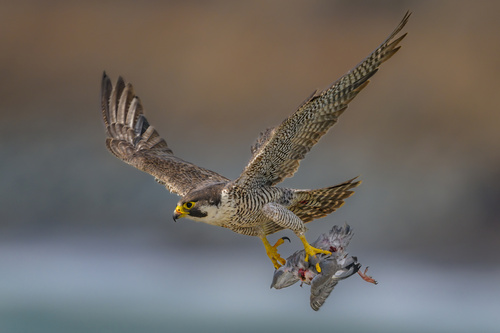
Adults typically have bluish black to slate grey backs and long pointed wings, with faint darker barring, and black wingtips. Their underparts range from white to rusty, marked with thin, distinct dark brown or black bars.
Tail Features
The tail matches the back in color, with thin, distinct bars; it is long, narrow, rounded at the tip, with a black end point and a white band at the very tip.
Head and Neck Markings
The top of the head and a dark "moustache" stripe along the cheeks are black, creating a sharp contrast with the pale sides of the neck and white throat.
Soft Part Traits
The cere and feet are yellow, while the beak and claws are black. The upper beak has a notch near the tip, an adaptation that lets falcons kill prey by severing the spinal column at the neck.
Immature Plumage
Immature peregrine falcons are much browner, with streaked rather than barred underparts, and a pale bluish cere and orbital ring.
Malar Stripe Function
The black feather patch below the eyes is called the malar stripe. A 2021 study of global peregrine photographs found that malar stripes are larger in regions with more sunlight, leading the study to conclude the stripe improves vision by reducing glare.
Habitat Preferences
In terms of ecology and behaviour, peregrine falcons primarily inhabit mountain ranges, river valleys, coastlines, and are increasingly found in cities.
Movement and Migration
In regions with mild winters, they are usually permanent residents, and some individuals, especially adult males, stay on their breeding territory year-round. Only populations that breed in Arctic climates typically make long migrations during the northern winter.
Hunting Stoop Behaviour
The peregrine falcon is famous for its characteristic hunting stoop, a high-speed dive: the bird soars to a great height, then dives steeply at very high speed, striking one wing of its prey to avoid damaging itself on impact.
Dive Adaptations
The air pressure from such a dive could potentially damage a bird's lungs, but small bony tubercles on the falcon's nostrils are thought to redirect powerful airflow away from the nostrils, reducing changes in air pressure and letting the bird breathe more easily while diving. To protect their eyes during the dive, falcons use their nictitating membranes (third eyelids) to spread tears and clear debris from the eyes while retaining vision.
Visual Capabilities
Peregrine falcons have a flicker fusion frequency of 129 Hz (cycles per second), which is very fast for a bird of their size, and much faster than mammals.
Lifespan and Mortality
The maximum recorded lifespan of wild peregrine falcons is 19 years 9 months. First-year mortality ranges from 59–70%, dropping to an annual adult mortality of 25–32%.
Natural Predators
Besides human-caused threats such as collisions with human-made structures, peregrine falcons may be killed by larger hawks and owls.
Pathogens Carried
Peregrine falcons host a wide range of parasites and pathogens. They act as a vector for Avipoxvirus, Newcastle disease virus, Falconid herpesvirus 1 (and possibly other members of Herpesviridae), along with some mycoses and bacterial infections.
Endoparasites
Endoparasites include Plasmodium relictum (which usually does not cause malaria in peregrine falcons), Strigeidae trematodes, Serratospiculum amaculata (a nematode), and tapeworms.
Ectoparasites
Known ectoparasites of peregrine falcons are chewing lice, Ceratophyllus garei (a flea), and Hippoboscidae flies (Icosta nigra, Ornithoctona erythrocephala).
Sexual Maturity
For reproduction, peregrine falcons reach sexual maturity at one to three years of age, but in larger populations they begin breeding after two to three years.
Pair Bond and Courtship
Breeding pairs mate for life and return to the same nesting spot each year. Courtship flight includes a mix of aerial acrobatics, precise spirals, and steep dives.
Prey Transfer During Courtship
The male passes captured prey to the female in mid-air; to do this, the female flies upside-down to receive the food from the male's talons.
Breeding Territoriality
During the breeding season, peregrine falcons are territorial. Nesting pairs are usually more than 1 km (0.62 mi) apart, often much farther, even in areas with high numbers of pairs. This spacing between nests guarantees enough food for pairs and their chicks.
Nesting Ledges
Within a breeding territory, a pair may use several nesting ledges, with the number ranging from one or two up to seven over a 16-year period.
Nest Site Preparation
Peregrine falcons nest in a scrape, most often on cliff edges. The female selects the nest site, scraping a shallow hollow in loose soil, sand, gravel, or dead vegetation to lay eggs; no additional nesting materials are added.
Cliff Nest Preferences
Cliff nests are usually located under an overhang, on ledges with vegetation, and south-facing sites are preferred.
Alternative Natural Nest Sites
In some regions, such as parts of Australia and the northern west coast of North America, large tree hollows are used for nesting. Before most European peregrine populations declined, a large population of peregrines in central and western Europe used abandoned nests of other large birds. In remote, undisturbed areas like the Arctic, steep slopes and even low rocks and mounds may be used as nest sites.
Human-Made Nest Sites
In many parts of the peregrine's range, they now also regularly nest on tall buildings or bridges; these human-made structures closely resemble the natural cliff ledges that peregrines prefer for nesting.
Nest Defense Against Non-Raptors
The pair defends their chosen nest site against other peregrines, and often against ravens, herons, and gulls. For ground-nesting pairs, they also defend against mammals such as foxes, wolverines, felids, bears, wolves, and mountain lions.
Raptorial Nest Predators
Both nests and (less frequently) adults are preyed on by larger raptorial birds such as eagles, large owls, or gyrfalcons. The most serious predators of peregrine nests in North America and Europe are the great horned owl and the Eurasian eagle-owl.
Reintroduction Predation Barrier
When peregrine reintroductions have been attempted, the most serious barrier was these two owl species routinely killing nestlings, fledglings, and adults at night.
Aggressive Nest Defense
Peregrines defending their nests have been recorded killing raptors as large as golden eagles and bald eagles (which they normally avoid as potential predators) that come too close to the nest, ambushing them in a full stoop. In one recorded case, after a snowy owl killed a newly fledged peregrine, the larger owl was killed in turn by a stooping parent peregrine.
Invasive Predators in Florida
In Florida, invasive snakes including Burmese pythons, reticulated pythons, Southern African rock pythons, Central African rock pythons, boa constrictors, yellow anacondas, Bolivian anacondas, dark-spotted anacondas, and green anacondas may eat peregrine falcons at some growth stage.
Egg-Laying Timing by Hemisphere
Egg-laying dates vary by location, but generally fall between February and March in the Northern Hemisphere, and between July and August in the Southern Hemisphere.
Regional Egg-Laying Variations
The Australian subspecies F. p. macropus may breed as late as November, and equatorial populations may nest any time between June and December.
Replacement Clutches
If eggs are lost early in the nesting season, the female usually lays a replacement clutch, though this is extremely rare in the Arctic due to the short summer season.
Clutch Characteristics
Typically, three to four eggs are laid in the scrape, though clutch sizes can range from one to five. Eggs are white to buff with red or brown markings.
Incubation Period and Parental Roles
Incubation lasts 29 to 33 days, and is done primarily by the female. The male helps incubate during the day, but only the female incubates at night.
Nesting Success Rates
The average number of young per nest is 2.5, and the average number that successfully fledge is around 1.5, due to occasional infertile eggs and various natural losses of nestlings.
Chick Appearance
After hatching, chicks (called "eyases") are covered in creamy-white down and have disproportionately large feet.
Parental Hunting for Chicks
Both the male (called the "tiercel") and the female (simply called the "falcon") leave the nest to hunt prey to feed the young. The parent pair's hunting territory can extend 19 to 24 km (12 to 15 mi) in radius from the nest.
Fledging and Post-Fledging Dependence
Chicks fledge 42 to 46 days after hatching, and remain dependent on their parents for up to two months.
Falconry History
Peregrine falcons are highly valued birds in falconry, and have been used in the practice for over 3,000 years, beginning with nomads in central Asia.
Falconry Desirable Traits
Their advantages for falconry include athleticism, eagerness to hunt, and an even temperament that makes them one of the easier falcons to train.
Stoop Advantages for Falconry
They also have the additional advantage of a natural flight style of circling above the falconer (called "waiting on") waiting for game to be flushed, then performing an effective and exciting high-speed diving stoop to catch the quarry. The speed of the stoop not only lets the falcon catch fast-flying birds, it also improves the falcon's ability to maneuver to catch highly agile prey, and lets the falcon deliver a knockout blow with a fist-like clenched talon against game that may be much larger than itself.
Versatility in Hunting Game
Furthermore, the species is versatile: its agility lets it capture smaller birds, while its strength and attacking style let it take game much larger than itself.
Subspecies Size Range for Game
Combined with the wide size range of the many peregrine subspecies, there is a subspecies suitable for almost any size and type of game bird. This size range, which evolved to suit different environments and prey species, spans approximately five to one (around 1500 g to 300 g), from the larger females of the largest subspecies to the smaller males of the smallest subspecies.
Smaller Falcon Game Suitability
Males of smaller and medium-sized subspecies, and females of smaller subspecies, excel at catching swift, agile small game birds such as dove, quail, and smaller ducks.
Larger Falcon Game Suitability
Females of larger subspecies can catch large and powerful game birds such as the largest duck species, pheasant, and grouse.
Airport Bird Deterrence Use
Peregrine falcons handled by falconers are also occasionally used to deter birds at airports, reducing the risk of bird-plane collisions and improving air traffic safety.
World War II Use
They were also used to intercept homing pigeons during World War II.
Captive Breeding Purposes
Peregrine falcons have been successfully bred in captivity, both for falconry and for release into the wild.
US Falconry Sourcing Pre-2004
Until 2004, nearly all peregrines used for falconry in the U.S. were captive-bred from the descendants of falcons captured before the U.S. Endangered Species Act was enacted, with occasional infusions of wild genes from Canada and special circumstances.
Endangered Species Recovery
Peregrine falcons were removed from the United States' endangered species list in 1999. The successful recovery program was supported by the effort and knowledge of falconers in collaboration with The Peregrine Fund and state and federal agencies, through a technique called hacking.
Wild Harvest for Falconry
After years of close work with the U.S. Fish and Wildlife Service, a limited harvest of wild peregrines for falconry was allowed in 2004, the first time wild peregrines were taken specifically for falconry in over 30 years.
Current Captive Breeding Role
The development of captive breeding methods has made peregrines commercially available for falconry, so capturing wild birds to support falconry is now mostly unnecessary. Currently, the main reason to take wild peregrines is to maintain healthy genetic diversity in captive breeding lines.
Gyrfalcon Hybrid Traits
Hybrids of peregrines and gyrfalcons are also available, combining the best traits of both species to create what many consider the ideal falconry bird for taking large game such as sage-grouse. These hybrids combine the greater size, strength, and horizontal speed of the gyrfalcon with the peregrine's natural instinct to stoop and greater tolerance for warm weather.
Other Falconry Hybrids
Today, peregrines are regularly paired in captivity with other species such as the lanner falcon (F. biarmicus) to produce the "perilanner", a bird popular in falconry that combines the peregrine's hunting skill with the lanner's hardiness, or with the gyrfalcon to produce large, strikingly colored birds for falconers.