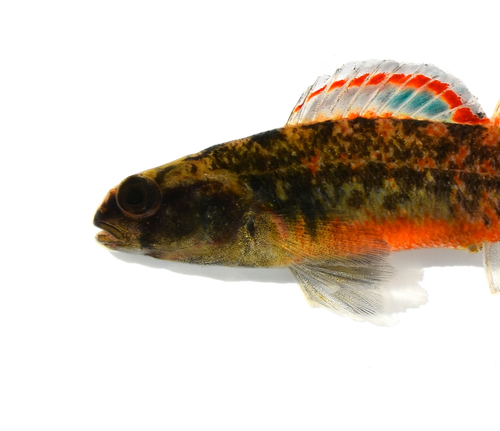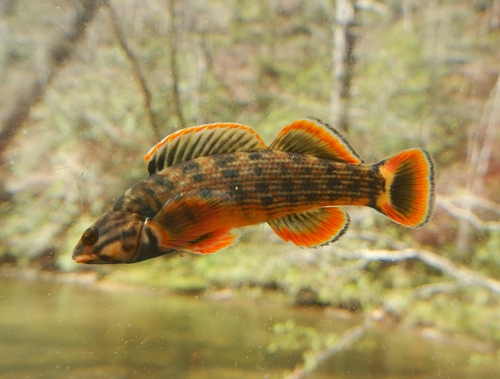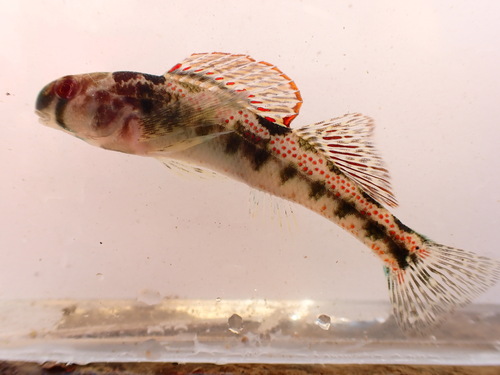
About Etheostoma atripinne (Jordan, 1877)
Taxonomic Classification
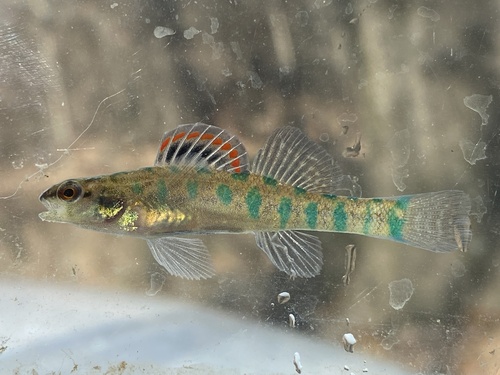
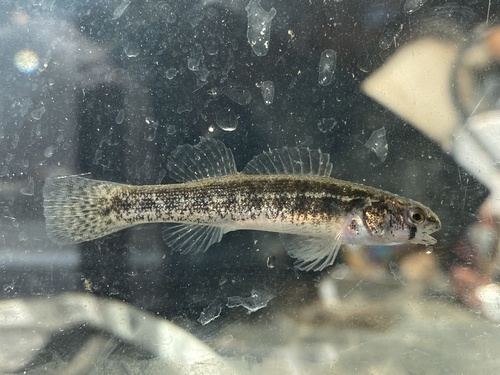
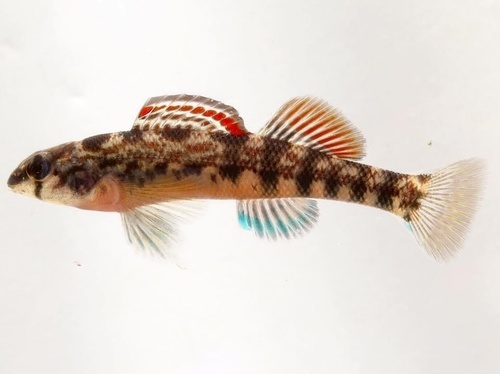
The Cumberland snubnose darter, scientifically named Etheostoma atripinne, is a species of freshwater ray-finned darter. It belongs to the subfamily Etheostomatinae, which is part of the family Percidae — a group that also includes perches, ruffes, and pikeperches.
General Distribution
This species occurs in the middle Cumberland River drainage across Tennessee, Kentucky, Virginia, North Carolina, Georgia, and Alabama. It is not present in river reaches above the Big South Fork, is rare in North Carolina, and does not occur in the western tributaries of the Tennessee River.
Ecological Research Status
Research on the ecology of E. atripinne is not extensive. What is known is that this species is usually found in small to medium freshwater streams, in gravel riffle areas where their eggs can attach to the substrate and remain unguarded.
Depth Classification
E. atripinne occurs across a wide range of depths in its habitat, so it is classified as benthopelagic.
Conservation Status
While its global conservation status is secure, the American Fisheries Society lists this species as "Special Concern".
Distribution Specificity
Like many other darter species, the geographic distribution of E. atripinne is quite narrow and localized. Populations found in Virginia, North Carolina, Georgia, and Alabama generally represent the outermost edges of the species' range, with observed low population densities in these areas.
Historical Distribution
Historically, the subspecies E. s. atripinne occurred in the Little South Fork of the Cumberland River.
Habitat Preference
The Cumberland snubnose darter inhabits flowing, rocky pools and adjacent riffles of small clear-water creeks with gravel or rubble-strewn bedrock bottoms, as well as small to medium rivers where it stays in shallow, gravel-bedded sections of riffles.
Substrate Importance
This type of substrate is critically important because the species' eggs attach to it. Eggs do not attach well in silted areas, so the species generally avoids these habitats.
Spawning Conditions
Spawning has been observed in streams with water temperatures ranging from 11 to 18 °C (52 to 64 °F), and the species prefers relatively neutral to slightly alkaline pH.
Natural Predators
The natural predators of Cumberland snubnose darters are large piscivorous freshwater fish, specifically including Micropterus dolomieu.
Feeding Guild
Both immature and adult Cumberland snubnose darters are invertivorous.
Primary Diet Component
An analysis of stomach contents from 45 individuals sorted into four size classes found that midge larvae from the family Chironomidae make up the bulk of the species' diet. Depending on individual size, midge larvae were present in 80% to 100% of the examined stomachs.
Additional Prey Items
Mayfly nymphs, caddisfly larvae, copepods, and cladocerans were also commonly found in stomach contents.
Interspecific Competition
Competition with other darter species is intense, because dietary overlap between species is relatively high.
Prey Selectivity
Selectivity for prey occurs at the prey genus and species level, but not at the family level.
Feeding Seasonality
Food consumption is highest in April, which aligns with the species' spawning peak. Consumption is much lower during months with extreme temperatures and decreased activity, such as January and July.