About Perca flavescens (Mitchill, 1814)
Nomenclature
This is the yellow perch, with the scientific name Perca flavescens (Mitchill, 1814).
Body Shape & Snout
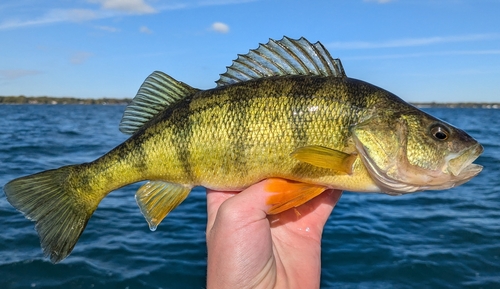
Yellow perch have an elongate, laterally compressed body, a subterminal mouth, and a relatively long but blunt snout that is shorter than the lower jaw.
Teeth & Scales
They have 800 fine teeth, and their rough skin comes from their ctenoid scales.
Dorsal Fin Structure
Like most perches, yellow perch have two separate dorsal fins: the first (anterior) dorsal fin holds 12–14 spines, while the second has 2–3 spines at its anterior followed by 12–13 soft rays.
Anal Fin Structure
The anal fin has 2 spines and 7–8 soft rays.
Other Body Fin Characteristics
The tips of the opercula are spined, the pelvic fins sit close together, the homocercal caudal fin is forked, and individuals have 7 or 8 branchiostegal rays.
Upper Body Base Color
The upper head and body ranges in color from bright green to olive or golden brown.
Flank Coloration & Markings
This upper body color extends onto the flanks to form 6–8 vertical bars over a yellow or yellowish green background.
First Dorsal Fin Blotch
There is normally a blackish blotch on the membrane of the first dorsal fin, between the rearmost 3 or 4 spines.
Fin Color & Spawning Males
The dorsal and caudal fins range in color from yellow to green, while the anal and pelvic fins can be yellow through silvery white; during spawning season, males develop prominent red or yellow coloring on their lower fins.
Ventral & Pectoral Fin Color
The pectoral fins are transparent and amber, and the ventral part of the body is white or yellow.
Juvenile Coloration
Juvenile yellow perch are paler, and can have an almost whitish background color.
Size & Weight
The maximum recorded total length of yellow perch is 50 centimetres (20 in), though most individuals reach around 19.1 centimetres (7.5 in), and the maximum published weight is 1.9 kilograms (4.2 lb).
Native North American Range Overview
Yellow perch are native to North American tributaries of the Atlantic Ocean and Hudson Bay, particularly the Great Lakes–St. Lawrence River and Mississippi River basins.
Native Canadian Range
In Canada, its native range covers all the Great Lakes, extends from Nova Scotia to the Prairie provinces, and reaches north to the Mackenzie River; it is also common in Great Slave Lake.
Native US Range
In the United States, its native range extends south into Ohio and Illinois, covers most of the northeastern United States, and includes the Atlantic Slope basin extending south to the Savannah River; its native distribution was shaped by postglacial melt from the Mississippi River.
Florida Native Population
There is also a small, likely native population in the Dead Lakes region of Florida's Apalachicola River system.
Introduction Purposes
Yellow perch have been widely introduced for sport and commercial fishing, and to create a forage base for bass and walleye.
Introduction Vectors
Most introductions were carried out by the U.S. Fish Commission in the late 19th and early 20th centuries, but unauthorized introductions have also likely happened via illegal releases, dispersal through connected waterways, and use as live bait.
Current US Range
Currently in the United States, the combined native and introduced range extends from northern Missouri to western Pennsylvania to South Carolina and north to Maine, with introduced populations in the northwest and southwest parts of the country; the species has been extirpated in Arkansas.
Canadian Introductions
Introductions in Canada have been less intense than in the United States.
British Columbia Range
It was originally limited to lakes in the Peace River drainage of British Columbia, but has since expanded to other nearby border areas; a population in Swan Lake of the Peace River drainage may be indigenous.
Asian Introductions
Yellow perch have also been introduced to China and Japan.
General Habitat Types
Yellow perch are most commonly found in the littoral zones of both large and small lakes, but they also live in slow-moving rivers and streams, brackish waters, and ponds.
Anthropogenic Habitats
Due to human activity, they are now found in many man-made lakes, reservoirs, and river impoundments.
Preferred Lake Habitat
They are most abundant in both warm and cool lakes, and thrive in smaller lakes where they can become the dominant species unless controlled by predation.
Diet Drivers
The diet of yellow perch is primarily determined by age and body size.
Larval Diet
Young and larval yellow perch feed mainly on zooplankton.
Juvenile Diet
By one year of age, they switch to feeding on macroinvertebrates such as midges and mosquitoes.
Adult Diet
Large adult yellow perch eat invertebrates, fish eggs, crayfish, mysid shrimp, and juvenile fish.
Piscivory & Cannibalism
In some cases, they are predominantly piscivorous and even cannibalistic.
Adult Fish Prey Proportion
Around 20% of the diet of yellow perch weighing over 32 g (1.1 oz) is made up of small fish.
Feeding Patterns
Yellow perch feed most heavily just before dark, and their average daily consumption equals 1.4% of their body weight.
Microhabitat Preference
Their microhabitat is typically along shorelines among reeds, aquatic weeds, docks, and other structures.
Vegetation Association & Substrate Preference
They reach their highest densities in aquatic vegetation, as they naturally form schools, and they also prefer small, weed-filled water bodies with muck, gravel, or sand bottoms.
Unfavorable Habitats
They are less abundant in deep, clear open water or unproductive lakes.
River Habitat Use
Within rivers, they only occur in pools, slack water, and moderately vegetated habitat.
Summer Habitat Use
They inhabit inshore surface waters during the summer.
Fish Predators Overview
Almost all cool- to warm-water predatory fish species, including northern pike, muskellunge, bass, sunfish, crappie, walleye, trout, and even other yellow perch, prey on yellow perch.
Walleye Predation
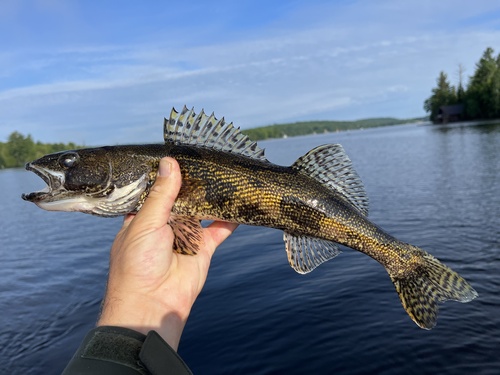
They are the primary prey of walleye (Sander vitreus), and walleye consume 58% of age zero and 47% of age one yellow perch in northern lakes.
Largemouth Bass Predation Influence
In shallow natural lakes, however, largemouth bass (Micropterus salmoides) may be the most influential species in shaping the quality of yellow perch populations.
Sandhill Lakes Population Drivers
In Nebraska's Sandhill lakes, the mean weight and quality of yellow perch is not linked to invertebrate abundance, but is linked to the abundance of largemouth bass.
Panfish Population Factors
The three main factors that influence the quality of panfish populations like yellow perch are predators, prey, and the environment.
Avian Predation Overview
In eastern North America, yellow perch are an extremely important food source for birds, particularly double-crested cormorants, which specifically target them as primary prey.
Other Avian Predators
Other birds that prey on yellow perch include eagles, herring gulls, hawks, diving ducks, kingfishers, herons, mergansers, loons, and white pelicans.
Cormorant Predation Rate
High estimates show that cormorants can consume up to 29% of the age-three yellow perch population.
Predation Escape Adaptation
Yellow perch can effectively escape predation from lake trout and other native fishes during the summer, likely due to their high thermal tolerance.
Activity Periods
Yellow perch are normally active during the day and inactive at night, except during spawning when they are active both day and night.
Schooling Behavior Basics
They most often form schools.
Schooling Light Dependence
Their vision is required for schooling: schools break up at dusk and reform at dawn.
School Size & Structure
Schools typically hold 50 to 200 fish, arranged by age and size into a spindle shape.
Age-Related Schooling Differences
Younger yellow perch school more often than older, larger fish, which occasionally travel alone.
Sex-Specific Schooling
Males and females often form separate schools.
Movement Patterns
Some yellow perch migrate, but only over short local distances.
Anadromy
They have also been observed to live a semianadromous life.
Swimming Ability
Yellow perch cannot accelerate quickly, and are relatively poor swimmers.
Swimming Speed
The fastest recorded speed for a school of yellow perch is 54 cm/s (12.08 mph), and individual fish swim at less than half that speed.
Parasites & Diseases
Parasites and diseases that affect yellow perch include the epizootic bacterium Flavobacterium columnare, the red worm Eustrongylides tubifex, myxozoan cnidarians including the brain parasite Myxobolus neurophilus, the broad tapeworm Diphyllobothrium latum, and parasitic copepods of the genus Ergasilus.