About Eremophila glabra (R.Br.) Ostenf.
Scientific Name and Growth Habit
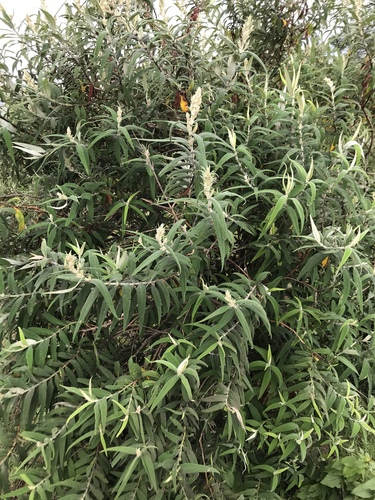
Eremophila glabra (R.Br.) Ostenf. is a shrub that grows between 0.1 and 3 meters (0.3 to 10 feet) in height, and can be either prostrate or erect. Its leaves are arranged alternately along stems, and may be crowded or sparse.
Leaf Shape and Dimensions
Leaves are most commonly lance-shaped, but can also be linear or egg-shaped, measuring 7.5 to 61 millimeters (0.3 to 2 inches) long and 0.8 to 18 millimeters (0.03 to 0.7 inches) wide. Leaf tips are pointed, and leaf bases taper gradually toward the stem.
Leaf and Stem Surface Features
Both leaves and stems are covered with small, raised glands.
Flower Arrangement and Stalks
Flowers grow singly or in pairs in leaf axils, on stalks 3 to 10 millimeters (0.1 to 0.4 inches) long.
Flower Color
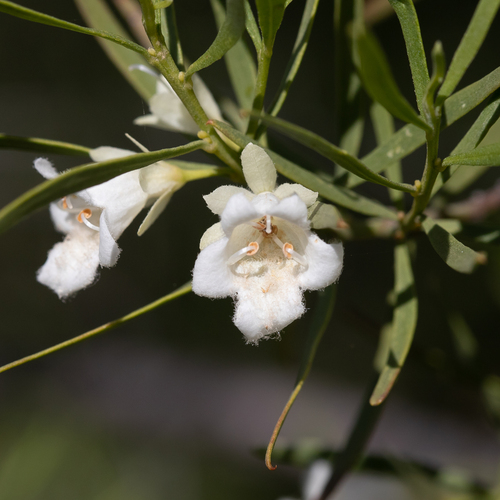
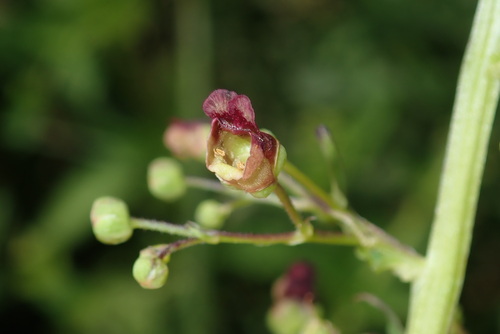
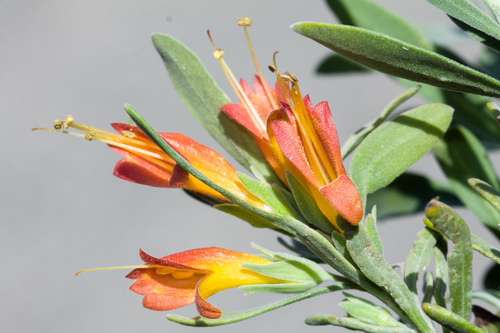
They may be red, orange, yellow, or yellowish green, and do not have spots.
Sepal Characteristics
There are 5 sepals that range from narrow egg-shaped to triangular, and differ slightly in length.
Petal Structure
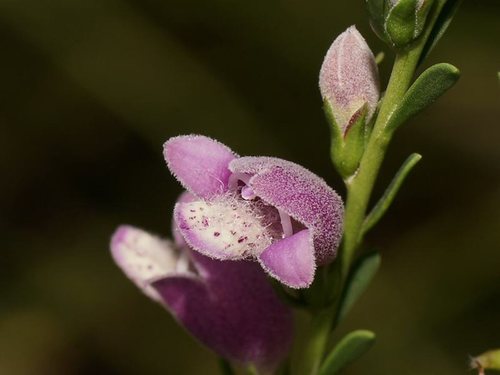
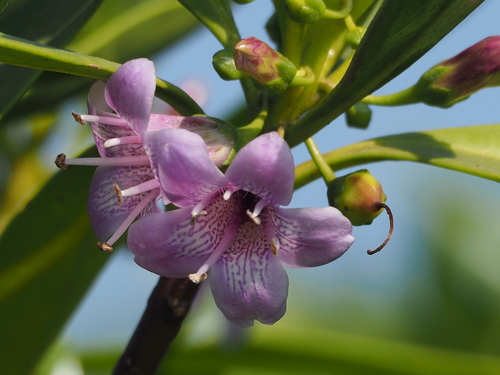
The colored petals measure 20 to 30 millimeters (0.8 to 1 inch) long, and are joined into a tube ending in 5 lobes. The upper two lobes are pointed and usually close together, while the lower lip is blunt and curves backwards.
Stamen Features
Four stamens extend past the end of the petals.
Flowering Period and Fruiting
Flowering occurs between early autumn and summer, which corresponds to March to December in Australia, and is followed by fruit.
Fruit Characteristics
Fruits are oval to nearly spherical, around 4 to 9 millimeters (0.2 to 0.4 inches) in diameter, hairless, and can be dry or fleshy, and dark brown.
Distribution Range
This eremophila species is found across all mainland states of Australia.
Subspecies glabra Habitat
Subspecies glabra is the most widely distributed, growing in a wide range of soils and vegetation associations, but only occurs in the continent's drier areas.
Common Name and Morphological Variability
Common name tar bush, this species is one of the most variable in the genus Eremophila; using multiple different forms in a single garden can give the impression of many distinct species.
Garden Maintenance Requirements
Most forms require little maintenance beyond occasional watering and light pruning.
Propagation Methods
Propagating this species from seed is difficult, but cuttings root easily and retain the characteristics of the parent plant.
Soil and Light Preferences
Eremophila glabra grows well in most soils and positions, ranging from full sun to full shade.
Environmental Tolerance
Most forms are drought tolerant and survive most frosts, though a few forms with hairy leaves cannot tolerate high humidity.
Horticultural Popularity and Cultivars
It is popular in native Australian gardens, and several cultivars have been developed. Two commercially available cultivars are the yellow-flowered prostrate form 'Kalbarri Carpet', and 'Murchison Magic', a silvery-leaved form with red flowers.