About Eremophila mitchellii Benth.
Taxon Identity
Eremophila mitchellii Benth. is a glabrous large shrub with a few main stems, or a small tree.
Height
It sometimes reaches a height of 10 m (30 ft), though it more commonly grows between 2 and 6 m (7 to 20 ft) tall.
Bark Characteristics
It has light grey bark that often flakes into small pieces, which sometimes curl at the edges.
Foliage Resin Properties
Its branches and leaves are glabrous, and some plant parts are often sticky due to the presence of resin.
Leaf Aroma
Leaves are aromatic when crushed.
Leaf Arrangement and Shape
Leaves are arranged alternately along the branches, and are linear to lance-shaped.
Leaf Size and Features
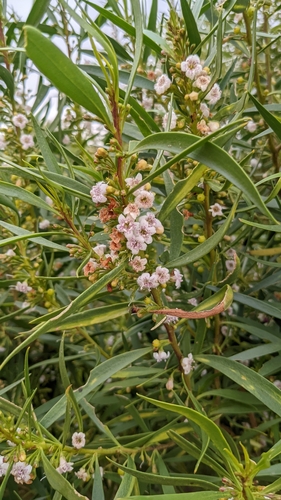
Most leaves are 24–55 mm (0.9–2 in) long and 2–5.5 mm (0.08–0.2 in) wide, slightly sticky, with a distinct mid-vein on the lower surface, and often have a hooked tip.
Flower Stalks
Flowers are borne in groups of 2 or 3 in leaf axils, on glabrous, sticky stalks 4.5–7 mm (0.2–0.3 in) long.
Sepal Characteristics
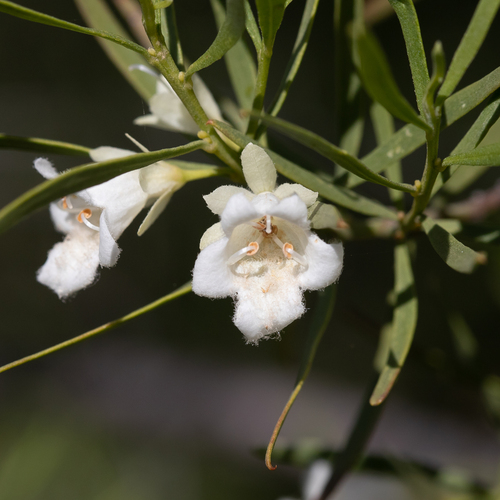
There are 5 white to cream-coloured, sometimes pinkish sepals, which are lance-shaped with a rounded end and mostly 4–9.5 mm (0.2–0.4 in) long.
Petal Structure
Petals are 10–18 mm (0.4–0.7 in) long and joined at their lower end to form a tube.
Petal Tube Coloration
The petal tube is usually white or cream-coloured, sometimes pale pink, and has spots inside the tube.
Petal Tube Hairiness
The petal tube is mostly glabrous, except the inside of the tube which is filled with long soft hairs.
Stamen Positioning
Two of the stamens are fully enclosed in the tube, while the other two sometimes extend slightly past the end of the tube.
Flowering Period
Flowering occurs mainly from September to November, and sometimes starts earlier.
Fruit Characteristics
Flowering is followed by the development of oval-shaped fruits, which are usually 4–7 mm (0.2–0.3 in) long and have a crusty covering.
Common Name and Distribution
This species, commonly known as false sandalwood, is found west of the Great Dividing Range and north of Hillston in New South Wales, and in eastern Queensland, where it grows in a range of soils and is common in most types of woodland.
Invasive Status
This species invades pasture land in New South Wales and Queensland, and its cultivation is prohibited in Western Australia.
Regeneration and Spread
The plant quickly regrows from roots remaining in the ground after clearing, and spreads rapidly from seeds to invade new areas.
Biological Control Agent
Native scale insects from the genus Pulvinaria (family Coccidae, order Hemiptera) have been shown to be able to kill Eremophila mitchellii, but these insects need to be physically applied to the plant.
Aboriginal Medicinal Uses
Aboriginal people used false sandalwood to treat rheumatism, and used the smoke from burning its leaves for general medicinal purposes.
Forage Uses
Joseph Maiden's 1889 book The Useful Native Plants of Australia records that the leaves of this species are eaten by stock, and that the seeds of several species of this genus are eaten by emus.