About Scrophularia umbrosa Dumort.
Species Nomenclature and Growth Form
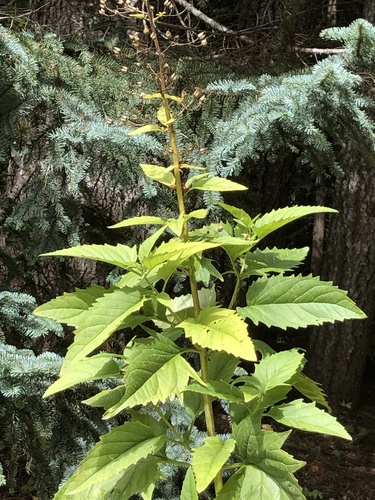
Scrophularia umbrosa Dumort., commonly known as green figwort, is a perennial monoecious hemicryptophyte herb. It lacks a basal rosette, grows from a short rhizome, and reaches around 100 cm in height.
Overall Plant Color and Pubescence
The entire plant is a pale green, sometimes tinted with brown or purple, and is completely glabrous (hairless).
Stem Characteristics
Its stem is square in cross-section, with broad wings along the angles, and is typically quite weak, so the plant sprawls over surrounding vegetation instead of growing upright on its own.
Leaf Arrangement and Petiole
Leaves grow in opposite pairs on petioles up to 15 mm long.
Leaf Blade Shape and Size
Their blades are ovate to oblong, measuring about 12 × 4 cm, with a fairly pointed tip and a rounded (not heart-shaped) base.
Leaf Margin Trait
Leaf margins are more sharply serrated than those of the related water figwort.
Flowering Period
Flowering occurs around July in northern Europe.
Inflorescence Structure
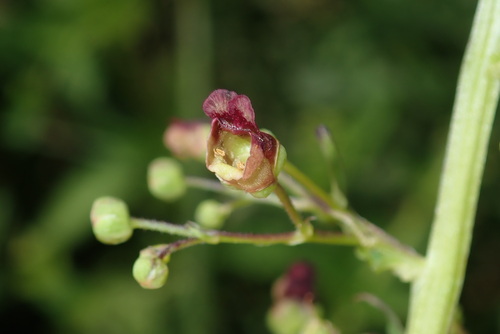
The inflorescence is a panicle that extends from the main stem, made up of opposite pairs of lax cymes growing from the axils of bracts (upper leaves). Each flower sits on a 5 mm-long pedicel, the same length as the flower itself.
Corolla and Calyx Structure
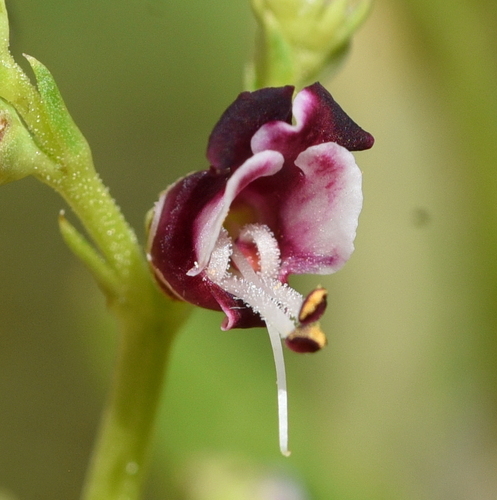
Both the calyx and corolla are 5-lobed; corolla lobes are grouped into two lips: the upper lip formed from two lobes, and the lower lip from the other three almost fully fused lobes.
Flower Reproductive Parts
Flowers are bisexual, with 4 fertile stamens and 1 sterile staminode that is distinctively 2-lobed. There is a single style ending in a capitate (blob-shaped) stigma.
Fruit and Seed Characteristics
When mature, the plant produces a round capsule 4–6 mm long, holding many tiny brown wrinkled seeds around 0.5 mm in diameter.
Species Similarity to Water Figwort
Green figwort is very similar to the much more common water figwort, which is why it was overlooked by botanists for a long time. Key differences between the two species include: water figwort sometimes has lobed leaves, blunter teeth on leaf margins, and an entire (non-bilobed) staminode, compared to the unlobed leaves, sharper serrations, and bilobed staminode of green figwort.
Native Distribution Range
Green figwort is native to Europe and western Asia, ranging north to the Baltic states and east as far as Xinjiang. It does not grow in Africa, and in Sweden it is classified as a recent introduction.
Non-Native Occurrence Records
It has no other recorded introductions outside its natural native range. There are old 19th century records of a casual figwort (either green or water figwort, sources disagree) in New York and Pennsylvania harbours, but the population did not persist.
British Distribution Centers
In Britain, green figwort is quite common in several distinct areas centered on major river basins, including the lower Severn in Worcestershire and neighbouring counties. The first confirmed British record is possibly from this area, in 1848, when J.H. Thompson found the species beside Sapey Brook.
Additional British Distribution Areas
Other distribution centers include the valleys of the River Yare in Norfolk, the Ribble in Yorkshire, the Eden in Cumbria, and the Tweed in Scotland.
Global and Regional Conservation Status
As of 2013, the global conservation status of this species is Least Concern, and it holds this status in Britain and France as well.
Irish Conservation Status
In Ireland, the species is much rarer: it is considered Near Threatened in the Republic of Ireland, and is protected under Schedule 8 of the Wildlife (Northern Ireland) Order in Northern Ireland. It is counted as an axiophyte in every British county where it occurs.
General Habitat Preferences
Green figwort grows on the edges of farmland ditches and small streams that run through woods, where it trails over other plants instead of growing upright. It can also be found in sedge swamps (such as those dominated by false fox-sedge) or in light woodland; in Britain it typically grows in slightly calcareous W8 ash woodland.
British Habitat Ellenberg Values
Its Ellenberg values in Britain are L = 7, F = 9, R = 7, N = 7, and S = 0, which place it in semi-open, very wet habitats with neutral pH, moderate fertility, and no salt.
Associated Plant Species
It often grows alongside water figwort, wood clubrush, yellow loosestrife, and hemlock water-dropwort.
Fungal Pathogen
Plants are frequently infected by the rust fungus Uromyces scrophulariae (DC.) Fuckel (1870), which causes marks and distortions at the base of the stem.
British Invertebrate Herbivores
In Britain, the beetles Longitarsus agilis and L. nigrofasciatus, and the sawfly Tenthredo scrophulariae feed on the leaves, while the weevil Cionus hortulanus feeds on both fruits and flowers. The small fly Contarinia scrophulariae forms galls in the plant's flower buds.
European Pest Records
Many more insect pests are recorded on this species across the rest of Europe.
Toxicity Risk
There is no specific information available about the toxicity of green figwort. However, the closely related water figwort has been reported to cause sickness in young cattle that eat it, so green figwort may carry the same risk.
Pollinators
Green figwort is pollinated by bees and wasps.