About Eremophila clarkei A.F.Oldfield & F.Muell.
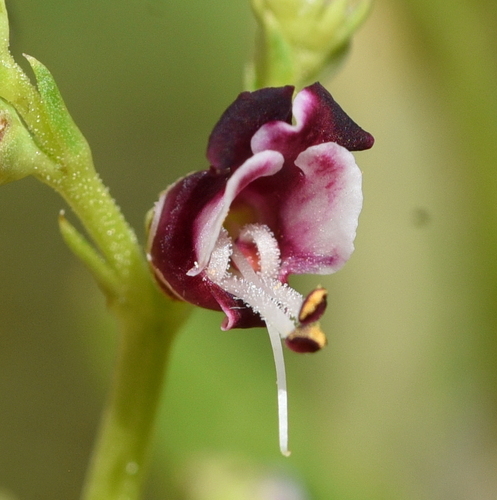
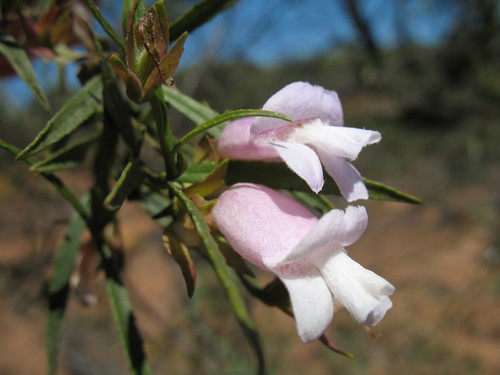
Eremophila clarkei is an erect shrub that grows between 0.6 m (2 ft) and 4 m (10 ft) in height and width. Its branches are flattened near the tip, glabrous, and very sticky from present resin. The dark green leaves are widely spaced, arranged alternately along the stems, and linear to narrow elliptic in shape, mostly 16–45 mm (0.6–2 in) long and 3–6.5 mm (0.1–0.3 in) wide. Leaf margins can be smooth, wavy or toothed. Flowers are borne singly in leaf axils on an S-shaped, flattened stalk that is 15–27 mm (0.6–1 in) long. There are 5 linear, green to purple sepals that differ slightly in length, measuring 10–15.5 mm (0.4–0.6 in) long and lance-shaped. Petals are 20–40 mm (0.8–2 in) long and joined at their lower end to form a tube. The petal tube can be white, pink, mauve or purple. The outside of the tube and petal lobes are hairy, the inner surface of the lobes is glabrous, and the inside of the tube is filled with woolly hairs. The lowest petal lobe covers the opening of the petal tube. Flowering occurs from March to October, and is followed by dry, woody, oval to cone-shaped fruits that are 5.5–9 mm (0.2–0.4 in) long. Commonly called turpentine bush, this species is widespread and common in the Eremaean and South-West botanical provinces of Western Australia, where it grows in sand or clay soils. It also occurs in the extreme south west of the Northern Territory, where it is classified as near threatened, and in South Australia. Its occurrence in South Australia was first recorded in 1977. In horticulture, turpentine bush is drought hardy and moderately frost hardy. It is most easily propagated by grafting onto Myoporum species, grows well in a wide range of soils, and does best in a sunny position.