About Psephotus haematonotus (Gould, 1838)
Scientific Classification & Basic Size
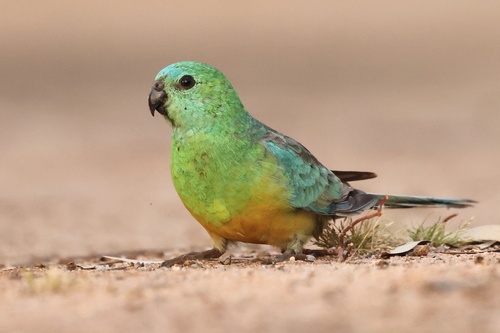
Red-rumped parrots (scientific name Psephotus haematonotus (Gould, 1838)) are slim, moderate-sized parrots that reach approximately 28 cm (11 in) in length and weigh between 45 and 77 grams.
Adult Male Plumage
Adult males have primarily bright emerald-green plumage with yellow underparts. Their mantle, upper back, and scapulars are dull green-blue, while their lower back and rump are brick-red. They have blue highlights on their wings and upper back, and bright yellow patches on their shoulders, and their irises are light brown.
Adult Female Plumage
Adult females have less vibrant plumage, with pale olive underparts, a dull olive-green mantle, upper back, and scapulars, and lime-green lower back and rump. Their irises are light grey-brown, and the characteristic red rump is only present in males.
Juvenile Male Plumage
Juvenile males have plumage that resembles adult females, but they have red rumps and light blue-green faces.
Bill Coloration
Adults of both sexes have grey bills that are darker in males, while immature birds have brown to yellow-brown bills.
Wing & Flight Feather Traits
Both sexes have dark-grey flight feathers and dark blue underwing coverts, with visible blue outer wing tips during flight. An off-white underwing bar is present in females of all ages, and is retained by juvenile and immature males. This underwing bar is absent in males that are approximately 2 years of age or older.
Moulting Pattern
A few months after fledging, juveniles moult into adult-like plumage while keeping their original flight and tail feathers. Moulting into full adult plumage begins when the birds are around 1 year old.
Similar Species Distinction
This species is similar in appearance to the closely related mulga parrot (Psephotellus varius), which can be distinguished by its overall color difference, specifically the yellow band above the bill, red patch on the nape, and smaller, darker red patch at the base of the tail found in both male and female mulga parrots.
General Habitat & Elevation Range
Red-rumped parrots are widely distributed across lightly timbered plains, open woodland, and other grassy habitats in south-eastern Australia, occurring below 1,000 metres (3,300 ft) elevation.
Geographic Distribution
Their range covers most of New South Wales and Victoria, as well as parts of southern Queensland and eastern South Australia. They avoid coastal areas and wetter, more heavily wooded regions.
Subspecies Distribution
The subspecies caeruleus is only found in far inland areas around the Queensland-South Australia border.
Modified Habitat Adaptation
Red-rumped parrots have adapted well to some urban and suburban areas, and can also be found in farmland, on roadside verges, and in parks and gardens.