About Aprosmictus erythropterus (Gmelin, 1788)
Scientific Classification and Size
The red-winged parrot, scientific name Aprosmictus erythropterus (Gmelin, 1788), is typically 30 to 33 cm (12 to 13 in) in length.
Shared Physical Traits
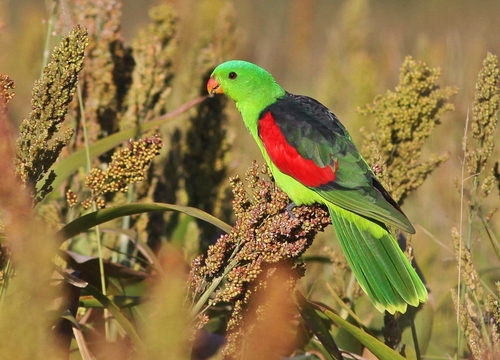
Both sexes have bright red wings and a bright green body.
Male Plumage and Features
Male red-winged parrots have a black nape, lower blue back and rump, a yellow-tipped tail, an orange bill and grey feet.
Female Plumage and Features
Female red-winged parrots have a yellowish-green body, with red and pink trimmings on their wings. Other distinguishing features of females are dark irises and a light blue lower back.
Juvenile Appearance
Juveniles have orange/yellow beaks and pale brown irises, and otherwise resemble females in colouration.
Plumage Maturation Timing
Males develop adult plumage at around two years of age, while females develop adult plumage at around one and a half years of age.
Australian Distribution Range
Their range extends from the Pilbara, Western Australia to Cape York Peninsula, Queensland, where they can be seen across almost all of Queensland, and reaches as far south as northeast South Australia.
New Guinea Occurrence
They are occasionally spotted in south New Guinea.
Habitat Types
These birds inhabit riverine forests, forest edges, acacia scrub, savanna, mangroves, and farmlands.
Social Grouping
They are often seen in pairs or flocks near water.
Diet Composition
Their diet typically consists of seeds from eucalyptus and acacia, berries, flowers, and insects.
Vocalization Characteristics
Their calls are described as ching-ching, chink-chink, or thin screeching.