About Pyrrhura amazonum Hellmayr, 1906
Taxon Authority
Pyrrhura amazonum Hellmayr, 1906 has a total length of approximately 22 cm, which is 8 and 3/4 inches.
Body Shape
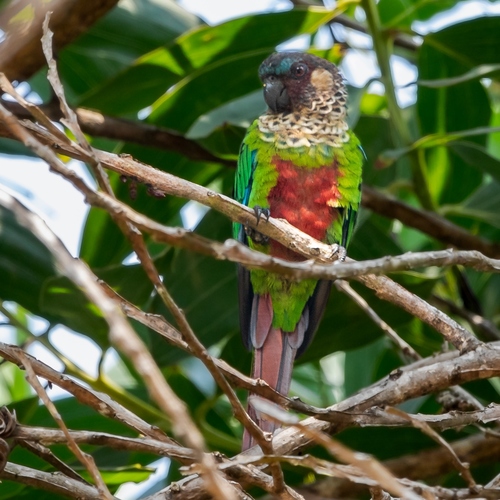
Like other members of the Pyrrhura picta complex, it is a long-tailed, primarily green parakeet.
Coloration of Ventrum and Tail
It has dark red coloration on its belly, rump, and tail-tip, and the entire tail is dark red when viewed from below.
Coloration of Auriculars and Remiges
It features a whitish or dull buff patch on its auriculars, and bluish remiges.
Facial Coloration
Its cheeks and ocular region are dark maroon.
Nominate Subspecies Markings
The nominate subspecies, P. a. amazonum, has a narrow blue band across the forehead and pale grey scaling on the chest.
Forecrown Color of Other Subspecies
The other two subspecies, P. a. snethlageae and P. a. lucida, have little to no blue on their forecrown.
Chest Markings of Non-Nominate Subspecies
Uniquely among the P. picta complex, their chests are overall pale, with relatively narrow, dark pointed markings.
Size of P. a. lucida
P. a. lucida is slightly smaller and paler than P. a. snethlageae.
Eye-Ring Variation in P. a. snethlageae
Some individuals of P. a. snethlageae have a yellowish eye-ring, though the cause of this variation is still unknown.
Typical Eye-Ring Color
Most P. a. snethlageae have a dark grey eye-ring, which matches the eye-ring color of all other subspecies.
Leg Color
All subspecies of Pyrrhura amazonum have dark greyish legs.
Distribution and Habitat
This species is found only in Brazil and Bolivia, where it inhabits tropical humid lowland forest and adjacent habitats.
Social Behavior
It is a social species, typically observed in pairs or groups.
Feeding and Nesting
It feeds on fruits, seeds, and flowers, and places its nests in tree cavities.
Conservation Status
It is fairly common across most of its range, and is found in several protected areas.
Occurrence in Protected Areas
For example, the nominate P. a. amazonum occurs in Amazônia National Park, Pará, Brazil, while P. a. lucida occurs in Cristalino State Park, Mato Grosso, Brazil.