About Endostemon obtusifolius (E.Mey.) N.E.Br.
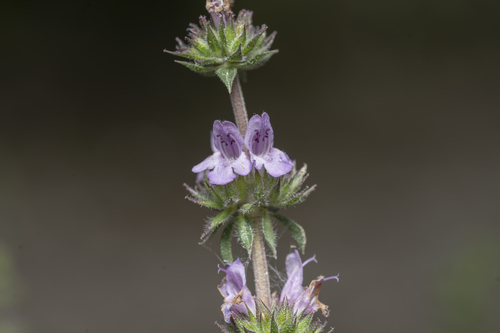
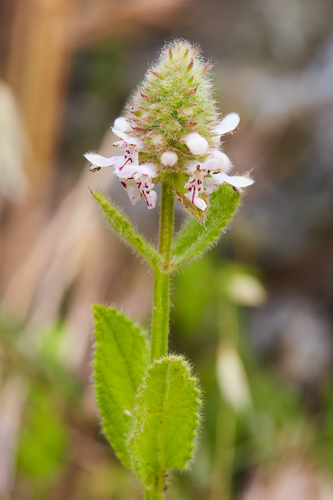
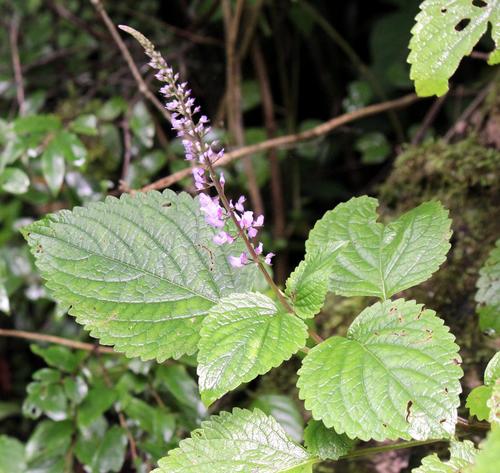
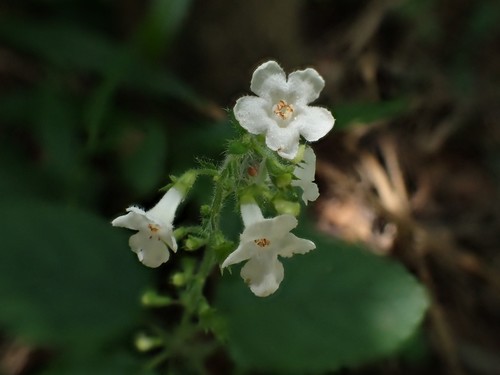
Endostemon obtusifolius (E.Mey.) N.E.Br. is a much-branched plant that grows as a straggling to erect herb or soft shrub, reaching 0.5–1.5 m (1 ft 8 in – 4 ft 11 in) in height, and has hispid stems. Its leaves grow on stalks, with broadly ovate leaf blades 15–40 mm (0.59–1.57 in) long. The upper leaf surface is thinly hairy, while the lower leaf surface is more coarsely hispid and has distinct reticulate venation. Leaf tips are blunt to rounded, leaf bases are obtuse to truncate, and leaf margins are shallowly crenate to serrate. The leaf petioles measure 5–15 mm (0.20–0.59 in) long. This species produces inflorescences that are lax racemes 150–300 mm (5.9–11.8 in) long, made up of many well-spaced whorls. Each whorl holds two to eight flowers, and occasionally bears up to twelve flowers. Its bracts are ovate and tapering, 4–5 mm (0.16–0.20 in) long. The calyx is hispid, measuring about 3.5 mm (0.14 in) long when the plant is flowering, and enlarges to 6–7 mm (0.24–0.28 in) when the plant produces fruit. The corolla is white and measures about 5 mm (0.20 in) long. Endostemon obtusifolius flowers between November and May. In tropical eastern Africa, this species can be told apart from Endostemon villosus and Endostemon usambarensis by its shorter, white flowers. Endostemon obtusifolius grows at forest margins and along wooded streams in Angola, Eswatini, Malawi, Mozambique, Tanzania, Zambia, Zimbabwe, and South Africa. In South Africa, it occurs from the Soutpansberg to Barberton, through coastal and semi-coastal Kwazulu-Natal, and extends into the Eastern Cape.