About Lamium maculatum (L.) L.
Growth Habit
Lamium maculatum is a prostrate, spreading herbaceous perennial plant. This species shows high variation in leaf size and shape, hairiness, and flower color.
Height
On average, it grows between 20 and 80 centimeters (7.9 to 31.5 inches) in height. It has erect, hollow, pubescent stems that only branch at the base.
Leaf Dimensions
The soft hairy leaf blades measure roughly 2 to 10 centimeters (0.79 to 3.94 inches) long, with long petioles that are 2 to 4 centimeters (0.79 to 1.57 inches) long.
Leaf Characteristics
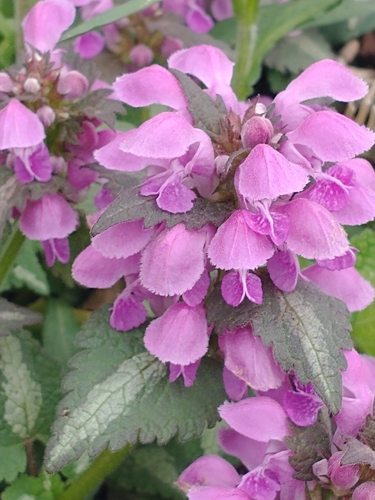
Leaves are sometimes spotted, which gives the species its Latin epithet maculatum, and have toothed edges. Leaf shape ranges from ovate-triangular to heart-shaped.
Inflorescence Structure
Inflorescences hold 2 to 8 hermaphrodite flowers, each 20 to 30 millimeters (0.79 to 1.18 inches) long. Flowers form in the leaf axils of the upper leaf pairs.
Flower Morphology
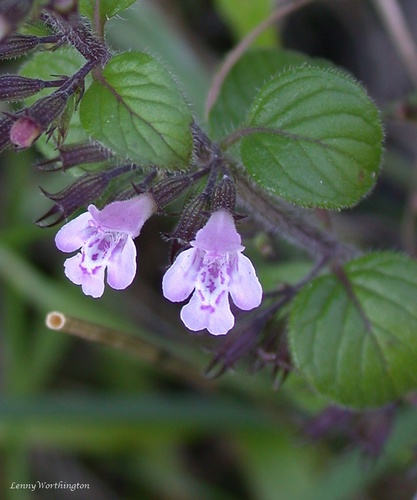
The upper lips of the flowers are helmet-shaped, and are usually pink or purplish, while the bilobate lower lips are whitish with purple dots. The stamens are located within the upper lip and produce orange pollen.
Flowering Period
The flowering period runs from April through November.
Seasonal Growth Patterns
This plant tends to grow taller in spring, and lies much flatter against the ground during colder weather. If exposed to light frost, L. maculatum will recover the following spring when it resumes its growth cycle.
Chemical Content
This plant is a source of lamenallenic acid, a rare fatty acid.
Habitat Range
Lamium maculatum grows across a wide range of habitats, from open grassland to woodland. It generally grows on moist, fertile soils at altitudes from 0 to 1,500 meters (0 to 4,921 feet) above sea level.
Cultivation Use
In cultivation, Lamium maculatum is valued as a groundcover for moist, shady areas. It can rapidly colonize an area, and may become invasive when growing in suitable conditions.
Cultivar Development
Numerous cultivars have been developed, mostly selected for their colored and variegated leaves. These cultivars include 'Album', a white-flowered form; 'Anne Greenaway', with leaves marbled in light green, dark green, chartreuse, and silver, and mauve-pink flowers; 'Aureum', which has yellow leaves; 'Beacon Silver', which has silver leaves; 'Cannon's Gold', which has gold leaves; 'Chequers', a vigorous cultivar with silver-striped leaves; 'Purple Dragon', which bears unusual purple snapdragon-type flowers multiple times a year, grows over bright silver foliage with a green edge, and reaches 4 to 8 inches (102 to 203 mm) tall when grown in shaded or partially shaded areas; 'Red Nancy', which has silver leaves with green margins; 'Roseum', which has leaves with a central silver stripe; 'Sterling Silver', which has silver leaves; and 'White Nancy'.