About Elagatis bipinnulata (Quoy & Gaimard, 1825)
Body Shape
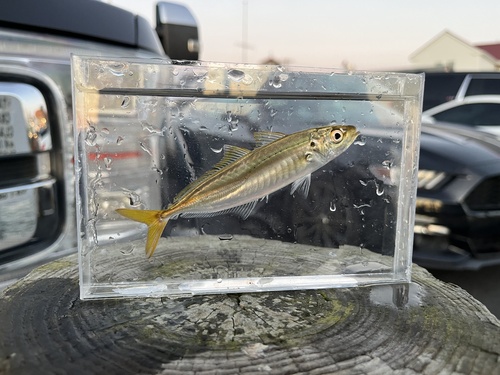
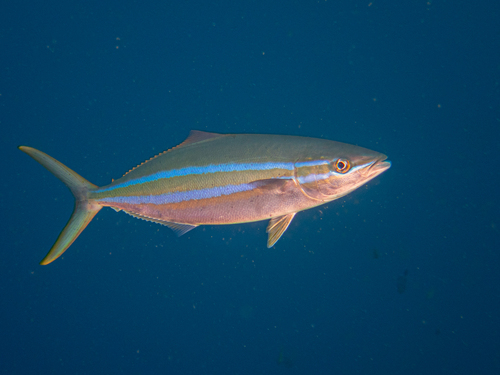
Elagatis bipinnulata, commonly called the rainbow runner, has a body shape that is unusual for the jack (carangid) family. Most jacks have deep, compressed bodies, but the rainbow runner has a subcylindrical, elongated, nearly fusiform body, with a long, pointed head and snout, and a tapered rear section before the caudal fin. Its eyes are relatively small, and its teeth are arranged in villiform bands on the jaws, with tiny teeth also present on the roof of the mouth and tongue.
Dorsal Fin Structure
The species has two dorsal fins: the long second dorsal fin has its posterior rays separated into a distinct finlet. The first dorsal fin has six spines (only around 4% of individuals are born with just five spines), while the second dorsal fin has one spine and 25 to 30 soft rays, with the last two soft rays forming the separate finlet.
Anal Fin Structure
The anal fin has one detached spine positioned ahead of the main fin; the main anal fin has one spine and 18 to 22 soft rays, with the last two rays also detached to form a finlet matching that of the dorsal fin. Both dorsal and anal fins are quite low, and the dorsal fin is much longer than the anal fin.
Paired Fin Structure
The pectoral fin is small for a carangid, is roughly the same length as the pelvic fin, is not falcate, and has 20 rays. The pelvic fin has one spine and five branched soft rays.
Caudal Fin Structure
The deeply forked caudal fin is highly distinctive, with 17 total caudal rays (9 dorsal and 8 ventral).
Lateral Line and Scales
The lateral line forms a slight arch in its anterior section, has no scutes, and holds approximately 100 scales. The scales covering the body and parts of the operculum, cheek, pectoral fins, pelvic fins, and caudal fins are ctenoid, and the species has 24 vertebrae.
Coloration
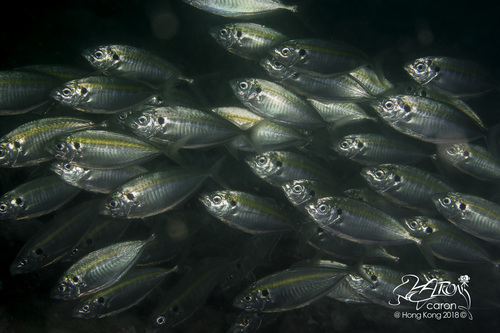
The rainbow runner gets its name from its striking coloration, which is often the easiest way to identify the species. The upper body is dark olive blue to green, fading to white on the underside. Two narrow, light blue to bluish white longitudinal stripes run along the sides, with a broader olive to yellow stripe between them.
Maximum Length
The species' maximum published length is debated: most sources place the confirmed maximum between 107 and 120 cm (42 and 47 in), while one source claims it can reach 180 cm (71 in).
Maximum Weight
The maximum confirmed weight is 46.2 kg, as recorded by the International Game Fish Association.
Global Distribution
The rainbow runner has a circumtropical distribution, living in tropical and some subtropical waters across the globe. In the Western Atlantic, it occurs from Massachusetts and Bermuda to northeastern Brazil, including the northern and southern Gulf of Mexico, the Bahamas, and the Greater and Lesser Antilles, and extends east to at least the Azores. It is widespread across the Pacific Ocean, but is slightly less abundant in parts of the Indian Ocean, and is rare or entirely absent from the Persian Gulf.
Mediterranean Occurrence
It is an occasional visitor to the Mediterranean Sea, most often as a Lessepsian migrant moving through the Suez Canal, and has not established permanent residence there unlike some other species. It is also found around the nearby Canary Islands, and may also enter the Mediterranean from the east via this route.
Depth Range
The rainbow runner is primarily a pelagic species that lives in the upper 164 m of the water column.
Habitat Types
It sometimes occurs near land around rock and coral reef systems, and also lives far offshore. It occasionally moves quite close to shore, and is known to occupy lagoons for short periods; juveniles have even been recorded in a Taiwanese estuary system.
Association with FADs
Like other carangids such as yellowtail kingfish, rainbow runners are easily attracted to floating buoy-type fish-attracting devices (FADs). They occupy an area around FADs extending up to 12 m deep and 10 m wide outside the device, treating FADs as stationary objects.
Sexual Maturity
Information on sexual maturity is only confirmed for female rainbow runners, which reach maturity at around 600 mm fork length; male maturity is estimated to fall between 600 and 650 mm fork length.
Spawning Periods
In the Atlantic, spawning occurs from spring through early autumn, but fish living in waters warmer than 27 °C spawn year-round. Even with year-round spawning, seasonal spawning peaks occur: Western Pacific populations have spawning peaks in May and December to January.
Reproductive Biology
The species is oviparous, producing pelagic eggs and larvae. Larval stages have been studied in detail, and diagnostic larval features include a supraoccipital crest and distinctive pigment and melanophore patterns.
Age and Growth
Growth of the species has also been studied, with estimated mean lengths at 1, 2, 3, 4, and 5 years of age being 30 cm, 46 cm, 59 cm, 69 cm, and 77 cm respectively.
Juvenile Migration
Juvenile migration patterns are poorly understood; only one migration route has been recorded, where juveniles move from equatorial spawning grounds to the coasts of Japan, often floating in currents beneath large Sargassum mats.