About Megalaspis cordyla (Linnaeus, 1758)
Size
The torpedo scad (Megalaspis cordyla) is a moderately large fish that reaches a maximum recorded length of 80 cm and weight of 4 kg, though it is more commonly found between 30 and 40 cm in length, and is rare at lengths over 80 cm.
General Body Form
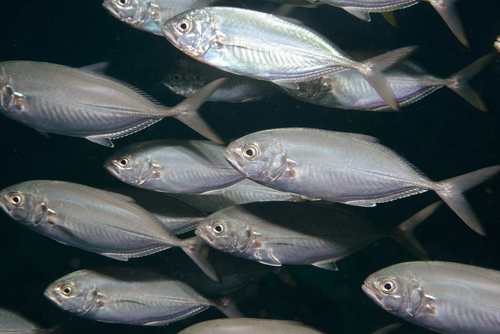
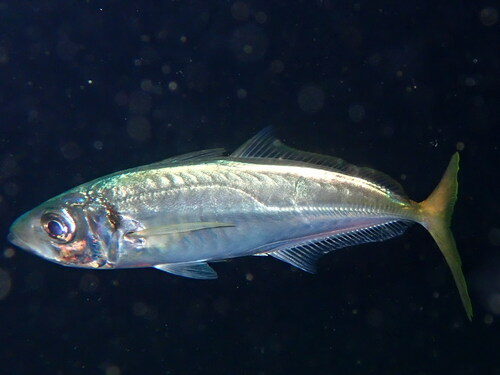
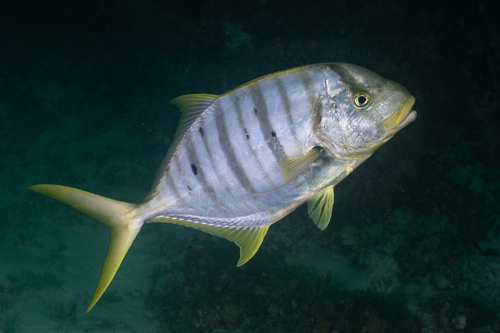
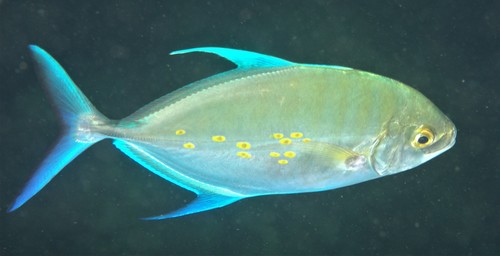
The species is often noted for its unusual body form, with superficial features similar to tunas, mackerels, and other carangids. Its body is elongate and subcylindrical, becoming highly compressed toward the tail and caudal fin, with a distinct median keel on the caudal peduncle. The dorsal and ventral profiles of the fish are nearly evenly convex, and the two profiles meet at the pointed snout.
Dorsal Fins
It has two separate dorsal fins: the first has 8 moderately high spines, and the second has a single spine followed by 18 to 20 soft rays.
Anal Fin
The anal fin has two anteriorly detached spines followed by a single spine attached to 16 or 17 soft rays. For both the dorsal and anal fins, the posterior 7 to 10 rays are detached and form a set of diagnostic finlets.
Pectoral Fin
The pectoral fin is strongly falcate, or scythe-shaped, and extends past the origin of the second dorsal fin.
Lateral Line
The lateral line is strongly arched over a short anterior section, with the intersection of the curved and straight sections falling vertically below the fourth or fifth spine of the first dorsal fin. The curved section of the lateral line holds 21 to 29 scales, while the straight section holds 51 to 59 very large scutes.
Scalation
A triangular patch of the breast lacks scales, extending to about one-third of the distance to the pectoral fin base.
Head Features
The eye has a well-developed adipose eyelid that nearly completely covers the eye. The upper jaw holds small villiform teeth, with some outer teeth moderately enlarged, while the lower jaw has a single row of small teeth.
Internal Anatomy
The species has 26 to 32 gill rakers and 24 vertebrae. The olfactory apparatus and hypothalamo-neurosecretory system of this species have been extensively described in Indian scientific literature. There is also a documented report of a heavily deformed individual from India that survived past maturity.
Coloration
Torpedo scad are bluish-grey to green on the upper body, fading to silvery white on the sides and belly. The dorsal and anal fins are pale to yellow, turning dusky at their outer edges. The pectoral and pelvic fins are also pale, with dusky upper halves, while the caudal fin is dark, particularly along its leading and trailing edges. A large black spot is present on the operculum.
Distribution Range
Torpedo scad are distributed across the tropical and subtropical waters of the Indian and west Pacific Oceans.
Western Indian Ocean Range
To the west, the species' range extends from the tip of South Africa north along the east African coastline to the Persian Gulf and Red Sea. The fish is commonly recorded from most Indian Ocean islands including the Maldives, Seychelles, and Madagascar.
Asian and Central Indo-Pacific Range
It is found along Indian and Asian coastlines, extending north to China and South Korea on the Asian mainland. It is abundant throughout the central Indo-Pacific and the Indonesian Archipelago, with its offshore range extending north to Taiwan and Japan.
Australian and Pacific Island Range
Around Australia, torpedo scad have been recorded as far south as Fremantle on the west coast and Sydney on the east coast. The species' range also extends to several western Pacific islands including Samoa, New Caledonia, and Tonga.
Habitat Preferences
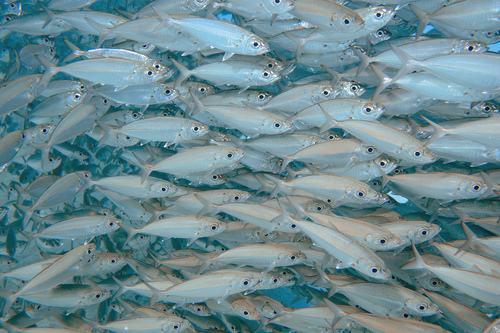
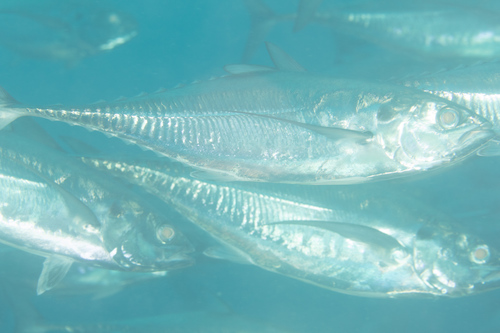
Torpedo scad is a pelagic schooling species found in both far offshore oceanic environments and more protected inshore environments. These fish are commonly found in the upper water column near the surface. They do not live in estuaries and appear to be intolerant of dirty or turbid waters. The species' range extends into more southern waters in summer, as warm water moves further down coastlines.
Research Context
Torpedo scad is an important commercial fishery species in parts of Asia, so a significant amount of research has been published on its biology and ecology. All this research is published in relatively obscure Indian journals and is unavailable to most institutions.
Diet Composition
Torpedo scad are predatory fish that consume both larger prey and filter feed on planktonic organisms. Larger prey items include a variety of fish and cephalopods such as squid and cuttlefish. Smaller food items are mostly crustaceans including shrimps, prawns, stomatopods, cladocerans, and crabs. Molluscs and gastropods are also reported to be minor components of the species' diet.
Diet Shifts and Predators
The species appears to shift its diet as it grows, but fish remain the dominant prey across all size classes. Documented predators of torpedo scad include species of drums and requiem sharks.
Sexual Maturity
Male and female torpedo scad reach sexual maturity at different lengths: females are mature by 22 cm and males by 26.4 cm. Other studies have reported similar length ranges, including 17 cm for males and 27 cm for females, as well as an average of 25 cm for both sexes.
Spawning and Early Life
Spawning has not been directly observed, but peaks in larval abundance are known to occur from March to July, with a peak in June in Indian waters. The eggs are pelagic, spherical, and transparent, with a yolk and a single oil globule. The larval stage has been extensively described, and the species has 24 myomeres.
Population and Fishery Research
Overall species growth has not been reported, but numerous morphometric studies comparing length to weight have been conducted on the species. Population structure in Indian waters has also been well studied, with the most recent research indicating a major recruitment event occurs between May and August. These studies inform fisheries regulations, which indicate the theoretical maximum yield is achieved when fish are only harvested once they reach 18 cm.