About Leuconotopicus fumigatus (d'Orbigny, 1840)
Size and Weight
The smoky-brown woodpecker (Leuconotopicus fumigatus) is about 18 cm (7.1 in) long and weighs 31 to 50 g (1.1 to 1.8 oz).
Adult Head Plumage Dimorphism
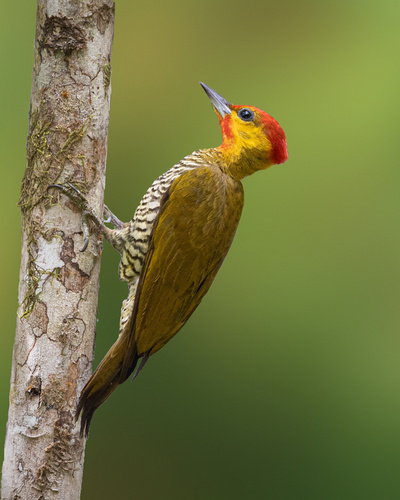
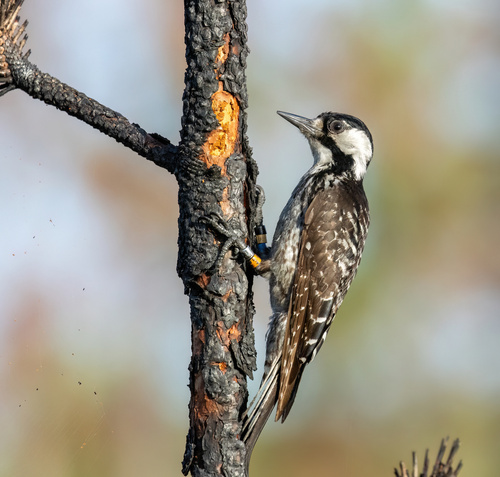
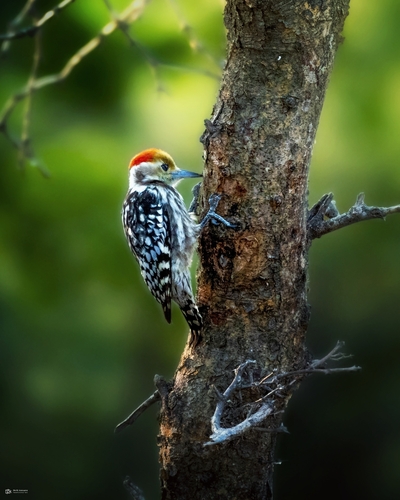
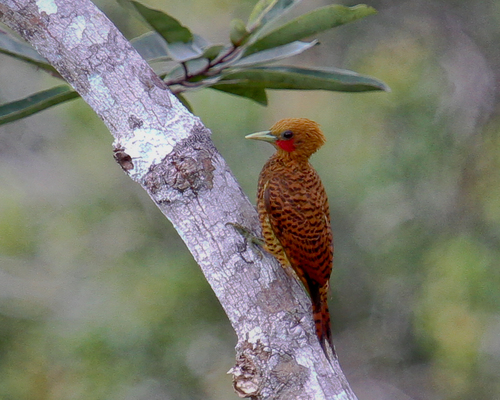
Males and females have identical plumage except for the coloration of their heads. Males are red from the forehead to the nape, with dark feather bases visible through the red. Females have dark brown with an olive tinge from the forehead to the nape, and occasionally have faint white speckles.
Nominate Subspecies Adult Facial Markings
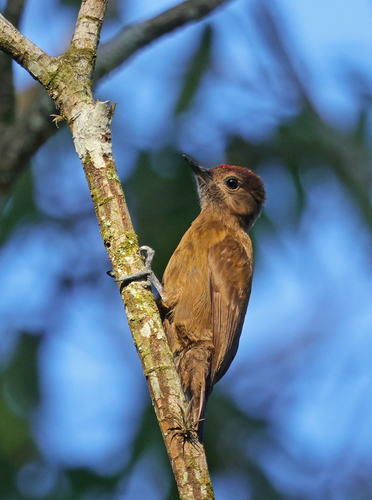
For the nominate subspecies L. f. fumigatus, adult birds of both sexes have a mostly olive-brown face, with whitish lores, a thin white supercilium, and a black "moustache" stripe with a thin white line above it.
Nominate Subspecies Upperparts Coloration
Their upperparts are mostly brown to olive-brown, with a red tinge on the shoulders and duller brown on the rump and uppertail coverts. Their flight feathers are dark brown, with pale bars on the inner webs.
Nominate Subspecies Tail and Underparts
Their tail is blackish brown, and the outer tail feathers are paler. Their underparts are olive-brown, which is sometimes paler on the belly and marked with faint darker bars.
Nominate Subspecies Soft Parts
Their moderately long beak is blackish with a paler lower mandible, their iris is deep brown to red-brown, and their legs are grayish.
Juvenile Plumage
Juveniles are duller and more sooty brown than adults, lack the red shoulder tinge, and have white bars on some flight feathers. Juvenile males have a dull red crown, while juvenile females have dull red only on the forehead.
Subspecies Overview
This species has four additional subspecies, each with distinct traits.
Subspecies oleagineus Traits
Subspecies oleagineus has longer wings than the nominate and a large amount of white feathering around the eyes.
Subspecies sanguinolentus Traits
Subspecies sanguinolentus is smaller than oleagineus with shorter wings; it is a richer brown than the nominate, has a paler face, and has no white around the eye.
Subspecies reichenbachi Traits
Subspecies reichenbachi is similar to sanguinolentus, but is a duller brown and has slightly longer wings.
Subspecies obscuratus Traits
Subspecies obscuratus has the longest wings of all recognized subspecies, and is otherwise similar to sanguinolentus but has darker, more gray-brown plumage.
Subspecies Geographic Ranges
The five subspecies of smoky-brown woodpecker have separate geographic ranges: L. f. oleagineus is found in southwestern and eastern Mexico; L. f. sanguinolentus ranges from southern Mexico to western Panama; L. f. reichenbachi occurs in northern and northeastern Venezuela; L. f. fumigatus is found from eastern Panama through Colombia east into northwestern Venezuela, and south through Ecuador and eastern Peru into western Bolivia and northwestern Argentina; L. f. obscuratus occurs in southwestern Ecuador and northwestern Peru.
Habitat Types
The smoky-brown woodpecker lives in a wide variety of mostly wooded landscapes. These include humid and wet forest, cloudforest, dry montane woodland, alder woodland, gallery forest, and secondary forest. It also occurs in dense understory along forest edges and in coffee plantations.
Elevational Range
Its elevational range varies by region: it occurs from near sea level to 1,500 m (4,900 ft) in Mexico; up to 750 m (2,500 ft), and locally to 1,850 m (6,100 ft), in Central America; between 800 and 2,700 m (2,600 and 8,900 ft) in Venezuela; mostly between 1,200 and 2,800 m (3,900 and 9,200 ft) in Colombia and Peru; mostly between 1,000 and 1,800 m (3,300 and 5,900 ft) in Ecuador; and between 1,200 and 2,500 m (3,900 and 8,200 ft) in Argentina.