About Sphyrapicus thyroideus (Cassin, 1852)
Scientific Name
This species has the scientific name Sphyrapicus thyroideus (Cassin, 1852).
Adult Male Plumage
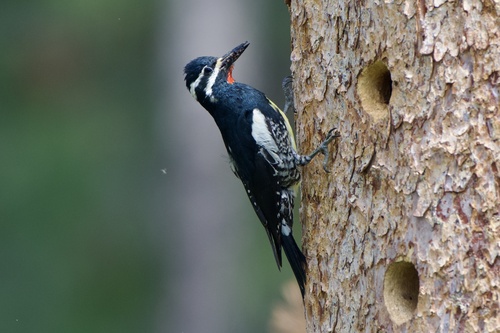
Adult males are iridescent black across the head, back, sides, and tail. They have a white stripe behind the eye, a lower white stripe running across each side of the head, a red chin, a bright yellow belly, and black wings marked with large white patches.
Adult Female Plumage
Females have a completely different appearance: they are mainly black, with a pale yellow breast, a brownish head with black streaking, and fine barring on the back, breast, and sides. When first discovered, females were incorrectly classified as a separate species, which Cassin named the black-breasted woodpecker.
Size Measurements
This woodpecker measures 8.3–9.8 inches (21–25 cm) in length, weighs 1.6–1.9 ounces (44–55 g), and has a wingspan of 17 inches (43 cm).
Nesting Habits
The birds excavate a new nesting cavity each year, and sometimes reuse the same tree.
Diet
They feed on sap, mostly from conifers; insects make up their main food source during the nesting season, and they also eat berries outside of the breeding period.
Territorial Behavior
They drum to establish their territories.
Population Decline Cause
This species may be declining in some parts of its range as a result of habitat loss.
Canadian Population Status
In south-central British Columbia, this woodpecker is associated with mature larch forests; fewer than 500 individuals breed in Canada, where its habitat is rapidly disappearing due to forest harvesting. The species was designated as endangered in 2005.
Common Name Origin
Its common name honors Lieutenant Robert Stockton Williamson, leader of the surveying expedition that collected the first male specimen; the expedition was seeking to identify the best route west for a railway to the Pacific Ocean.
Breeding Habitat
The breeding habitat of Sphyrapicus thyroideus is open coniferous forest, dominated mainly by ponderosa pine, Douglas-fir, and grand fir. Subalpine fir and western larch can also be important components of high-quality habitat for this species.
Migratory Status
This species is partially migratory.
Breeding Range
It breeds in western North America, ranging from northern Mexico as far north as British Columbia.
Movement Patterns
Some populations are permanent residents within their range. Migrating individuals form small flocks and may travel as far south as central Mexico.