About Dendrocopos hyperythrus (Vigors, 1831)
Size
The rufous-bellied woodpecker (Dendrocopos hyperythrus) measures between 19 and 23 cm (7.5 to 9.1 inches) in length.
Crown Plumage
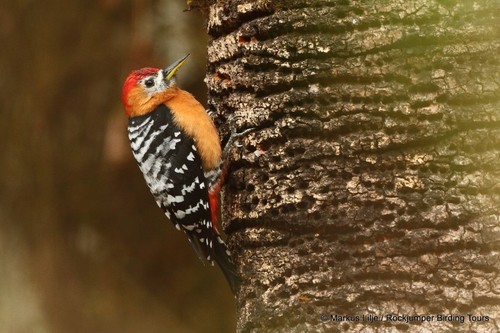
Males have a red crown, while females have a black crown speckled with white.
Mantle, Back, Wing and Tail Plumage
Both sexes share the same plumage and physical traits: they have a black mantle and back, black wings barred with white, and a black upper tail with white barring on the outermost two pairs of tail feathers.
Face and Underpart Plumage
Their face is white, and their throat and underparts are a uniform cinnamon or rufous.
Lower Belly and Undertail Plumage
The lower belly is black barred with white, and the undertail coverts are red or pink.
Soft Part Features
They have chestnut irises, a black upper mandible and grey lower mandible on the beak, and grey or olive legs.
Tongue Adaptation
Ecologically, this woodpecker has a brush-tipped tongue adapted to feed on sap.
Feeding Habits
It mostly seeks sap in the spring, and feeds on wood-boring and bark insects during most other seasons.
Host Tree Species
Tree species it uses include Quercus semecarpifolia, Quercus glauca, Betula utilis, Ilex dipyrena, and rhododendrons.
Long-term Sap Extraction Effects
The same individual trees may be used for sap extraction year after year, which causes changes to the tree's shape.
Sap Well Visitor Species
Other bird species also visit the sap wells that this woodpecker creates; these visiting species include the rufous sibia, white-browed fulvetta, rufous-winged fulvetta, hoary-throated barwing, chestnut-tailed minla, blue-winged minla, several warblers, green-backed tit, yellow-browed tit, white-tailed nuthatch, and green-tailed sunbird.