About Heliodoxa schreibersii (Bourcier, 1847)
Taxonomy
Heliodoxa schreibersii, the black-throated brilliant, has two recognized subspecies.
Nominate Subspecies Size
The nominate subspecies, H. s. schreibersii, is 11.5 to 13 cm (4.5 to 5.1 in) long. Males of this subspecies weigh approximately 9.9 g (0.35 oz), while females weigh between 7.1 and 8.5 g (0.25 to 0.30 oz).
Shared Morphological Features
Both subspecies have an almost straight dark bill about 2.8 cm (1.1 in) long, and a small white spot behind the eye.
Nominate Male Plumage
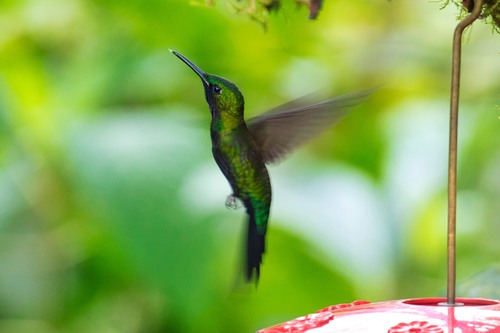
For nominate males, upperparts are shining green with a glittering green forehead. Underparts are black, with a small glittering purple patch and a narrow glittering green band on the lower throat. The tail is steel blue, very long, and deeply forked.
Nominate Female Plumage
Nominate females have upperparts matching the male's, plus a whitish to rufous malar stripe. Their underparts are gray with bronzy green spots; central tail feathers are green, and the tail is less deeply forked than the male's.
Juvenile Plumage
Juvenile black-throated brilliants resemble females, but have a more intensely colored malar stripe.
H. s. whitelyana Size
The second subspecies, H. s. whitelyana, is 13 to 14 cm (5.1 to 5.5 in) long.
H. s. whitelyana Morphology
Males of this subspecies have entirely shining green upperparts, including the forehead; their underparts and tail match those of the nominate subspecies. H. s. whitelyana females and juveniles are identical to those of the nominate subspecies.
Nominate Subspecies Range
The nominate subspecies ranges from southeastern Colombia south through eastern Ecuador into northeastern Peru as far as San Martín Department, and also extends east into the upper Rio Negro watershed in extreme northwestern Brazil.
Nominate Subspecies Habitat
It inhabits the interior of mature humid forest and scrublands.
Nominate Subspecies Elevation Range
Across most of its range, it occurs at elevations between 400 and 1,000 m (1,300 and 3,300 ft). In eastern Ecuador, however, it is regularly found locally as high as 1,450 m (4,800 ft), and occasionally as high as 1,900 m (6,200 ft).
Nominate Subspecies Range Observation
In the early 2000s, two individuals of the nominate subspecies were recorded much further east in Peru than any previously known occurrence. It is unclear whether these individuals were vagrants, or if their presence represents a permanent range extension of the subspecies.
H. s. whitelyana Distribution
H. s. whitelyana is native to central and southeastern Peru, where it inhabits humid montane forest at elevations between 600 and 1,250 m (2,000 and 4,100 ft).
Map Note
The accompanying map only shows the range of the nominate subspecies.