About Thalurania colombica (Bourcier, 1843)
Taxonomic Naming
The crowned woodnymph, scientifically named Thalurania colombica (Bourcier, 1843), shows notable size differences between sexes.
Sexual Size Dimorphism
Males measure 9.5 to 11.5 cm (3.7 to 4.5 in) long and weigh 4 to 5.5 g (0.14 to 0.19 oz), while females are 8.5 to 9.2 cm (3.3 to 3.6 in) long and weigh 3.5 to 4.2 g (0.12 to 0.15 oz).
Subspecies Plumage Variation
Each recognized subspecies has distinct plumage traits.
Nominate Subspecies Male Plumage
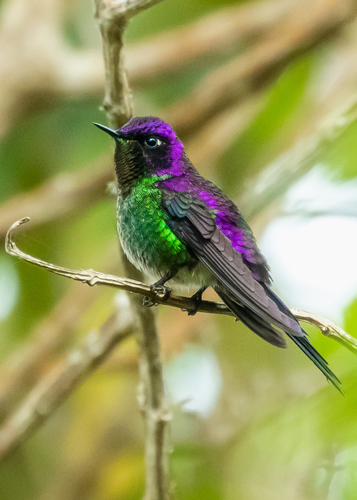
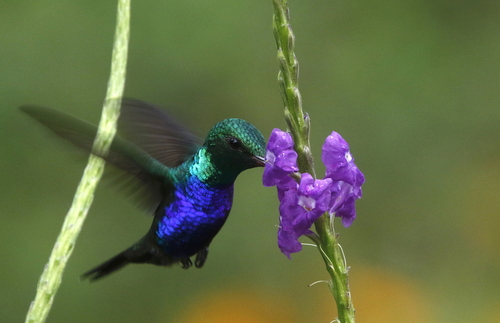
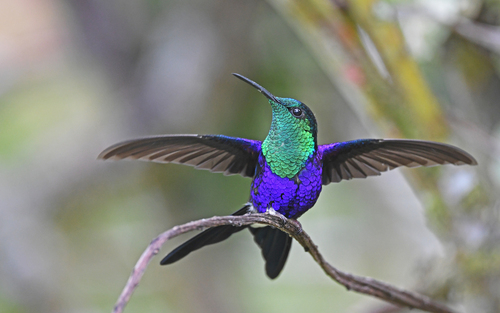
For the nominate subspecies T. c. colombica, adult males have violet coloring on the forehead, crown, upper back, and belly; a dark bronzy green nape; dark bluish green lower back and rump; glittering green throat and chest; and a deeply forked blue-black tail.
Nominate Subspecies Female Plumage
Adult females of this subspecies have bright green upperparts, pale gray throat and chest, darker gray belly, and a blue-black tail with white tips on the outer three pairs of feathers.
Immature Nominate Male Plumage
Immature males have dusky crown, throat, and underparts with very few iridescent purple feathers.
Immature Nominate Female Plumage
Immature females have dull green upperparts and entirely pale gray underparts.
T. c. townsendi Plumage
Subspecies T. c. townsendi males have a bronze nape and a green belly with violet sides, and their females are dark gray on the underparts.
T. c. venusta Plumage
T. c. venusta males are larger than the nominate subspecies with a longer tail and a very dark blue-green nape; the female belly is much darker gray than the nominate's and has a green gloss.
T. c. rostrifera Male Plumage
T. c. rostrifera males are very similar to the nominate, but have an entirely green back.
T. c. fannyae Plumage
T. c. fannyae males have glittering green on the forehead and crown in place of the nominate's violet, but are otherwise very similar; their females are essentially the same as the nominate but have somewhat darker gray underparts.
T. c. subtropicalis Plumage
The T. c. subtropicalis male resembles fannyae, but has a more bronzy nape and less violet on the back; females have paler gray underparts.
T. c. verticeps Male Plumage
T. c. verticeps males have an entirely green back.
T. c. hypochlora Plumage
Males of T. c. hypochlora have a mostly green belly with a small amount of violet, a blue nape and blue sides of the breast, and white fringes on the undertail coverts; females have entirely pale gray underparts with white fringes on the undertail coverts.
Subspecies Distribution
Different subspecies of the crowned woodnymph are distributed across Central and South America: T. c. townsendi ranges from eastern Guatemala and Belize to southeastern Honduras; T. c. venusta ranges from eastern Nicaragua to central Panama; T. c. colombica ranges from northern Colombia to the head of the Magdalena River valley, and extends east into northwestern Venezuela; T. c. rostrifera is found in Táchira state, northwestern Venezuela; T. c. fannyae ranges from eastern Panama to southwestern Colombia; T. c. subtropicalis is found in the Cauca Valley and the nearby Western and Central Andes of west-central Colombia; T. c. verticeps is found on the Pacific slope of extreme southwestern Colombia and western Ecuador; T. c. hypochlora is found in the Pacific lowlands of southern Ecuador and northwestern Peru.
Habitat Preferences
The crowned woodnymph lives in the interior, edges, and clearings of humid primary forest and mature secondary forest, as well as in semi-open landscapes including coffee and cacao plantations and gardens.
Avoided Habitat
It avoids open scrublands.