About Dendrochirus biocellatus (Fowler, 1938)
Common Name and Taxon
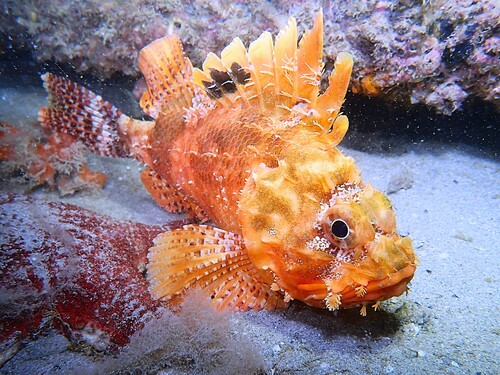
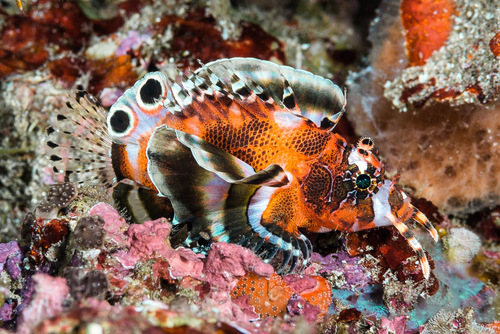
Dendrochirus biocellatus, commonly called the twospot turkeyfish, is a small lionfish species with distinct physical characteristics.
Dorsal and Anal Fin Counts
Its dorsal fin has 13 spines and 9 soft rays, while its anal fin has 3 spines and 5 soft rays.
Dorsal Fin Spine and Membrane Features
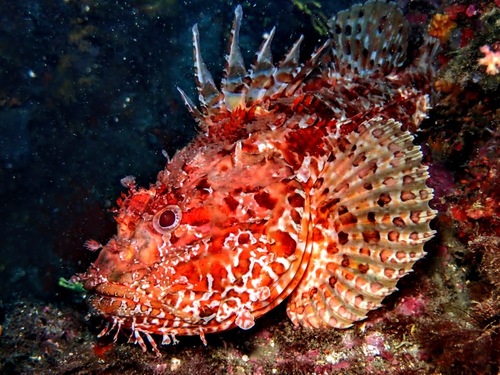
The middle spines of the dorsal fin are shorter than the depth of the fish’s body, and the dorsal fin’s membranes have deep incisions.
Pectoral Fin Structure
Its large, wing-like pectoral fins hold 20 or 21 fin rays: the upper rays are fully connected by membranes, the lower rays are simple, and their tips extend past the membrane.
Lacrimal Tentacle Size
The tentacles on its lacrimal bone are long, reaching over twice the diameter of the eye.
Base Body Color
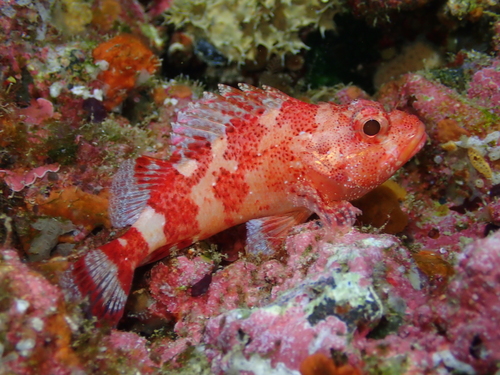
The species’ overall body color is reddish-brown.
Dorsal Fin Ocelli
It has 2, sometimes 3, large black ocelli, which are eye-like spots, on the soft-ray portion of its dorsal fin.
Flank and Fin Color Patterns
There are 3 pink to yellowish bars along its flanks, and its pectoral fins are marked with alternating pale and brown bands.
Maximum Length
This fish reaches a maximum total length of 13 centimeters, or 5.1 inches.
Indo-Pacific Distribution Range
It has a wide distribution across the Indo-Pacific region, ranging from the western Mascarene Islands, the Maldives, and Sri Lanka east to the Mariana and Tuamotu Islands, north to southern Japan, and south to New Caledonia and Tonga.
Australian Distribution
In Australian waters, it occurs at Scott Reef off Western Australia, at the Ashmore and Hibernia reefs in the Timor Sea, and at Christmas Island.
Habitat and Depth Range
Dendrochirus biocellatus inhabits clear-water reefs with abundant coral growth, at depths between 1 and 40 meters, or 3 feet 3 inches to 131 feet 3 inches.