About Damaliscus lunatus (Burchell, 1823)
Common Name & Total Body Length
Adult Damaliscus lunatus, commonly known as topi, are antelopes ranging 150 to 230 cm in total body length.
Body Mass
They are large animals: on average, males weigh 137 kg and females weigh 120 kg, with overall body mass ranging from 68 to 160 kg (150 to 353 lb).
Head-and-Body & Tail Length
Head-and-body length ranges from 150 to 210 cm (59 to 83 in), and tails measure 40 to 60 cm (16 to 24 in).
Shoulder Height
This is a tall antelope species, with shoulder height ranging from 100 to 130 cm (39 to 51 in).
Sexual Dimorphism in Size & Colour
Males are generally larger and darker than females.
Horn Length
Horn length ranges from 37 cm in females to 40 cm in males.
Horn Function in Reproduction
While horn size is important for male territory defence and mate attraction, it is not positively correlated with territorial factors of mate selection.
Horn Shape & Species Distinction
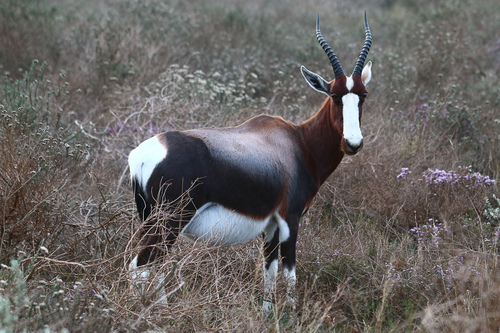
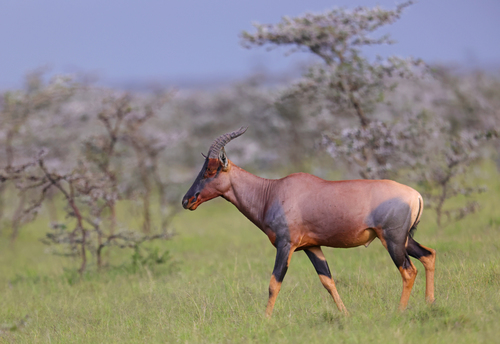
Topi have ringed, lyrate-shaped horns, differing from hartebeest by their darker colouration and lack of sharply angled horns.
Body & Limb Colouration
Their bodies are chestnut brown or reddish brown, with mask-like dark colouration on the face, black tail tufts, and greyish, dark purple or bluish-black patches on the upper forelimbs and thighs. Hindlimbs are brownish-yellow to yellow, and bellies are white.
Coat Characteristics
Their coats are made of short, shiny hairs.
Head & Gland Morphology
They have elongated heads, a distinct hump at the base of the neck, preorbital glands that secrete clear oil, and hoof glands on the front legs.
Death Vocalization Trait
A characteristic trait of this species is the groaning sound it makes as it dies.
Wild Lifespan
In the wild, topi usually live a maximum of 15 years, with a much lower average lifespan.
Spoor Similarity
Topi spoor is very similar to that of oryx and hartebeest.
Track Morphology
Their tracks are about 8 cm long; the two impressed hooves are narrow and point inward toward the tip, and the base of the hooves are bulbous and indented more deeply into the soil than the rest of the track.
Continental Distribution
This species has a long but patchy distribution across Southern, East and West Africa, where it prefers specific grasslands in arid and savanna biomes.
Subpopulation Isolation Threats
Human hunting and habitat modification have further isolated the species' subpopulations.
Local Population Patterns
Topi are usually either numerous or completely absent from an area, and scattered populations do not persist long, either increasing in size or dying off.
Population Health Driver
Population health depends on access to green vegetation.
Migratory Behavior
Herds of topi migrate between pastures, with a large migration occurring in the Serengeti, where topi join migrating wildebeests, zebras and gazelles.
Herd Spatial Strategies
Topi herds can follow three main spatial strategies: perennially sedentary-dispersion, perennially mobile-aggregated, or an intermediate form, depending on the local habitat and ecology.
Male Territory Establishment
Males establish territories that attract herds of females with their offspring; territories can be as large as 4 km² and sometimes border one another, depending on patch size.
High-Density Territory Behavior
In more densely populated areas such as Queen Elizabeth National Park in Uganda, topi move across the plain and set up territories during resting periods.
Primary Habitat Types
Topi are primarily found in grasslands, treeless open plains, and lightly wooded savannas.
Elevation Range
They prefer flat lowlands, but are occasionally found in rolling uplands (such as in Rwanda), and are very rarely seen at altitudes higher than 1,500 m above sea level.
Ecotone Habitat Use
In ecotone habitats between woodlands and open grasslands, they stay along the edge to use shade during hot weather.
Vantage Point Use
Topi use elevated vantage points, such as termite mounds, to survey their surroundings.
Habitat Specialization
Compared to many other more popular antelope species, population studies indicate topi are habitat specialists with a strong preference for seasonally dry grasslands.
Botswana Seasonal Habitat Shifts
In Botswana, topi spend most of their time in open habitats, primarily grassland, but retreat to mopane woodland during the rainy season.
Annual Reproductive Output
Topi produce one calf per mating pair per year.
Lek Breeding System Basics
Breeding begins with the formation of a lek: a congregation of adult males in an area that females visit only to mate.
Female Mate Choice Independence
Female choice of mate within the lek is independent of any direct male influence.
Proposed Mate Choice Explanation
Multiple explanations for female mate choice have been proposed, with one notable explanation focusing on how males are grouped in the centre of the lek.
Lek Centre Mating Preference
Dominant males occupy the centre of leks, so females are more likely to mate at the centre than the periphery of the lek.
Benefits of Male Lek Grouping
There are several reasons male grouping can be attractive to females: grouped males can provide protection from predators, grouping in low-food areas prevents competition between males and females for resources, and grouping places a wider variety of potential mates in a single central area for females to choose from.
Lek Position & Mating Success
A 2003 study by Bro-Jørgensen examined lek dynamics in more detail, finding that the closer a male is to the centre of the lek, the higher his mating success rate.
Central Lek Territory Eligibility
To reach the centre of the lek, a male must be strong enough to outcompete other males.
Central Lek Territory Tenure
Once a male establishes a territory in the middle of the lek, he maintains it for a long time; even if a space opens at the centre, males rarely move into it unless they can outcompete the large males already holding central territories.
Central Lek Territory Costs
However, maintaining a central lek territory has notable physical costs: males are often wounded while defending their territories from hyenas and other competing males.
Regional Lek Territory Traits
In areas such as Akagera National Park in Rwanda and Masai Mara National Reserve in Kenya, male topi establish leks made of clustered individual territories that have little value beyond their use for mating.
Lek Dominance Distribution
The most dominant males occupy the centre of the lek cluster, while less dominant males occupy the periphery.
Male Territory Marking & Defense
Males mark their territories with dung piles and stand on them in an erect posture, ready to fight any other male that attempts to invade.
Female Lek Visiting & Mating Pattern
Oestrous females enter leks both alone and in groups, and mate with males in the centre of the lek cluster.
Peripheral Male Reproductive Success Boost
Males further from the centre can increase their reproductive success if they are located near water.
Female Oestrous & Mate Competition
Females only enter oestrous once a year, so they will compete with each other for access to dominant males.
Sex Differences in Mating Preference
Females generally prefer to mate with dominant males they have mated with before, while males attempt to mate with as many new females as possible.
Copulation Disruption Dynamics
As a result, favoured males prefer to split mating investment equally between females, but females will aggressively disrupt copulations between their favoured males and other females.
Disruption Outcomes
Subordinate females experience more copulation disruption than dominant females, and males will eventually counter-attack disrupting females, and refuse to mate with them afterward.
Calf Rearing System Classification
Topi calf rearing combines traits of the "hider" system seen in blesbok and the "follower" system seen in blue wildebeest.
Newborn Calf Mobility
Calves are able to follow their mothers immediately after birth and may not "lie out" in hiding.
Post-Birth & Nighttime Calf Behavior
However, females separate themselves from the herd to give birth, and calves commonly seek hiding places during the night.
Maternal Association Duration
A young topi stays with its mother for a year or until a new calf is born.
Yearling Herd Membership
Both yearling males and females can be found in bachelor herds.