About Cymolutes praetextatus (Quoy & Gaimard, 1834)
Head and Body Markings
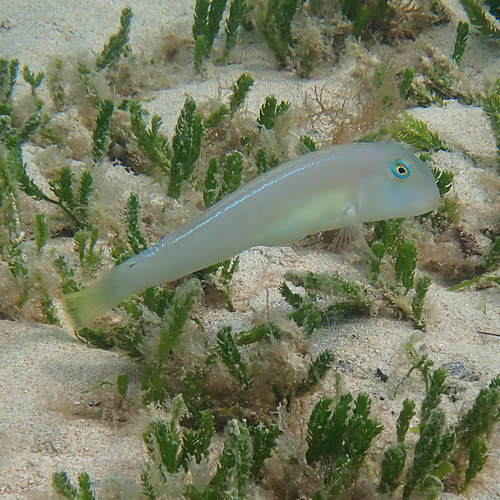
Cymolutes praetextatus is a pale-colored wrasse with a steeply profiled head. Its flanks are marked with indistinct whitish bars, and it has a white stripe running along its back, which sits above a wide yellowish or darker stripe, though this darker stripe may not be present.
Fin Structure
The dorsal fin of this species has 9 to 10 spines and 12 to 13 soft rays, while the anal fin has 2 to 3 spines and 11 to 12 soft rays.
Maximum Size
The largest known males of the species reach a standard length of 20 centimetres (7.9 in).
Original Description
Cymolutes praetextatus was originally described under the name Julis praetextata in 1834 by French zoologists Quoy & Gaimard, from type material collected off Mauritius during the voyage of the Astrolabe.
Genus Type Designation
When Albert Günther established the genus Cymolutes, he designated C. praetextatus as the genus's type species.
Broad Indo-Pacific Range
This is an Indo-Pacific species, distributed from the eastern coast of Africa through the Indian Ocean, and east into the Pacific Ocean as far as the Society Islands, the Line Islands, and Hawaii.
Australian Distribution
In Australian waters, it can be found at Ningaloo Reef, Rowley Shoals, and Scott Reef in Western Australia; at Ashmore Reef in the Timor Sea; and at the Great Barrier Reef in Queensland.
Additional Oceanic Distribution
It also occurs around Norfolk Island in the Tasman Sea and around the Cocos (Keeling) Islands.
Habitat Preferences
Cymolutes praetextatus is a solitary fish that lives on reef flats and in shallow lagoons. It inhabits sandy areas with rubble and weed that are swept by currents.
Feeding Habits
Its diet consists mainly of small benthic invertebrates.
Anti-Predator Behavior
When this species senses danger, it can dive into sand to hide.
Human Interaction
This species is rarely caught by fisheries and does not appear often in the aquarium trade.