About Semicossyphus pulcher (Ayres, 1854)
Sexual Dimorphism in Color and Shape
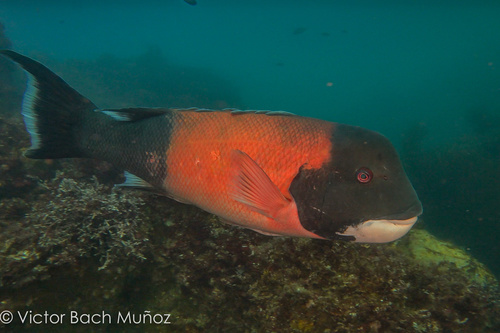
Male and female California sheepheads (Semicossyphus pulcher) display different color patterns and body shapes. Males grow larger, with black-colored tail and head regions, a wide reddish-orange midsection, red eyes, and fleshy bumps on the forehead. Females are silvery or dull pink with white undersides.
Shared Morphological Features
Individuals of both sexes have white chins and large, protruding canine teeth. These teeth can pry hard-shelled animals off rocks, and can also leave serious puncture wounds on skin divers. After the species' strong jaws and sharp teeth crush prey, modified throat bones called a throat plate grind shells into small pieces.
Maximum Size and Weight
California sheephead can reach a maximum size of 91 cm (3 ft) and a maximum weight of 16 kg (35 lb).
Sex Transition Traits
All California sheephead are born female, and eventually transition to male when they reach roughly 45 cm (1.5 ft) in length. The age at which this transition occurs depends on environmental factors such as food supply.
Lifespan
This species can live for more than 50 years.
Home Range Variation Drivers
Home ranges of California sheephead vary widely, and this variation is linked to differences in habitat shape (embayment versus connected coastline) and natural habitat boundaries (deep, sandy expanses).
Habitat Use Patterns
The species is found in rocky-reef areas 54% of the time, and spends a larger portion of daytime in high-relief areas within these rocky reefs. Even though California sheephead are often thought to have very clearly defined home ranges, home range size and site fidelity can vary with the fish's life stage, season, and habitat availability.
Site Attachment Behavior
California sheephead have relatively small home ranges and very high site attachment. They most often select rocky areas with kelp, likely because this habitat has increased complexity that provides more feeding opportunities and shelter from large predators.
Foraging Habitat Range
California sheephead are generally classified as a species associated mainly with rocky reefs and kelp beds, but they will occasionally visit sandy habitats during foraging trips.
Taxonomy and Fishing Value
The California sheephead is a monandric protogynous hermaphrodite, and a wrasse species that is valuable for both commercial and recreational fishing.
Local Assemblage Role
It is a prominent species in the fish assemblages of southern California rocky reefs and kelp beds.
Ecological Variability
Both the ecology and life history patterns of California sheephead are known to vary with local environmental conditions.