About Ctenophorus mirrityana Mclean, Moussalli, Sass & Stuart-Fox, 2013
Species Naming and Size
The Barrier Range dragon, scientifically named Ctenophorus mirrityana, is a medium-sized terrestrial lizard that can reach a total length of 26 cm. Compared to other species in the Ctenophorus genus, both males and females of this species have smaller head and snout length measurements.
Body Morphology
They have a compressed head and a dorsoventrally flattened body, which is likely an adaptation for moving through the narrow rock crevices that this species inhabits.
Sexual Dimorphism Overview
Barrier Range dragons are a sexually dimorphic species: males are brightly colored, while females have cryptic, camouflaged coloration.
Male Body Coloration
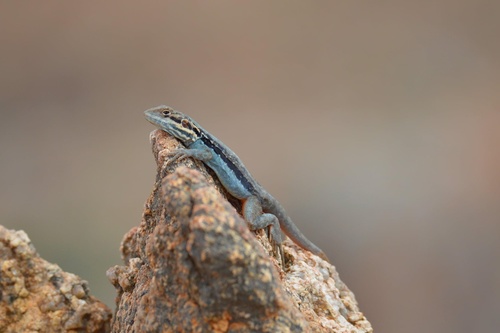
Males have a body color that ranges from grey-blue to pale blue, and this blue becomes more prominent as the lizard’s temperature rises. Unlike the pale body, the male’s head is orange, with a black stripe that starts at the eye and continues along the side of the flank.
Male Throat Markings
The male’s throat has a cream base color, marked with parallel grey stripes, an overlay of orange color, and a central black stripe that runs the full length of the throat. This unique throat coloration is one feature that separates this species from C. decresii.
Female Body Coloration
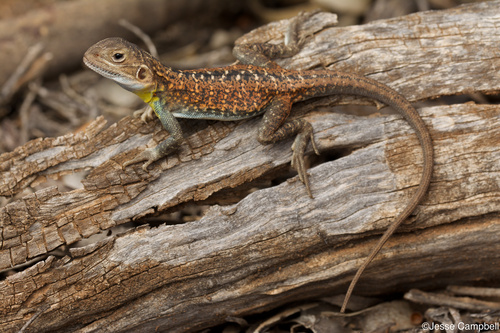
Females are brown, with black and terracotta stripes running along their flanks. Their dorsal scales also have scattered grey and terracotta specks.
Female Throat Markings
Like males, females have cream-colored throats with grey stripes, but they lack any black or orange coloration on the head.
Juvenile Appearance
Juveniles have a similar appearance to adult females, but they are generally paler and have less vibrant speckling.
Geographic Distribution
The Barrier Range dragon is found only in the rocky hills of western New South Wales, Australia, at just three locations: Mutawintji National Park, Purnamoota, and Silverton Wind Farm.
Habitat Types
The species most commonly occurs in rocky habitats including outcrops, gorges, ridges, and scattered rock aggregates, but it has also been recorded in mulga shrubland, black oak woodland, and hummock grass woodland.
Activity Pattern
C. mirrityana is a rock-dwelling, diurnal species that primarily lives on rock aggregates and the flat tops of ridges. As an ectotherm, these lizards use rocky habitats for basking, but they are inactive between 13:00 and 15:00, the hottest part of the day.
Crevice Use
When daily temperatures reach their peak, the lizards seek out rock crevices, which are a critical habitat requirement for this species. They also shelter in these crevices when threatened.
Morphological Adaptations
The species’ dorsoventrally flattened head and body are an evolved adaptation to relying on rock crevices. Barrier Range dragons also have long hindlimbs that help them move through their rocky environment.
Male Territorial Behavior
Male Barrier Range dragons are territorial and perform conspicuous courtship displays, so they use elevated rocky outcrops as sites for these displays.