About Ctenophorus pictus (Peters, 1866)
Common Name and General Morphology
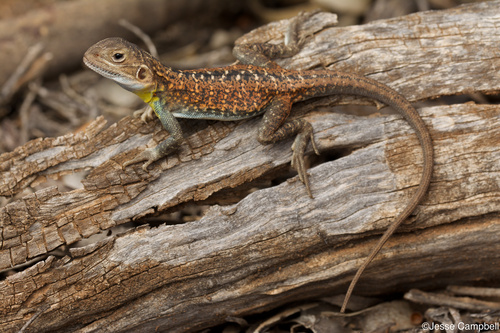
Ctenophorus pictus, commonly called the painted dragon, is a medium-sized terrestrial lizard with a short, deep head and uniform body scales.
Appearance Variability
The species has extremely variable appearance, with many different possible color combinations.
Adult Male Base Coloration
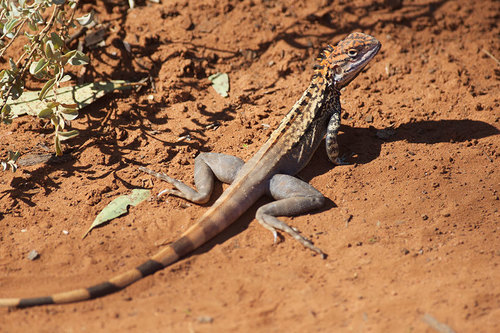
Adult males can be brown, yellowish brown, orange, or reddish brown, with dark-edged pale bars, blotches or spots overlying a dark vertebral stripe.
Male Flank Pattern
Their flanks are spotted, variegated (marked with irregular patches or streaks), or reticulated (marked with a net-like pattern) in dark brown, and dotted with scattered pale dark-edged spots that are sometimes aligned perpendicular to the vertebral stripe.
Male Limb and Tail Pattern
Their limbs are variegated, and the tail pattern is often obscure, though it has broad dark bands at its base.
Breeding Male Coloration
Breeding males develop a bright blue coloring over the lower lips, throat and limbs, and a bright yellow to orange coloring over the anterior chest and shoulders.
Female and Juvenile Coloration
Adult females and juveniles have duller coloration and lack the bright blue and yellow pigment; females are most commonly rusty brown.
Scale Texture and Distribution
Though scale size varies slightly across different body regions, scales are relatively uniform across the body and feel smooth to the touch.
Nuchal Crest
A low crest on the back of the neck is often present, which males raise when alarmed.
Vertebral Scale Series
A distinct vertebral series of slightly enlarged scales can usually be found along the back.
Ear Structure
The ears are exposed on the side of the head, and the species has rather large, conspicuous eardrums.
Adult Body Length
Adults reach a total length of around 18–25 cm (7.1–9.8 in), with a snout-to-vent length of about 7.5 cm (3.0 in).
Tail Proportion
The tail usually makes up around 65% of the species' total body length.
Geographic Range
Painted dragons are found across the drier parts of southeastern Western Australia, through South Australia to northwestern Victoria and central-western New South Wales.
Habitat Preferences
They inhabit semi-arid to arid regions, and prefer shrublands and hummock grasslands growing on sandy and saline soils.
Locomotion Ability
Like most agamids, painted dragons are swift-moving reptiles capable of impressive short-distance sprints.
Thermoregulation
This diurnal (day-active) lizard is an ectotherm, like most reptiles, meaning it must rely on its environment to regulate its body temperature, and it spends considerable time basking to absorb heat.
Shelter and Microhabitat
It is especially fond of low vegetation and ground debris such as fallen logs and branches, and occupies short burrows that are often concealed at the base of shrubs like saltbush.
Perching and Foraging Behavior
Unlike most other agamids, which prefer to perch in elevated places, this species prefers to rest on low branches, and forages over surrounding open areas and ground litter from these perches.
Anti-predator Response
When disturbed or alarmed, it quickly retreats to the safety of a nearby burrow.
Agamid Family Traits
Painted dragons share many traits common to the Agamidae family.
Sensory and Alertness Traits
They are very alert lizards with an upright stance and acute vision, which they use to search for prey and watch for mates, rivals, and predators.
Visual Communication
Most of their communication is visual, with stylized head bobs and dips, arm waving, and tail lashing playing important roles.
Prey Capture Method
When searching for food, agamids seize prey with a short, thick tongue rather than their jaws.