About Crotalus ruber Cope, 1892
Mainland Typical Length
This moderately large species of rattlesnake commonly grows longer than 100 cm (39 in) on mainland areas. Large males may reach over 140 cm (55 in), and specimens measuring over 150 cm (59 in) are quite rare.
Maximum Recorded Length
The largest recorded specimen measured 162 cm (64 in), documented by Klauber in 1937.
Base Coloration
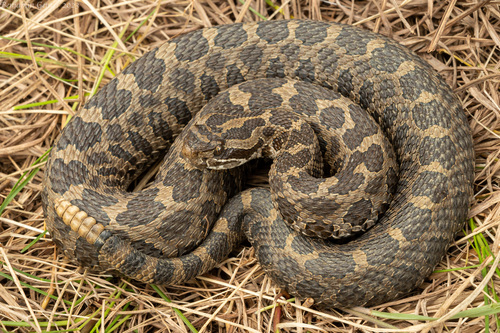
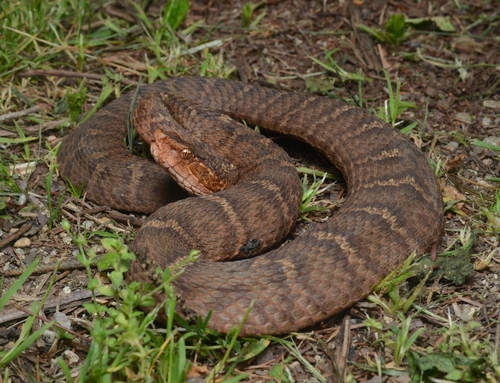
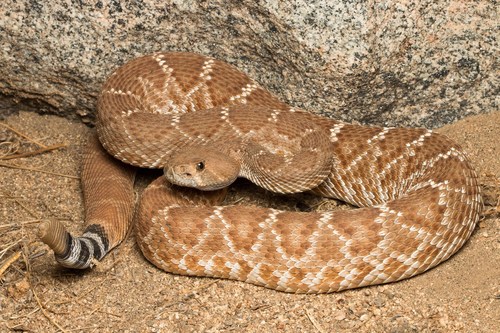
Crotalus ruber is very similar in pattern to Crotalus atrox, but it is set apart by its reddish base coloration, which is the source of its specific epithet ruber.
Labial Scale Feature
Additionally, the first lower labial scale on each side of the head is transversely divided, forming a pair of anterior chin shields.
Dorsal Scale Arrangement
Its dorsal scales are usually arranged in 29 rows, but can vary between 25 and 31 rows.
Ventral Scale Count
Ventral scales number between 185 and 206.
Regional Size Variation
On average, individuals from coastal regions are longer than those from desert regions.
United States Distribution
Red diamond rattlesnakes, the common name for Crotalus ruber, occur in the United States in southwestern California, and range southward through the Baja California peninsula.
Baja California Range Exclusion
They are not found in the desert east of the Sierra de Juárez in northeastern Baja California.
Gulf of California Island Distribution
This species also lives on multiple islands in the Gulf of California, including Angel de la Guarda, Pond, San Lorenzo del Sur, San Marcos, Danzante, Monserrate, and San José.
Western Baja California Island Distribution
Off the west coast of Baja California, it occurs on Isla de Santa Margarita, which lies off Baja California Sur, and on Isla de Cedros as the subspecies C. ruber exsul.
Sandstone Mesa Habitat Preference
It often dwells on brush-covered hillsides, and it especially favors small caves and clefts in reddish sandstone mesas.
Broad Habitat Range
C. ruber lives in the cooler coastal zone, across mountain areas, and extending into the desert beyond.
Specific Habitat and Altitude
It prefers dense chaparral regions of the foothills, cactus patches, and brush-covered boulders, and can be found from sea level up to 1,500 m in altitude.
Mating Period
Mating takes place between February and April.
Reproductive Mode
C. ruber is ovoviviparous.
Litter Details
Females give birth in August, producing between three and 20 young per litter.
Newborn Length
Newborn neonates measure 30 to 34 cm in length.