About Corythoichthys haematopterus (Bleeker, 1851)
Body and Fin Morphology
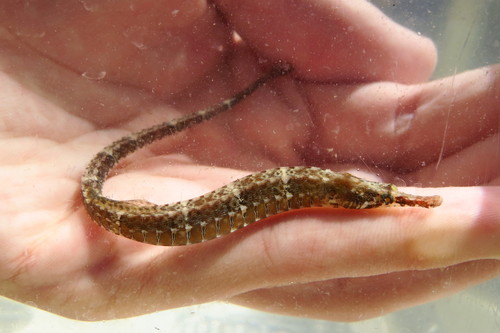
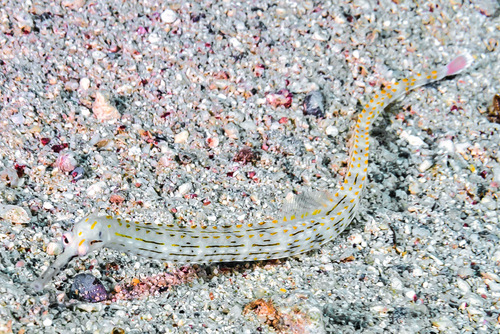
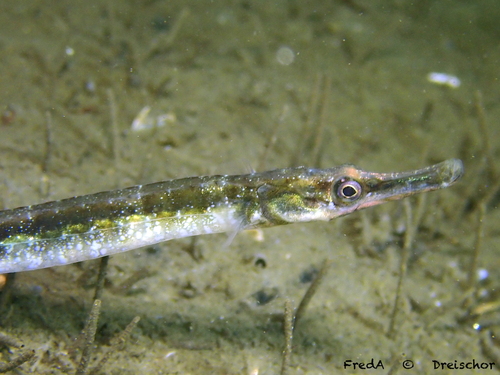
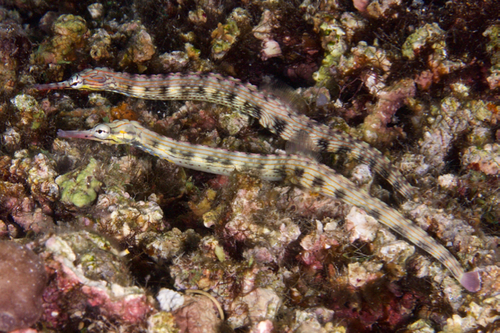
Corythoichthys haematopterus, commonly known as messmate pipefish, has an elongated body with a long narrow snout, soft-rayed dorsal fin, and caudal fin.
Size Range
Adult messmate pipefish range in length from 9 cm to 18 cm, with an average length of 13 cm.
General Coloration
Their coloration is variable: most have a pale body, a striped or reticulate head, poorly defined brown horizontal stripes on the sides of the trunk and tail, and a dorsal fin without pale spots.
Female Coloration
Bands are generally less visible on females, which also have dark splotches on the underside of the anterior trunk rings.
Male Coloration
Males may have bright blue transverse bars on the ventral side of the anterior trunk.
Male Brood Pouch Structure
Males have a brood pouch on the ventral side near the tail; instead of protective plates, the eggs are covered by fleshy folds.
Juvenile Morphology and Coloration
Juvenile messmate pipefish generally lack a color pattern, but have spiny, serrated trunk and tail ridges, and post-larval membranous dorsal fin folds that extend along the tail.
Developmental Color and Ridge Changes
Coloration becomes visible as they mature to around 4 cm, and adult ridges are mostly smooth.
Seychelles Population Markings
Messmate pipefish from the Seychelles have minimal markings across their entire body; when markings are present, they are light brown and do not follow any particular pattern.
Sri Lanka and Pacific Population Markings
In contrast, messmate pipefish from Sri Lanka and the Pacific are well patterned, with a strongly reticulate pattern on their heads.
Genus Distinguishing Feature
This species can be distinguished from other members of the Corythoichthys genus by having 17 trunk rings.
Body Ring and Fin Ray Counts
Messmate pipefish have approximately 48-54 total body rings, 16 pectoral fin rays, and around 29 dorsal fin rays.
Geographic Distribution
Messmate pipefish inhabit the Indo-Pacific region, covering tropical waters from the Indian Ocean to the Pacific Ocean.
Depth and Habitat Type
They are found in shallow seawater between 0 and 19.8 meters deep, near sandy bottoms in reef, seagrass, coral, and rocky habitats.
Environmental Tolerances
They cannot tolerate salinity fluctuations and prefer warm temperatures.
Population Status
The population size and abundance of this species are unknown.
Mating System
Messmate pipefish are strictly monogamous.
Pair Bond Duration
They mate with the same partner throughout the breeding season and remain paired until one dies or disappears.
Sex Role Reversal
Despite being monogamous, females are the primary sex that competes for mates, which is a reversal of traditional sex roles where males invest more in mating and females provide most parental care.
Male Mate Choosiness
In this sex role reversal, males are typically more choosy.
Male Brood Pouch Capacity
A male's brood pouch can only hold one clutch of eggs at a time, which prevents him from successfully mating with more than one female.
Multiple Clutch Viability
Occasionally males are observed carrying two clutches, but the outer clutch cannot adhere properly and always falls off within one day.
Female Clutch Limitation
Females cannot divide their clutches between different males.
Breeding Season and Mating Frequency
Pairs mate around 8 times per breeding season, which runs from April to October.
Male Brooding Period
Each male's brooding period (the time between egg spawning and hatching) lasts 9 to 19 days, and higher water temperatures lead to shorter brooding periods.
Female Spawning Interval
Females spawn eggs every 9 to 24 days.
Female Size and Offspring Fitness
Larger females produce more eggs, as well as larger eggs; larger eggs produce larger offspring with higher anti-predatory capacity.
Courtship Ritual Displays
Before breeding, a pair performs a courtship ritual including the following displays: approach, parallel swim, arch, both arch, cross, up, both up, spawning, and wiggle dance.
Courtship Timing and Duration
The ritual starts at sunrise and lasts for one hour.
"Both Up" Courtship Display
During the "both up" display, the pair swims horizontally with their genital regions close together.
Egg Transfer Process
The female lays eggs as a flat sheet before horizontal swimming stops, then the eggs are turned inside out and attached to the male's brood pouch.
Male Parental Care
After mating is complete, the male provides all parental care, including protecting, aerating, and osmoregulating the clutch.
Population Sex Ratio
Populations generally have more females than males, so some females do not reproduce every breeding season.
Paired Male Proportion
Most males are paired.
Female Mate Guarding
Unmated females may sometimes intrude on pairs performing their courtship ritual, but the male's paired female partner guards against this.
Home Range Differences
Females also have a larger home range and travel further than males.
Territoriality
While many adult individuals have overlapping home ranges, interactions with other pipefish are generally non-territorial, except on the morning of spawning, or when mated females guard their partners from other females.
Male Monogamy Adherence
Even though there are more females than males in a population, males will not mate with more than one female.
Mate Switching Cost
Males that switch mates require more time between spawning cycles, which reduces the number of breeding opportunities they have in a season.
Male Mate Size Preference
Even though larger females produce more fit offspring, males do not appear to prefer larger females.
Clutch Size Matching
Size may still play a role in mate choice: the amount of eggs that fits in a male's brood pouch matches the size of the clutch the female can extrude.
Size Mismatch Limitation
Males that are significantly smaller than their partner may not be able to hold the entire clutch.