About Syngnathus scovelli (Evermann & Kendall, 1896)
Body Shape and Exoskeleton
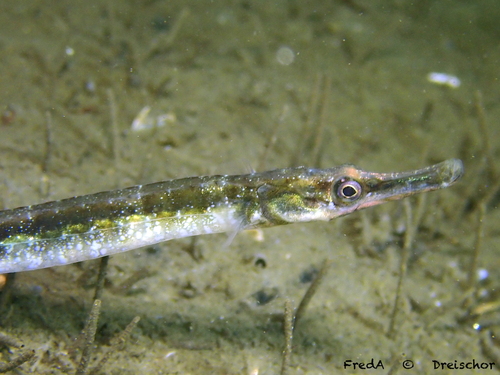
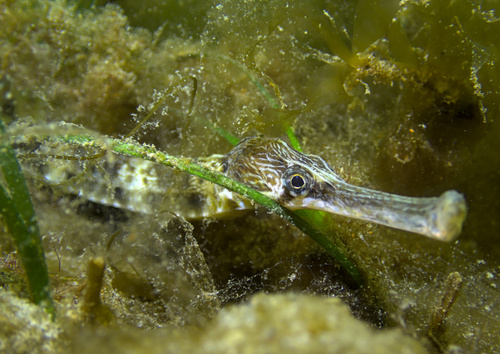
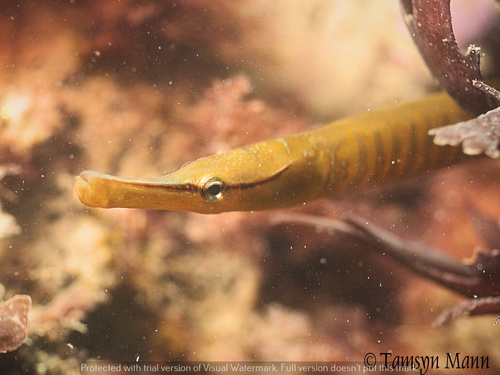
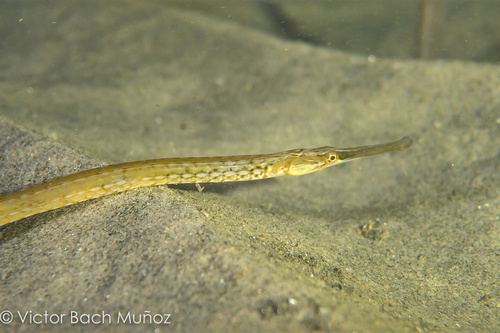
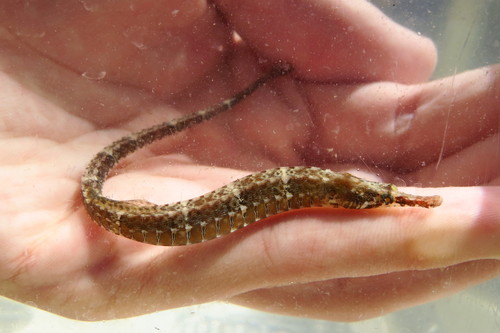
Gulf pipefish (Syngnathus scovelli) is an elongated fish whose body is encased in distinct body rings.
Coloration
Individuals are uniformly brown or dark olive green, with silvery white vertical bars along their sides that sometimes take on a Y shape.
Size
The maximum recorded standard length (SL) of this species is 183 mm, though most gulf pipefish rarely exceed 100 mm SL.
Snout Morphology
It has a short snout, with a snout length that is 1.9 to 2.3 times shorter than its head length (HL).
Body Ring Count
This species has 18 to 19 trunk rings and 30 to 34 tail rings.
Dorsal Fin Characteristics
Its moderate-length dorsal fin spans 2 to 4 trunk rings and 3 to 5 tail rings; the dorsal fin of females is usually banded.
Other Fin Morphology
The caudal fin is present and rounded, while the anal fin is greatly reduced, and pelvic fins are completely absent.
Sexual Dimorphism in Abdomen Structure
Females have a well-developed keel on their abdomen, which is reduced in both juveniles and males.
Male Brood Pouch Structure
Mature males have a brood pouch on their underside that spans 10 to 13 tail rings.
Species Habitat Type
Gulf pipefish is a marine-estuarine species.
Specific Habitats
It commonly lives in shallow, heavily vegetated shoreline areas, as well as clear, tannin-stained streams and rivers, and also frequently occupies estuarine seagrass meadows.
General Population Threats
The population of this species has declined due to impacts from growing human populations, which cause negative changes including nutrient loading, pollution, harmful algal blooms, and habitat degradation.
Regional Population Decline Records
Large declines have been recorded along the Atlantic Ocean coast and the coast of Florida, United States.
Indian River Lagoon Decline Driver
The loss of much of the seagrass meadows in the Indian River Lagoon, paired with ongoing harmful algal blooms, is driving the decline of gulf pipefish there.
Coastal Distribution Range
This species ranges from the Atlantic coastal regions of northern Georgia, a U.S. state, southward along the Florida coast into the Gulf of Mexico, and continues south to São Paulo, Brazil.
Inland Distribution Records
Populations of gulf pipefish have also been reported in inland freshwaters: 150 miles inland at Lake St. John, Louisiana, and 50 miles inland at Lake Texana, Texas.
Age and Growth Knowledge Gaps
Little is known about the age and growth of this species.
Lifespan and Maturity Timeline
It may reach maturity within six months and typically lives less than one year, and there is also limited knowledge of its larval development.
Breeding Salinity Tolerance
Gulf pipefish can breed in fresh, brackish, or highly saline water.
Spawning Period
Spawning can occur throughout the year, except on the northern Gulf Coast where reproductive activity declines in winter.
Male Brood Pouch Development
Males develop a brood pouch when they reach maturity, and retain the pouch for life.
Courtship Initiation
This species has an elaborate courtship ritual that is initiated by the female.
Courtship Ritual Behavior
The ritual involves the pair swimming together and bobbing up to the water surface, before they intertwine their bodies.
Post-Mating Male Behavior
After mating, the male rubs his brood pouch along the substrate; this behavior is thought to help move eggs from the front of the pouch to the rear.
Mature Egg Characteristics
Mature eggs are bright orange, oval to pear-shaped, and average 1.3 mm in diameter.
Egg Transport Process
Eggs remain in the ovarian lumen until they are transported to the brood chamber for fertilization.
Egg Incubation Period
At a temperature of 24.5 degrees Celsius, eggs hatch after 14 to 15 days.
Mating System
Males collect eggs from multiple different females.