About Strophurus williamsi (Kluge, 1963)
Species Nomenclature
Strophurus williamsi (Kluge, 1963), commonly called the eastern spiny-tailed gecko, is a small, slender gecko.
Body Size Measurements
It reaches a snout-to-vent length of 6 cm, with an average tail length of 5 cm.
Dorsal Body Coloration
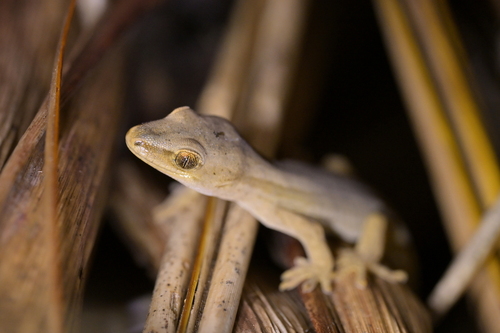
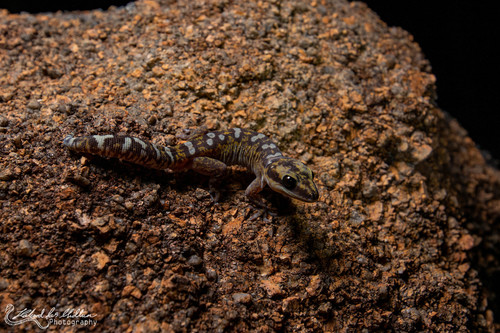
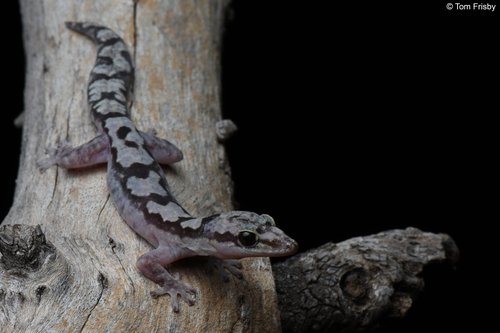
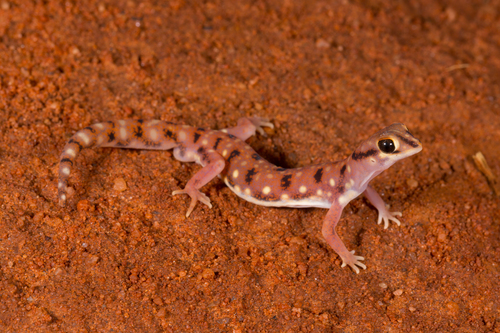
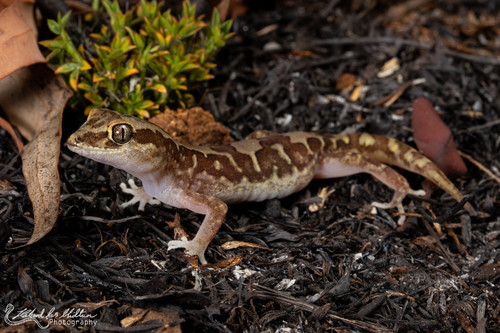
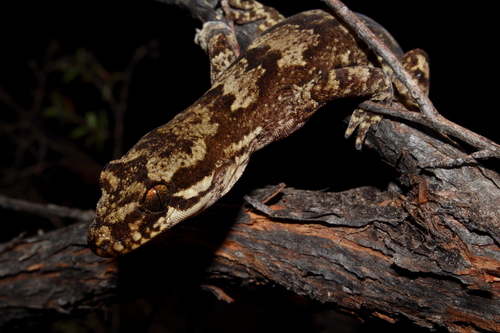
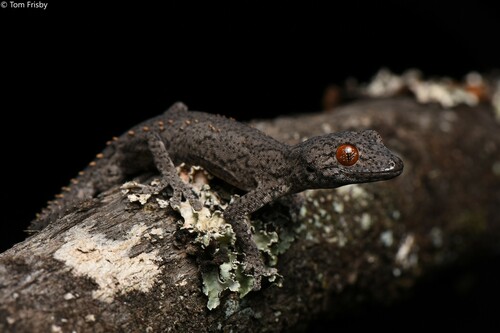
Its primary body colour is grey, marked with darker brown or grey patches and spots. Some individuals develop a diamond or reticulated pattern on their dorsal (back) surface.
Ventral Body Coloration
Ventral (belly) surfaces are pale grey or white, dotted with brown or black spots.
Eye Features
The iris of its eye is surrounded by an orange to red rim.
Toe Structure
Its toes are long and expanded, with well-developed adhesive pads. Large adhesive lamellae sit at the toe tips, and decrease in size toward the palm.
Distinguishing Tail Tubercles
This species can be told apart from other similar Strophurus species by four longitudinal rows of enlarged, orange projections called tubercles along the back of its tail.
Tail Anti-Predator Function
Research by Eric Pianka shows that the tails of eastern spiny-tailed geckos have evolved anti-predator functions, and are commonly used in behavioural displays. Special caudal glands on the tail can project thin streams of a sticky, noxious, odorous substance through ruptured skin along the tail's mid-dorsal line.
Defensive Secretion Ejection
Geckos can aim this defensive secretion, made of protein and glycoprotein, at predators by curving their tail. This ejection of sticky defensive secretion from the tail is directly linked to lower rates of tail loss in S. williamsi.
Tail Loss Reduction Factors
This lower tail loss rate may also be connected to the specialized tubercles that surround the caudal glands, since many other gecko species rely solely on tail autotomy (self-amputation) to escape predators.
Defensive Posture
Another anti-predator adaptation is a defensive posture: individuals lift and arch their body, extend their throat, and slowly wave their tail from side to side. During this display, they open their mouths to expose their vibrant mouth colour, which is usually dark blue or bright yellow.
Sexual Dimorphism Scales
Males can be distinguished from females by a single diagonal row of cloacal scales: males have one to five larger, more prominent scales, while females have one to three. Males also have preanal pores, which are absent in females.
Diurnal Behaviour
During the day, S. williamsi basks on thin branches, and uses its camouflage colouration to avoid predators.
Nocturnal Behaviour
This species is most active at night, when it forages on the ground around grassy bushes.
General Habitat Range
S. williamsi occupies a range of Australian ecosystems and ecoregions with varying vegetation structures and compositions. Its preferred habitats are sclerophyll forest, savanna, eucalypt woodland, and eucalypt forest communities.
Additional Habitat Locations
It can also be found at the edges of rainforest communities adjacent to these preferred vegetation types. Earlier studies found that S. williamsi is commonly found under loose bark of Callitris pine or Ironbarks, as well as in tree hollows and on tree trunks.
Associated Vegetation
It is also associated with shrubs, Spinifex, Casuarina, Callitris, and Leptospermum. Some populations of S. williamsi live in treeless savanna ecosystems, so the species may occupy unstudied niches beyond its known habitat associations.
Broad Geographic Distribution
In Australia, this species is distributed across the eastern part of the continent, with a patchy range that extends as far north as Cairns, Queensland, as far south as Adelaide, South Australia, and as far west as Bourke, New South Wales. Specifically, it occurs in north-eastern New South Wales, Queensland, south-eastern South Australia, and north-western Victoria.
Ecoregion Distribution
It is commonly found in the Murray-Darling woodlands and mallee ecoregion of Victoria. The semi-arid biome of central New South Wales and south-west Queensland makes up the largest portion of the species' range, with the species also shifting into surrounding sclerophyll and monsoon communities.
Preferred Temperature
Its preferred temperature range is 25–30 °C.
Reproductive Basics
The breeding season for S. williamsi runs from September to February, and reproduction is dioecious. This species is oviparous, meaning it produces undeveloped eggs rather than giving birth to live young.
Egg Laying Habits
Females lay two clutches of two eggs each; eggs are typically laid at the base of trees, under rocks, or in abandoned burrows no longer occupied by other animals. At a temperature range of 27–30 °C and an optimal humidity of 70–80%, eggs hatch between 45 and 80 days.
Juvenile Development
Juvenile geckos can begin feeding three to five days after hatching.
Female Reproductive Cycle
Females can mate again as soon as one hour after finishing laying a clutch. On average, females produce five clutches per year.