About Phaethornis pretrei (R.Lesson & Delattre, 1839)
Basic Taxonomy
The planalto hermit (scientific name Phaethornis pretrei) is a medium-sized hummingbird species.
Size
It measures about 14 to 16.5 cm (5.5 to 6.5 in) in total length. Males weigh 4.5 to 7 g (0.16 to 0.25 oz), while females weigh 3 to 5 g (0.11 to 0.18 oz).
Upperpart Coloration
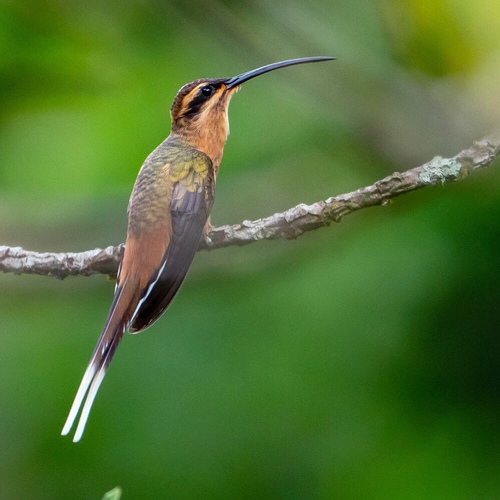
Most of its upperparts are olive green, and its uppertail coverts are reddish.
Tail Structure
The next-to-inner tail feathers are longer than the other tail feathers, and all tail feathers have white tips.
Underpart Coloration
Its underparts are cinnamon red.
Facial Markings
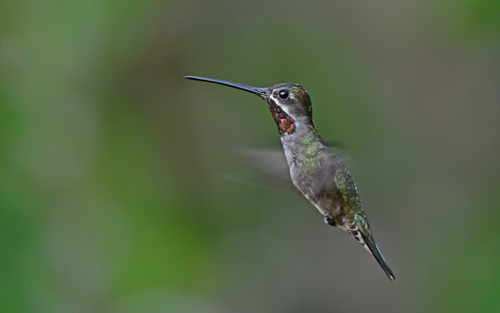
Its face features a black "mask", paired with a white supercilium and a white gular stripe.
Sexual Dimorphism
The sexes have similar appearance, though females have shorter wings and a less strongly decurved bill.
Core Distribution
Major taxonomic systems recognize the planalto hermit's distribution as covering a wide area of Brazil south of the Amazon rainforest, as well as eastern Bolivia, northern Argentina, and most of Paraguay.
Additional Distribution Records
The South American Classification Committee (SACC) of the American Ornithological Society recognizes the species' presence in these four countries, and also notes many documented records of the species in Peru.
Natural Habitat
The planalto hermit inhabits a diverse range of landscapes, including non-forested but vegetation-rich areas, dry forest, secondary forest, and gallery forest.
Anthropogenic Habitat
It also occurs in human-modified environments, so long as trees and herbs are present there.
Elevational Range
Its elevational range extends from 400 to 2,100 m (1,300 to 6,900 ft).