About Ocreatus underwoodii (R.Lesson, 1832)
Nomenclature
This species, the white-booted racket-tail, has the scientific name Ocreatus underwoodii (R.Lesson, 1832).
Sexual Dimorphism Overview
Like all racket-tail hummingbirds, it displays strong sexual dimorphism.
Male Tail Feather Morphology
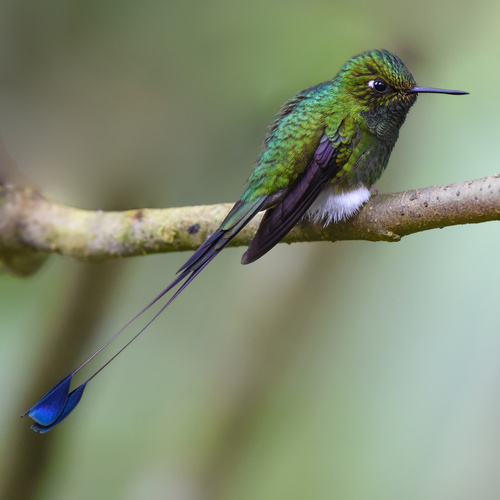
Only males have elongated outer tail feathers (rectrices); these feathers have bare shafts with long terminal oval flags, and across all five subspecies of white-booted racket-tail, these modified feathers are straight and do not cross, with their terminal flags slightly overlapping.
Shared Sex Traits
Both sexes of this species have greenish upperparts without a glittering forehead, and both have white leg puffs.
Male Plumage Details
Males have a greenish gray throat and a solid green belly.
Male Size and Weight
Including their 7 to 8 cm (2.8 to 3.1 in) long outer tail feathers, males measure 11 to 15 cm (4.3 to 5.9 in) in total length and weigh 2.5 to 2.7 g (0.088 to 0.095 oz).
Female Size and Weight
Females measure 7.6 to 9 cm (3.0 to 3.5 in) long and weigh 2.6 to 3.2 g (0.092 to 0.11 oz).
Subspecies Variation Overview
Subspecies differ in the color and shape of male tail flags, and in the pattern of green spots on the female’s white throat and belly.
Subspecies Morphological Differences
The differences are: for O. u. polystictus, males have bluish black oval flags and females are heavily spotted; for O. u. discifer, males have bluish to turquoise-black oval flags and females have a medium density of fine spots; for O. u. underwoodii, males have bluish to turquoise-black oval flags and females have medium spotting; for O. u. incommodus, males have bluish black oval flags and females have medium to scarcely spotted patterning; for O. u. melanantherus, males have bluish black oval to round flags and females have no spotting.
Subspecies Distributions
The five subspecies have distinct distributions: O. u. polystictus occurs in the Venezuelan Coastal Range between Carabobo and Miranda states; O. u. discifer occurs in northwestern Venezuela and adjacent northern Colombia; O. u. underwoodii occurs in the Eastern Andes of Colombia; O. u. incommodus occurs in the Central and Western Andes of Colombia; O. u. melanantherus occurs on the Andean Pacific slope from Nariño Department in Colombia to southwestern Ecuador.
Overall Geographic Range
The white-booted racket-tail lives in the temperate and subtropical Andes.
Habitat Preferences
It prefers the edges of humid to wet forest, but also occurs in forest interiors and more open secondary forest.
Elevation Range
It is most abundant between 1,600 and 2,200 m (5,200 and 7,200 ft) in elevation, but can be found as low as 600 m (2,000 ft) and as high as 4,000 m (13,000 ft).