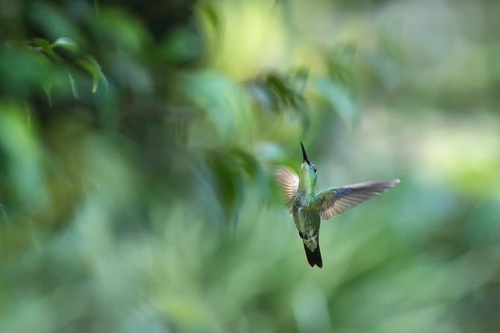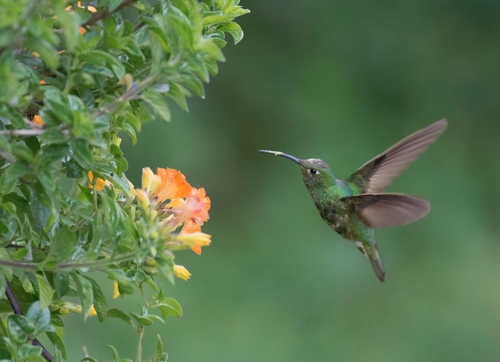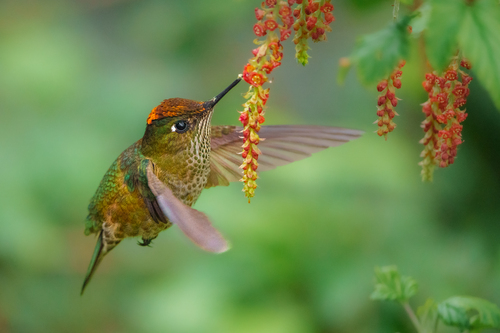
About Sephanoides sephaniodes (R.Lesson & Garnot, 1827)
Species Identification
This species is the green-backed firecrown, with the scientific name Sephanoides sephaniodes (R.Lesson & Garnot, 1827).
Size and Weight
The green-backed firecrown is 10 to 10.5 cm (3.9 to 4.1 in) long. Males weigh about 5.5 g (0.19 oz) and females weigh about 5 g (0.18 oz).
Sexual Dimorphism
The species is sexually dimorphic: males are larger and have shorter bills, while females are smaller and have longer bills.
Adult Plumage
Adult individuals of both sexes have bronzy green upperparts, slaty green wings and tails, and pale buff underparts marked with black and green spots. Adult males have an iridescent red-yellow crown, which gives the species its common name.
Juvenile Traits
Juveniles of both sexes have rusty-colored feather edges on the head, and their underparts have a cinnamon tone. Because young green-backed firecrowns are sexually monochromatic, it is difficult to identify the sex of a juvenile.
Main Distribution Range
The green-backed firecrown is distributed across Chile from south of the Atacama Region to the southern tip of South America, in adjoining areas of southern Argentina, and east across central Argentina to the Atlantic coast. For additional details on this species' range, see information on movement in the behavior section.
Island Populations
An isolated population lives on Robinson Crusoe and Alejandro Selkirk Islands of the Juan Fernández group, about 770 km (420 nmi) off the coast of Chile. It has been recorded as a vagrant on the Falkland Islands.
Habitat
This species inhabits forest edges, introduced Eucalyptus plantations, clearings, thickets, and gardens. It is an important pollinator for the temperate rainforest regions of southern South America.
Elevation Range
Its elevation range extends from sea level to above 2,000 m (6,600 ft).