About Lophornis delattrei (R.Lesson, 1839)
Taxonomy and Basic Measurements
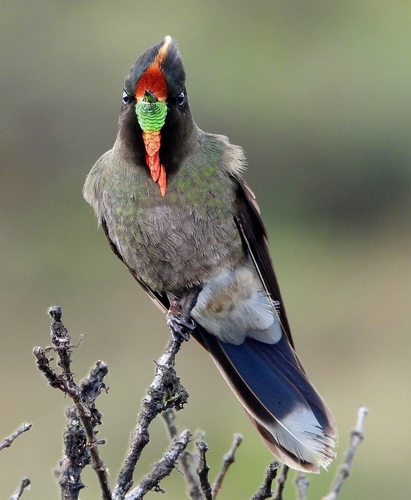
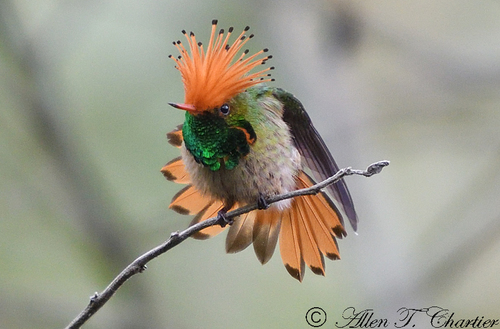
Rufous-Crested Coquettes (scientific name Lophornis delattrei (R.Lesson, 1839)) measure 6.4 cm to 7.0 cm in length, have a wingspan of 4.0 cm to 4.5 cm, and weigh an average of 2.8 g. This species has a short orange bill that ends in a sharp blackened tip.
General Plumage
Its back and belly are light iridescent green. A band of white feathers crosses the rump, and brown, orange, and green tail feathers extend backward from the rump.
Male Head Features
The adult male has a crest made up of slender, rigid rufous feathers tipped with black, which extend upward from its rufous-colored head feathers. It has a throat covered in darker iridescent green feathers that end in small pointed white feathers toward the back.
Male Additional Plumage
A vertical band of rufous feathers frames the male's green throat and tail feathers, and the male's tail has a double-rounded shape.
Female Plumage Comparison
Female rufous-crested coquettes share similar physical traits with males, with a few key distinct differences. Females have no head crest; instead, their rufous-colored forehead feathers fade into the iridescent green feathers that extend down their backs.
Female Throat and Head Plumage
Their throats are not uniformly green, but are primarily white with small clusters of green feathers. A band of rufous feathers extends fully from the side of the throat up to the forehead.
Female Tail Features
The tail of the female rufous-crested coquette is singly rounded, and its tail feathers, while primarily green, end in small patches of light orange.
Geographic Range
This species inhabits the Pacific and Caribbean mountainsides of Peru, Bolivia, Colombia, Ecuador, Panama, and Costa Rica; at least one observation of the species has been reported in western Brazil.
Altitude Range
The species is primarily found at altitudes between 500 m and 1,900 m above sea level, and it likely inhabits higher altitudes when breeding and lower altitudes when not breeding.
Habitat Preferences
Rufous-crested coquettes prefer humid forests that are evergreen or semi-deciduous, and they travel large distances within these ecosystems to find suitable food.
Movement Range Reference
In a homing experiment conducted on frilled coquettes, a genetically similar species, the birds were observed navigating ranges of up to 15 km.
Courtship Ritual
While no mating or egg-laying has been observed in Lophornis delattrei to date, the species performs a courtship ritual similar to that of other coquette species. This ritual involves a male performing a series of side-to-side oscillating flights in front of a perched female, while displaying his crest.