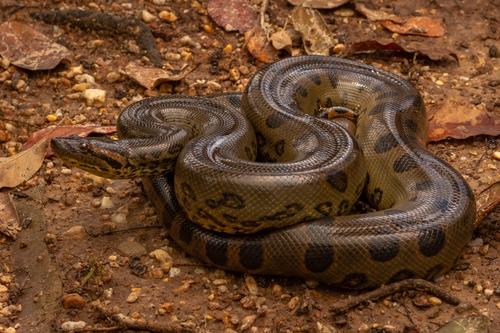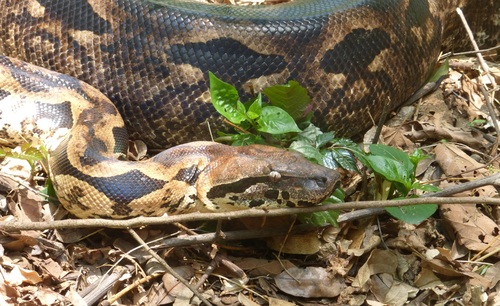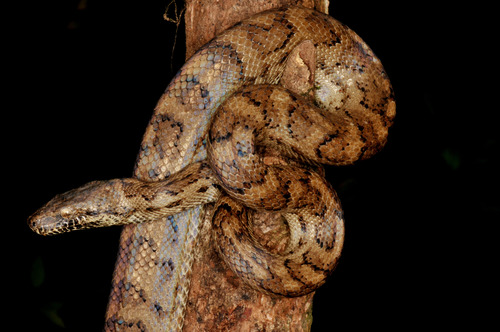
About Chilabothrus inornatus (Reinhardt, 1843)
Diagnostic Scale Characteristic
This species, Chilabothrus inornatus, can be identified by its characteristic irregular parietal scales.
Stejneger 1904 Length and Scale Counts
Stejneger recorded in 1904 that the species reached around 1.9 m (6.2 ft) in total length, with 261 to 271 ventral scales and 67 to 75 caudal scales.
Stejneger's Examined Specimen Sample
At the time of his publication, Stejneger knew of at least only twelve specimens of Chilabothrus inornatus, and had access to three live individuals to examine for colour and pattern, which varied between these specimens.
Dorsal Colour of Examined Specimens
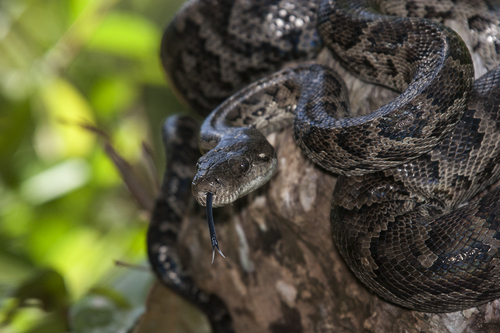
Two of the three specimens Stejneger examined were bistre, a deep, dark grayish brown, while the third was chestnut with darker colouration near the tail.
Ventral Colour of Examined Specimens
The first bistre specimen had a darker ventral surface; the second bistre specimen had a slate-coloured ventral surface; the chestnut specimen had a lighter slate-brown underside, with paler edges on its ventral scales.
First Specimen Dorsal Patterning
The first specimen had 70 to 80 indistinct dusky cross bars made up of a row of spots, and these cross bars increase in width towards the end of the snake.
Second Specimen Dorsal Patterning
The second specimen had much more distinct patterning: its cross bars had pale centres, were outlined in blackish colour, and its lateral spots aligned to form a blackish line along the front third of the body.
Third Specimen Dorsal Patterning
The third specimen showed very little patterning, with only a small number of scattered, obscure darkish spots along its sides.
Iris Colouration
Stejneger described the iris of Chilabothrus inornatus as silvery gray clouded with dusky.
Species Total Length Range
More broadly, the species reaches a total length of 1.8–2.7 m (5.9–8.9 ft).
Common Name and Endemic Range
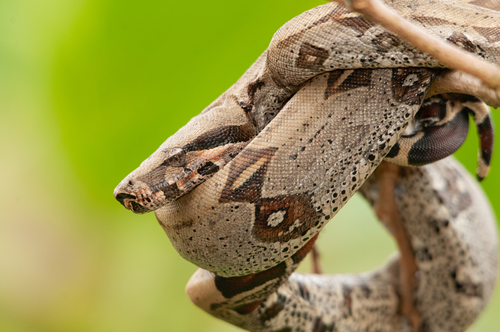
Chilabothrus inornatus, commonly called the Puerto Rican boa, is endemic to Puerto Rico.
Habitat and Distribution in Puerto Rico
It inhabits wooded and rocky locations in the island's foothills, and is more common in the northwest of Puerto Rico, as well as in the karst regions along the island's northern coast.
Reproductive Litter Size
Pregnant female Puerto Rican boas give birth to approximately 23 to 26 live young.