About Eunectes murinus (Linnaeus, 1758)
Size
The green anaconda (Eunectes murinus (Linnaeus, 1758)) is the world's heaviest snake, and one of the world's longest snakes, with a maximum recorded length of 6.32 m (20 ft 9 in). Most mature individuals grow up to 5 m (16 ft 5 in); adult females are generally much larger than males, with a mean length of around 4.6 m (15 ft 1 in) compared to an average male length of around 3 m (9 ft 10 in). Weights of adult green anacondas are less thoroughly studied, but typical adults reportedly weigh between 30 and 80 kg (66 to 176 lb). This species is the largest snake native to the Americas.
Length Comparisons
While it is slightly shorter than the reticulated python, it is far more bulky: a 5.2-metre (17 ft 1 in) green anaconda has a comparable bulk to a 7.4-metre (24 ft 3 in) reticulated python. Unverified reports of green anacondas reaching 11–12 m (35–40 ft) or longer exist, but these claims must be treated with caution, as no specimens of this size have ever been stored in a museum and no hard evidence confirms these lengths. The longest and heaviest verified specimen examined by Dr. Jesús Antonio Rivas, who studied more than 1,000 anacondas, was a female 5.21 m (17 ft 1 in) long weighing 97.5 kg (214 lb 15 oz). In 1937, a specimen shot in Guyana was claimed to measure 5.9 m (19 ft 4 in) long and weigh 163 kg (359 lb 6 oz).
Color Pattern
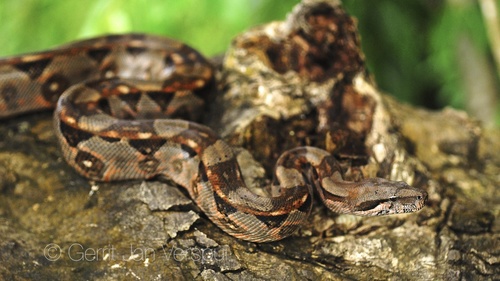
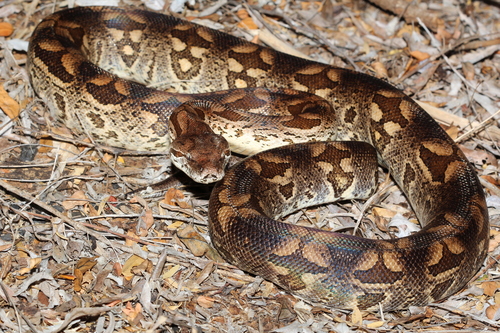
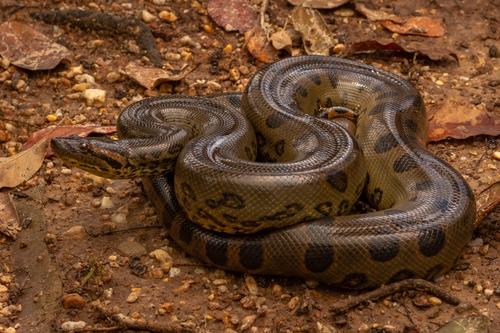
The green anaconda's color pattern has an olive green base, with black blotches running along the full length of its body. Its head is narrow compared to its body, and usually has distinct orange-yellow stripes on each side. Its eyes are positioned high on the head, which lets the snake see above water while swimming without exposing the rest of its body.
Jaw Structure
The green anaconda's jaw bones spread open at the front, because they are connected loosely by flexible ligaments rather than solid bone. This allows the snake to swallow prey larger than its own head. Its windpipe positioned within its mouth lets it breathe while swallowing prey.
Digestion
The largest internal organ in the green anaconda is the liver. Digestion takes many days to finish, and the snake moves and behaves very sluggishly throughout this period.
Native Range
Eunectes murinus is native to South America east of the Andes, found in Colombia, Venezuela, the Guianas, Ecuador, Peru, Bolivia, Brazil, the island of Trinidad, and ranges as far south as northern Paraguay. Its given type locality is simply "America".
Florida Records
In April 2021, green anacondas were added to Florida's list of prohibited non-native species. As of August 2023, eleven green anacondas have been confirmed observed in the wild in Florida, including one juvenile found in the Florida Everglades. These observed specimens, some of which have evaded capture, range across an area stretching more than 350 miles (560 km) from Gainesville to Homestead, Florida.
Florida Habitat
Florida is the only state in the continental United States that provides suitable habitat for the species. While individual green anacondas have been recorded or captured in Florida since 2010, there is no known established wild population in the state as of 2023. Even so, the Florida Fish and Wildlife Conservation Commission rates the ecological, economic, and safety risks posed by the presence of green anacondas in the state as 'very high', with ecological threat reaching an extreme risk level. This is because introduced green anacondas are apex predators that can compete with Florida's native species and potentially prey on native wildlife, including white-tailed deer, American alligators, American crocodiles, wading birds, other birds, mammals, and reptiles.
Habitat
In their native range, green anacondas inhabit swamps, marshes, lagoons, and slow-moving streams and rivers, mainly found in the tropical rainforests and seasonally flooded savannas of the Amazon and Orinoco basins. They are slow and clumsy on land, but move stealthily and smoothly in the water. Their eyes and nasal openings sit on the top of their heads, which lets them remain almost completely submerged while waiting for prey.
Mating Season
Individual green anacondas live alone until the mating season, which takes place during the rainy season and can last several months, most often from April to May. Typically, females leave pheromone trails for males to follow, though how males track these trails is not yet clear.
Chemical Signals
One theory suggests the pheromone is airborne, which is supported by observations of motionless females attracting multiple males that move toward them from all directions. Male anacondas also frequently flick their tongues to detect chemical signals that show a female is nearby.
Breeding Ball
It is common for multiple males to find the same female and wrap around her to copulate. This grouping, called a "breeding ball", can include up to 12 males and stay in place for two to four weeks, while males engage in slow-moving wrestling to compete for mating with the female.
Courtship
During mating, males use spurs to arouse the female. They aggressively press their cloacal regions hard against the female's body, while continuously scratching her with their spurs, which can produce an audible scratching sound. Mating reaches its climax when stimulation from the males' spurs causes the female to raise her cloacal region, allowing the cloacae of the two snakes to align.
Copulation
The male then coils his tail around the female, and they copulate. Most often, the strongest and largest male wins mating access, but females may choose a different male since they are much larger and stronger than males. Courtship and mating occur almost entirely in water.
Gestation
After mating, green anacondas have a gestation period of six to seven months. The species is ovoviviparous, meaning females give birth to live young. Litters usually have 20 to 40 offspring, though litters as large as 100 young have been recorded. After giving birth, females may lose up to half their body weight.
Neonates
Newborn green anacondas, called neonates, are around 70–80 cm (2 ft 4 in – 2 ft 7 in) long and receive no parental care. Because of their small size, they are often preyed on by other animals. If they survive, they grow quickly until they reach sexual maturity after a few years, after which their growth slows.
Parthenogenesis
When no males are available, female green anacondas can reproduce through facultative parthenogenesis, producing a viable homozygous litter. In 2014, a green anaconda at West Midland Safari Park gave birth to three young via parthenogenesis.